

Crochet snowflake ornaments can be much more varied than a row of nearly identical white motifs. Some designs rely on fine openwork and sharply blocked points, while others use puff stitches, chunky cord, layered squares, beads, tassels, glitter, or even a round ornament underneath the crochet. Scale also changes how a snowflake works: a tiny thread motif can disappear on a large tree while an oversized flake may be better suited to a window or wall.
The 21 ideas below focus on those practical differences. You can compare compact and statement-scale designs, soft versus structured finishes, flat versus dimensional ornaments, and simple silhouettes versus more decorative construction. Each project also includes an original YouTube tutorial from a different creator so you can check the exact crochet method before choosing your version.
Quick List
- Crochet Scalloped Snowflake Hanging Ornament
- Crochet Scandi Bead-and-Tassel Snowflake Ornament
- Crochet Puff-Center Cotton Snowflake Ornament
- Crochet Glitter-Finished Snowflake Tree Ornament
- Crochet Mixed-Size Snowflake Ornament Set
- Crochet Celtic-Knot Snowflake Ornament
- Crochet Snowflake-Covered Bauble Ornament
- Crochet Picot-Edge Lace Snowflake Ornament
- Crochet Classic Six-Point Snowflake Ornament
- Crochet Openwork Winter Snowflake Ornament
- Crochet Flat Snowflake Appliqué Ornament
- Crochet Four-Round Snowflake Hanging Ornament
- Crochet Starburst Snowflake Tree Ornament
- Crochet Oversized Statement Snowflake Ornament
- Crochet Mini Two-Round Snowflake Ornament
- Crochet Tiny Thread Snowflake Ornament
- Crochet Puff-Stitch Snowflake Motif Ornament
- Crochet Simple Branch-Tip Snowflake Ornament
- Crochet Decorative Lace Snowflake Ornament
- Crochet Sparkle-Yarn Six-Point Snowflake Ornament
- Crochet Macramé-Cord Folksy Snowflake Ornament
Choose Snowflake Ornaments by Scale and Display Distance
Before settling on a snowflake simply because its stitch pattern looks attractive, think about where the finished piece will actually hang. A tiny thread motif rewards close viewing and can work well on smaller branches, gift wrapping, or grouped displays. A broad snowflake with widely spaced points has more visual presence from across a room and may suit a window, wreath, wall, or larger tree.
Make one sample before committing to an entire coordinated set. Hold it where the ornaments will be displayed and view it from the normal distance. Fine details that look beautiful in your hand can become difficult to see from several feet away, while a heavier motif may overwhelm a small tabletop tree. Mixing several scales can also create a more natural collection, provided the yarn colors and finishing choices connect them visually.
Blocking, Stiffening, and Yarn Body Change the Silhouette
Snowflake designs often depend on symmetry, open spaces, picots, or pointed branches, which means the finishing stage can influence the appearance almost as much as the crochet itself. Blocking can help straighten arms and distribute points evenly. Stiffening is another option when a very crisp hanging shape is desired, but it is not necessary for every design.
Yarn construction matters too. Fine thread emphasizes lace and negative space, while thicker yarn or cord creates a more substantial silhouette. A soft yarn may produce a relaxed ornament unless the motif is naturally dense or receives additional finishing. If you plan to use a stiffening product, test it on one sample first and follow the instructions appropriate to both the product and fiber. Let ornaments dry completely before hanging or packing them away.
Decide How the Snowflake Will Hang Before Finishing It
A hanging loop changes more than convenience. Its position determines which point faces upward and can reveal whether the snowflake hangs straight or rotates to one side. Test the orientation before permanently securing the loop, especially on asymmetrical embellishments or designs carrying beads, tassels, ribbon, or a heavier center.
Also consider the display hardware. A soft yarn loop creates a subtle handmade finish, while ribbon or decorative cord can become part of the ornament itself. For tree use, test the finished piece on an actual branch rather than judging it flat on a table. Large or heavy ornaments may need sturdier placement closer to the trunk. Keep long hanging cords and loose decorative additions appropriately placed when young children or pets can reach the display.
1. Crochet Scalloped Snowflake Hanging Ornament

This Crochet Scalloped Snowflake Hanging Ornament has a traditional six-direction silhouette softened by curved, decorative outer sections. The open spaces let a contrasting tree, wall, or gift surface show through, so the design reads as lace rather than as a solid patch. Hooked by Robin’s tutorial also includes an optional hanging loop, making the motif particularly relevant for ornament use rather than requiring you to guess how a flat appliqué might hang.
This is a useful choice when you want a recognizable snowflake without moving into extremely fine thread work. The shape has enough detail to stand alone but remains visually lighter than chunky or layered options later in this collection.
Give the Curved Outer Edges Room to Show
The open scalloped outline is easiest to appreciate when the ornament is not pressed against other dense decorations. If your tree already carries large ribbons, pinecones, or closely packed ornaments, leave a little visual space around this snowflake so its negative spaces remain visible.
Against a window or dark greenery, contrast can do much of the work. Before making a large batch, hang one sample under the same lighting as the final display and check whether the outer shaping still reads clearly.
Check Symmetry Before Adding the Hanging Loop
With a radial motif, small differences between the arms can become more obvious once one point is designated as the top. Lay the snowflake flat and compare the overall spread before deciding where the hanger belongs.
If the motif curls after crocheting, finish the shaping first rather than allowing the hanging cord to pull one arm into alignment. A loop should support an already balanced snowflake rather than compensate for uneven finishing.
Use Yarn Changes to Control Presence, Not Just Color
The tutorial notes that the motif can be made with different yarn and hook combinations, so scale is something to evaluate rather than assume. A finer combination can emphasize delicacy, while thicker yarn will give the same general motif more visual weight.
If you plan a coordinated set in several scales, make samples first. Changing yarn can alter not only diameter but also how open the scallops appear and how firmly the points hold themselves.
Original Tutorial and Creator Credit
Creator: Hooked by Robin
2. Crochet Scandi Bead and Tassel Snowflake Ornament

The Crochet Scandi Bead-and-Tassel Snowflake Ornament turns a flat snowflake into a longer hanging decoration. Bella Coco’s Scandinavian-inspired version combines the crocheted motif with additional decorative elements, including a bead and tassel, creating a vertical silhouette that feels quite different from a simple looped snowflake.
This style is useful when you want crochet ornaments that can contribute movement and length to a tree rather than sitting as compact disks between branches. It can also work as a hanging accent on a seasonal hook or wrapped gift. Because the embellishments extend beneath the snowflake, consider the ornament’s total drop and balance rather than planning from the crochet motif alone.
The Tassel Changes the Space the Ornament Needs
A tassel creates movement beneath the snowflake, so this design needs more vertical clearance than a compact motif. On a crowded tree, place it where the tassel can hang without resting on the branch below.
That extra length can also be an advantage. If much of your ornament collection is round or compact, a few longer snowflake decorations can break up repetitive spacing and lead the eye down the tree.
Treat the Bead as Part of the Visual Balance
A decorative bead introduces a hard material beside soft yarn, which creates contrast but also changes where the visual weight sits. Compare bead size with the crocheted snowflake rather than automatically using whatever is available.
The goal does not have to be exact symmetry. A modest bead can act as a transition between motif and tassel, while an oversized one may compete with the crochet. Check the completed arrangement vertically before securing the final hanger.
Store Embellished Snowflakes Without Crushing the Fringe
Flat snowflakes can often be stored in shallow layers, but tassels and beads need a little more care. Avoid sharply folding the fringe or packing a heavy ornament directly on top of it.
Before putting seasonal decorations away, make sure all yarn components are completely dry. Keeping the tassel straight during storage reduces the amount of reshaping needed when the ornament comes out again the following winter.
Original Tutorial and Creator Credit
Creator: Bella Coco
3. Crochet Puff Center Cotton Snowflake Ornament

A raised center gives this Crochet Puff-Center Cotton Snowflake Ornament more texture than a completely flat lace flake. Naztazia’s tutorial uses worsted-weight cotton and includes puff or cluster-style texture within a six-sided snowflake, producing a motif that has visible body without becoming a stuffed ornament.
That middle ground can be useful on a tree: the snowflake still has open points and a recognizable radial outline, yet its center remains visible against busy greenery. It is also a practical direction if very fine crochet thread is not the look you want. The thicker fabric becomes part of the design, so judge the snowflake by both its outline and its center density.
Raised Texture Needs Enough Stitch Definition
When the center relies on puffed or clustered texture, highly fuzzy yarn can soften the very detail that distinguishes the motif. A smoother yarn surface generally makes raised sections easier to see, particularly when the ornament will be viewed from several feet away.
If you substitute materials, crochet one center section and assess the definition before completing a full set. The yarn that feels softest in the skein is not necessarily the one that shows the snowflake texture most clearly.
Cotton Body Can Reduce the Need for a Delicate Look
Naztazia uses worsted-weight cotton for the demonstrated snowflake. That creates a different visual character from fine thread designs: more substantial, less lace-like, and easier to pair with rustic or yarn-heavy holiday decor.
If you prefer softer drape, remember that the ornament still needs to hold a recognizable outline while hanging. Finish and shape your sample first, then decide whether additional stiffening is necessary rather than assuming every cotton snowflake needs the same treatment.
Original Tutorial and Creator Credit
Creator: naztazia
4. Crochet Glitter Finished Snowflake Tree Ornament

The Crochet Glitter-Finished Snowflake Tree Ornament makes finishing part of the design rather than treating it as an invisible final step. The Purple Poncho demonstrates a snowflake along with starching and a glitter finish, creating an option for readers who want a crisper, more reflective ornament instead of an entirely soft yarn surface.
This direction works particularly well when snowflakes need to catch light among darker branches. It also gives you a way to create visual variety while staying within a restricted winter palette such as white, cream, or pale blue. Because surface finishes can change both feel and storage requirements, make one complete sample before applying the same treatment across a full set.
Shape the Points Before the Finish Becomes Firm
A stiff finish preserves the silhouette you give it, so alignment matters. Arrange the arms and outer points while you can still adjust them, checking that the motif is centered rather than stretching one side farther simply to make it look larger.
Use the finished outline as the goal rather than maximum tension. Snowflakes generally look cleaner when corresponding arms have comparable reach and open spaces remain recognizable.
Glitter Looks Different Under Tree Lights
Reflective decoration can be subtle in daylight but much more noticeable beside string lights. Before adding a generous amount, test the finish on one ornament and view it in the same lighting used on the final display.
This is especially helpful when combining glittered and non-glittered snowflakes. A small amount of sparkle can separate a feature ornament from surrounding matte pieces without requiring a completely different crochet design.
Protect the Surface During Seasonal Storage
A treated snowflake should be completely dry before packing. If the finished surface is rigid or embellished, avoid bending the points just to fit a smaller container.
Flat storage with a little separation between ornaments can help maintain the outline and reduce rubbing. When unpacking, inspect the hanging loop and finish before placing the snowflake over furniture or textiles where loose decorative material would be inconvenient.
Original Tutorial and Creator Credit
Creator: The Purple Poncho
5. Crochet Mixed Size Snowflake Ornament Set
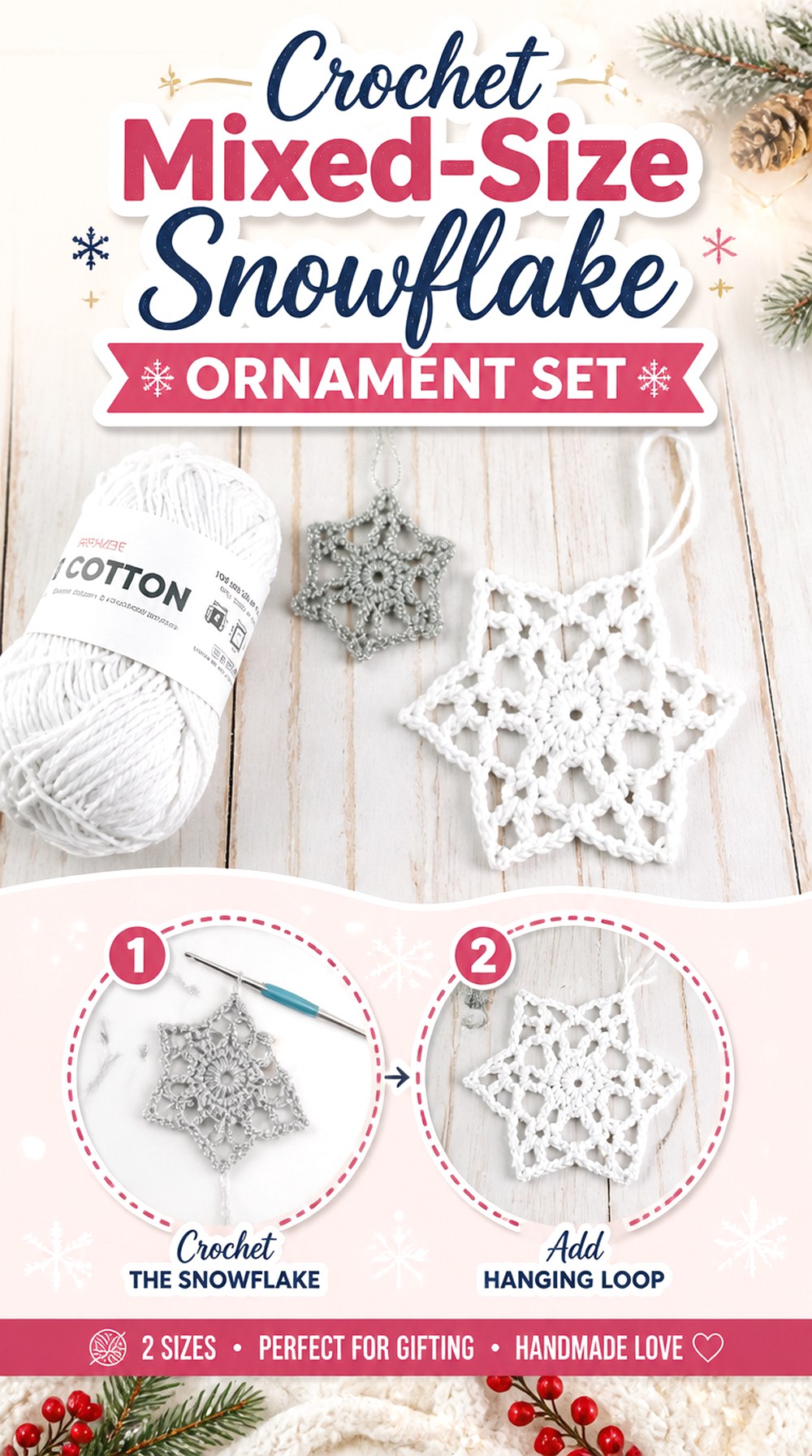
Instead of repeating one diameter across an entire tree, the Crochet Mixed-Size Snowflake Ornament Set uses scale as the main source of variation. Desert Blossom Crafts presents a snowflake ornament design in three sizes, making the tutorial useful for planning a coordinated collection that still has hierarchy.
A mixed-size group can solve several decorating problems at once. Smaller flakes can fill narrow branch spaces or accent gift wrapping, while larger versions can occupy gaps that would swallow a tiny motif. Keeping the underlying snowflake language related prevents the display from looking random. This is a particularly good route when you prefer a limited color palette but do not want every handmade ornament to have the same visual weight.
Distribute Sizes Instead of Clustering Them Accidentally
On a tree, step back after hanging the largest snowflakes first. If all of them collect at one height, the arrangement can look banded rather than natural.
Use medium motifs to bridge the spaces between statement pieces, then place the smallest where branches are short or other ornaments already provide visual weight. This approach lets scale organize the display even when every snowflake uses the same yarn color.
Yarn Substitutions Can Shift the Size System
A three-size tutorial gives you an intentional starting structure, but substitutions can change the actual proportions. If you change yarn or hook, complete and measure one example before assuming all three finished scales will suit your planned display.
What matters is not matching an arbitrary number. The useful checkpoint is whether the smallest, middle, and largest ornaments still look meaningfully different when viewed together.
A Coordinated Set Simplifies Gift Packaging
A scale-based collection is easy to divide into smaller gifts because the pieces already relate visually. You might pair different sizes rather than giving several indistinguishable snowflakes.
Before using any ornament as a package topper, consider how it will survive handling. A very rigid or elaborately blocked snowflake may be better attached at the end of wrapping rather than compressed beneath stacked parcels.
Original Tutorial and Creator Credit
Creator: Desert Blossom Crafts
6. Crochet Celtic Knot Snowflake Ornament
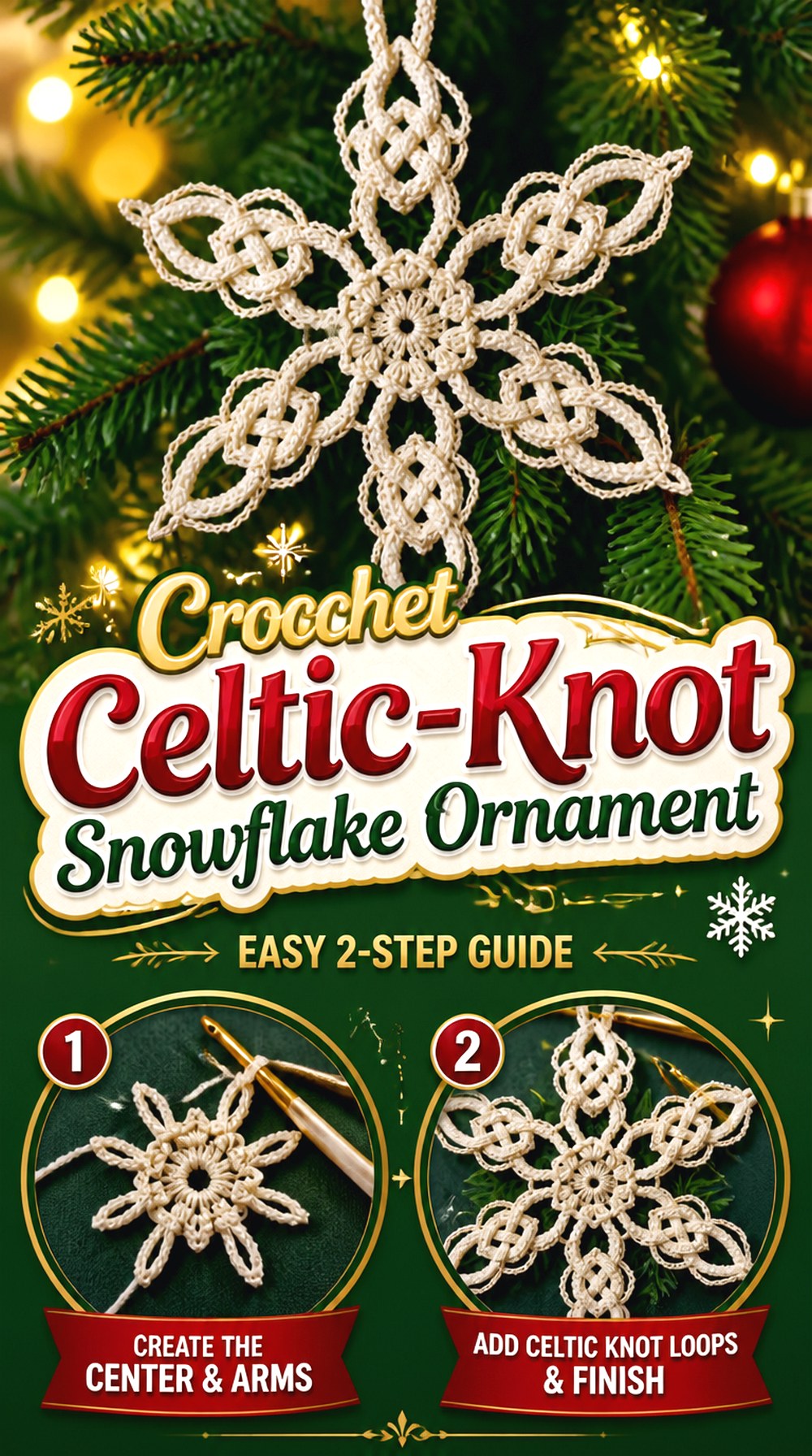
The Crochet Celtic-Knot Snowflake Ornament introduces an entirely different visual idea: interlaced forms rather than a snowflake defined only by radiating lace points. Celtic Knot Crochet’s tutorial demonstrates a Celtic-style snowflake with repeated cord or knot elements, creating a stronger graphic center and a handcrafted look that stands apart from conventional openwork flakes.
Choose this option when the ornament itself should be a focal point rather than quiet filler between larger decorations. The interwoven appearance rewards close viewing, so it is well suited to a prominent tree branch, hanging hook, wreath, or gift presentation. Because the final look depends on both crochet and arrangement, take time to inspect the crossings before completing the finish.
The Interlaced Center Needs Visual Order
In a knot-inspired ornament, uneven crossings can attract more attention than small differences along the outer edge. Before finalizing the shape, compare where the strands appear to pass over and under each other and check whether the central geometry looks deliberate.
This is one of those designs that benefits from viewing both close up and at display distance. From farther away, the goal is a clear snowflake silhouette; up close, the woven construction becomes the special detail.
Keep the Outer Points From Competing With the Knot
The center already supplies considerable visual information. If you add extra embellishment, highly contrasting beads, or a very decorative hanging ribbon, the overall ornament can become busy.
A restrained hanger lets the interlaced structure remain the feature. Conversely, if the snowflake will be displayed against a similarly colored surface, a contrasting loop can help define where the ornament begins without altering the crocheted body.
Stiffening Can Support a More Architectural Shape
The creator’s tutorial includes finishing guidance for holding the snowflake shape. With an interlaced design, that matters because twisting or sagging can make the knot structure harder to read.
Shape the crossings and outer points carefully before the piece fully sets. If you substitute fiber, test how the material responds to your planned finishing method instead of assuming it will behave exactly like the tutorial sample.
Original Tutorial and Creator Credit
Creator: Celtic Knot Crochet
7. Crochet Snowflake Covered Bauble Ornament

The Crochet Snowflake-Covered Bauble Ornament is the clearest departure from flat snowflakes in this collection. Jo to the World Creations uses crochet snowflake sections around a round ornament, producing a dimensional finished object rather than a motif that hangs by itself.
This option works when you like the familiar proportions of a Christmas bauble but want crochet to remain the main decorative surface. The sphere provides structure, while the open crochet lets the underlying ornament contribute color or shine. It also creates an opportunity to coordinate old plain baubles with handmade pieces. The key decision is fit: the crochet needs to relate to the specific ornament you intend to cover, not merely look correct when lying flat.
Match the Crochet to the Actual Bauble
The tutorial is built around a specific ornament format, so do not assume every round decoration has interchangeable dimensions. If you plan to substitute a bauble, compare its circumference and shape with the tutorial’s intended base before making multiples.
A cover that is too much) symbolic term size can lose the open snowflake effect, while one that is too hard no matter. Your most useful checkpoint is a trial fit on the exact ornament that will remain inside.
Contrast Can Make the Snowflake Easier to Read
Because the crochet sits over another surface, you effectively have two color choices: yarn and bauble. High contrast makes the snowflake structure obvious from across a room, while similar tones give a quieter, textural effect.
Test them together under tree lighting. Metallic or glossy bases can appear much brighter beside matte yarn at night than they do on a worktable in daylight.
The Hanger Must Work With Both Layers
Unlike a flat motif, this project already has the bauble’s top hardware to consider. Check that the crochet does not interfere with the existing cap or hanging point and that the finished cover sits correctly once suspended.
If you are using ornaments from several manufacturers, their neck shapes may differ even when the bodies look similar. Test one complete piece before preparing an entire batch of covers.
Original Tutorial and Creator Credit
Creator: Jo to the World Creations
8. Crochet Picot Edge Lace Snowflake Ornament

The Crochet Picot-Edge Lace Snowflake Ornament focuses attention on delicate outer detailing. Kristines Crochets demonstrates a fine, decorative snowflake whose small pointed edging gives the circumference a crisp lace character.
This style fits a tree or window where viewers can appreciate detail at relatively close range. It is less about heavy texture and more about clean negative space, small points, and a balanced radial outline. That makes careful finishing important: the outer details can look wonderfully sharp when shaped evenly but less intentional if several points curl inward. If you are planning a large set, complete one fully blocked sample before deciding how much time you want to devote to shaping each ornament.
Picot Details Need Deliberate Final Shaping
Tiny edge points can fold or lean while the piece is being handled. Before the ornament dries after blocking, inspect each outer section rather than shaping only the six main arms.
This extra attention matters because repeated little points create the lace effect. They do not need to look mechanically identical, but they should contribute to a balanced outline instead of disappearing into curled edges.
Fine Snowflakes Benefit From Background Contrast
A delicate white motif may be almost invisible against a pale wall but highly defined against dark evergreen branches. Consider the final backdrop before choosing yarn color.
If the ornament will hang in a window, remember that daylight can illuminate open spaces differently than evening tree lights. Testing one finished snowflake in both conditions can help you decide whether the lace is substantial enough for the intended location.
Original Tutorial and Creator Credit
Creator: Kristines Crochets
9. Crochet Classic Six Point Snowflake Ornament

For a straightforward winter shape, the Crochet Classic Six-Point Snowflake Ornament keeps the focus on a recognizable radial motif rather than added embellishment. Crochet Jewel’s tutorial demonstrates a snowflake that can function as an ornament or appliqué, giving you a versatile base if you want several matching decorations without beads, tassels, or an interior bauble.
This is the kind of design that can bridge different decorating styles. In white it can read as traditional winter decor; in saturated colors it becomes more graphic. Because the motif itself carries the theme, the most important planning questions are scale, hanging orientation, and whether your chosen yarn preserves enough open space to keep the snowflake from looking like a solid star.
Keep All Six Directions Visually Balanced
Six-point motifs make uneven spacing noticeable because opposite arms naturally invite comparison. Before adding a hanger, lay the piece flat and check the negative spaces as well as the points.
If one section looks compressed, address the shaping rather than pulling aggressively on the neighboring arms. Balanced open space usually gives a cleaner snowflake impression than trying to maximize the overall diameter.
Use a Simple Motif Where Embellishments Would Be Too much
A highly decorated Christmas tree does not always need another elaborate ornament. A clean crochet snowflake can provide a visual pause between reflective baubles, ribbon, figurines, and lights.
It is also easier to repeat a restrained motif in several colors without creating as much visual clutter. For a coordinated display, keep the hanging-loop style consistent even if the yarn shades vary.
Original Tutorial and Creator Credit
Creator: Crochet Jewel
10. Crochet Openwork Winter Snowflake Ornament

The Crochet Openwork Winter Snowflake Ornament emphasizes airy spaces between branches rather than a dense center. Pattern and Craft’s tutorial is specifically presented as a Christmas ornament, so the finished form already matches tree and hanging decor rather than requiring a separate adaptation from a blanket motif or garment square.
Openwork is useful when you want the tree itself to remain visible through the crochet. Dark green branches can outline pale yarn naturally, while window light can highlight the holes and branching silhouette. The trade-off is that open fabric may need more attention during shaping. Judge the ornament only after it has been arranged and finished, not immediately after it comes off the hook.
Negative Space Is Part of the Pattern’s Appearance
For openwork snowflakes, the holes between stitches are just as important visually as the yarn. If the motif is pulled unevenly during blocking, some spaces can dominate while others almost disappear.
Compare corresponding areas around the snowflake and aim for a balanced spread. This is especially worthwhile if several ornaments will hang near each other, because uneven openings become easier to notice when repeated.
Keep the Hanger Visually Lighter Than the Motif
A wide ribbon or oversized knot can overwhelm an airy snowflake. A narrower loop generally allows the branching crochet to remain the main feature.
That does not mean the hanger has to disappear. Metallic thread or a subtle contrasting cord can provide enough definition to find the ornament against the tree while preserving the open character of the snowflake itself.
Original Tutorial and Creator Credit
Creator: Pattern and Craft
11. Crochet Flat Snowflake Appliqué Ornament
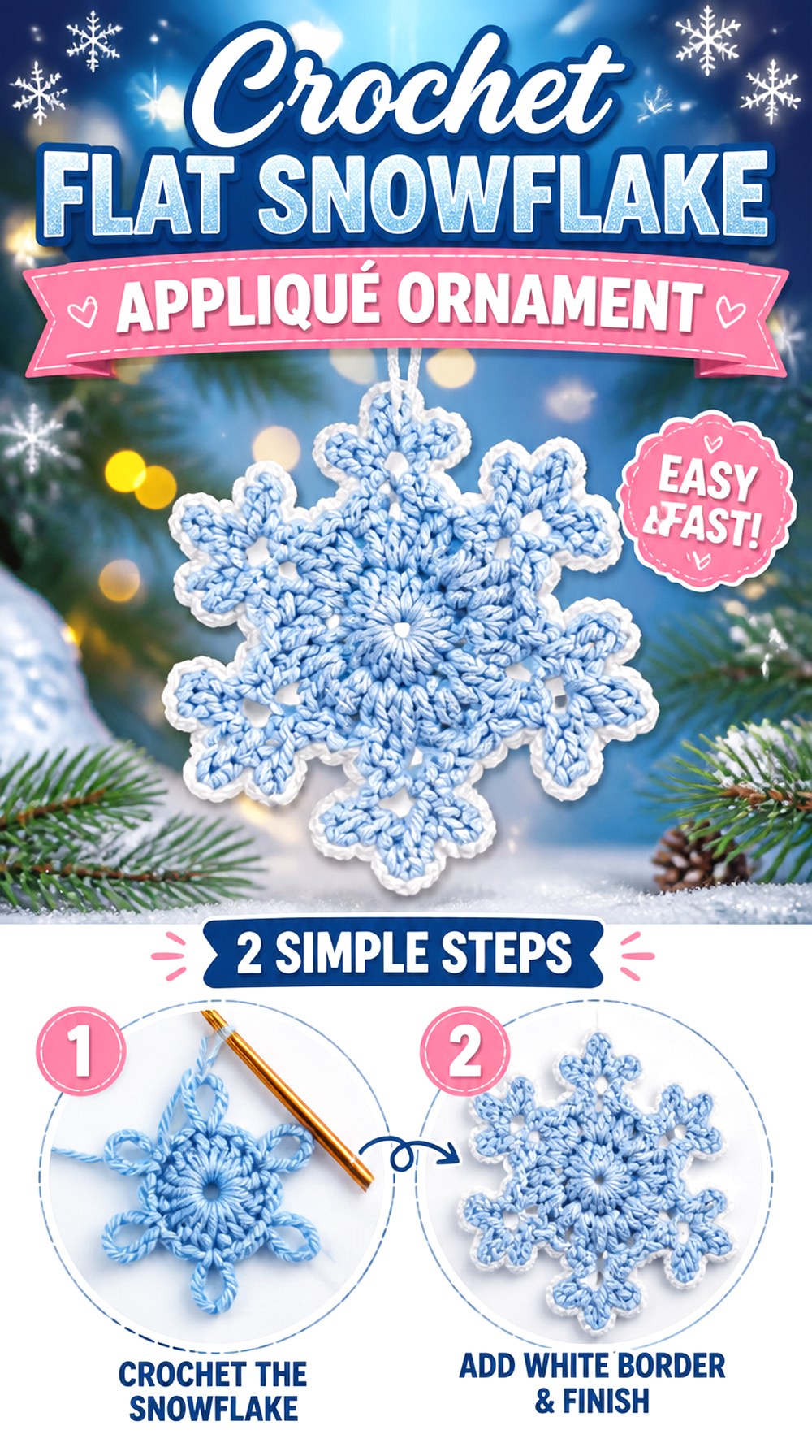
The Crochet Flat Snowflake Appliqué Ornament begins with a motif that can serve more than one purpose. Jayda InStitches’ tutorial presents a crochet snowflake pattern that works as a flat decorative piece, making it a useful choice if you want some snowflakes for the tree and others for cards, gifts, garlands, or sewn-on seasonal accents.
That versatility distinguishes it from ornaments built around beads or rigid forms. You can decide how each motif will be used after seeing the finished crochet. For hanging versions, add an unobtrusive loop and judge whether the snowflake needs more shaping. For appliqué use, a softer flat finish may be preferable because the motif needs to sit against another surface.
Ornament Finishing and Appliqué Finishing Have Different Goals
A hanging snowflake needs enough shape to remain readable without support behind it. An appliqué, however, can rely on the background fabric to keep it flat.
Decide which role the motif will play before applying a rigid finish. If you are making a mixed batch, separate the pieces first so ornaments can be blocked for hanging while appliqués remain appropriate for sewing or attaching elsewhere.
Flat Motifs Are Useful for Matching Decor Across the Room
A versatile snowflake can repeat the same visual language in different places. One version might hang on the tree while another decorates a gift or seasonal textile.
Keep the yarn and motif consistent but adjust the finishing for each use. That creates coordination without requiring every snowflake to function exactly the same way.
Original Tutorial and Creator Credit
Creator: Jayda InStitches
12. Crochet Four Round Snowflake Hanging Ornament
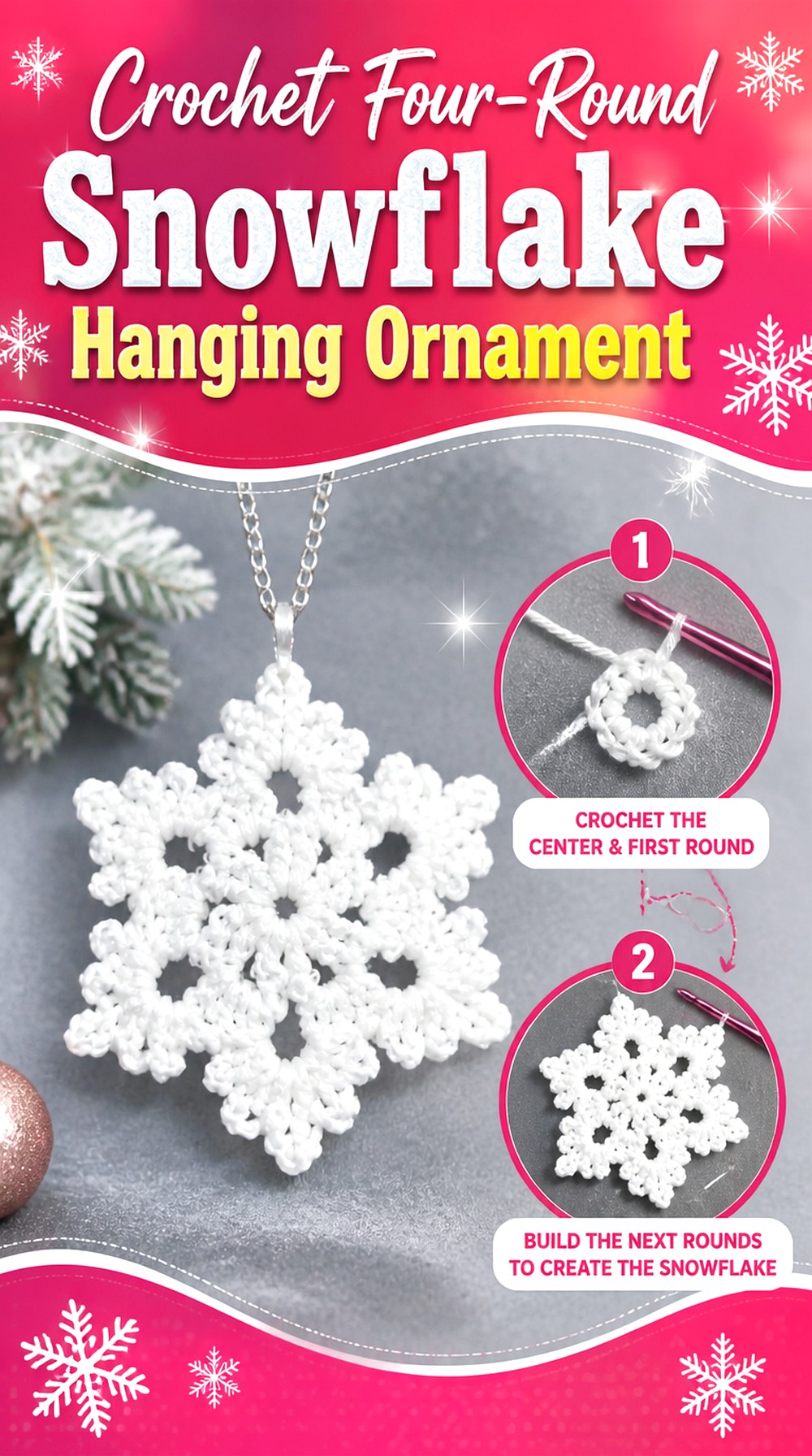
The Crochet Four-Round Snowflake Hanging Ornament offers a compact construction for readers who prefer a motif with relatively few rounds rather than a large lace piece with extensive outer detailing. The Crochet Crowd’s tutorial demonstrates its popular snowflake pattern as a hanging decoration, keeping the project firmly within ornament territory.
A compact round count does not mean the finishing is unimportant. Because a small snowflake has fewer large visual elements, the spacing between those elements becomes noticeable. This design is a good candidate for repeating across a tree when you want continuity without relying on one oversized centerpiece. Make one complete sample first so you can assess the finished scale against your branches and other decorations.
Repetition Works Better With Consistent Final Shape
If you plan to make many copies, use the first finished ornament as a visual reference for the rest. Compare overall spread, point direction, and hanging-loop length rather than relying only on how each motif looks immediately after crocheting.
Minor handmade variation is natural, but a shared finishing approach makes a repeated set look intentional when several snowflakes appear within the same sightline.
Let a Compact Snowflake Fill Awkward Branch Spaces
Small-to-medium motifs can fit where deep baubles or long ornaments cannot. Use them near branch tips, beside ribbon, or in narrow gaps that still need a light seasonal detail.
Before committing to a specific hanger length, test how the ornament sits between branches. A loop that is too wind-sized by tree branches can hide the motif deeper inside the tree than intended.
Original Tutorial and Creator Credit
Creator: The Crochet Crowd
13. Crochet Starburst Snowflake Tree Ornament
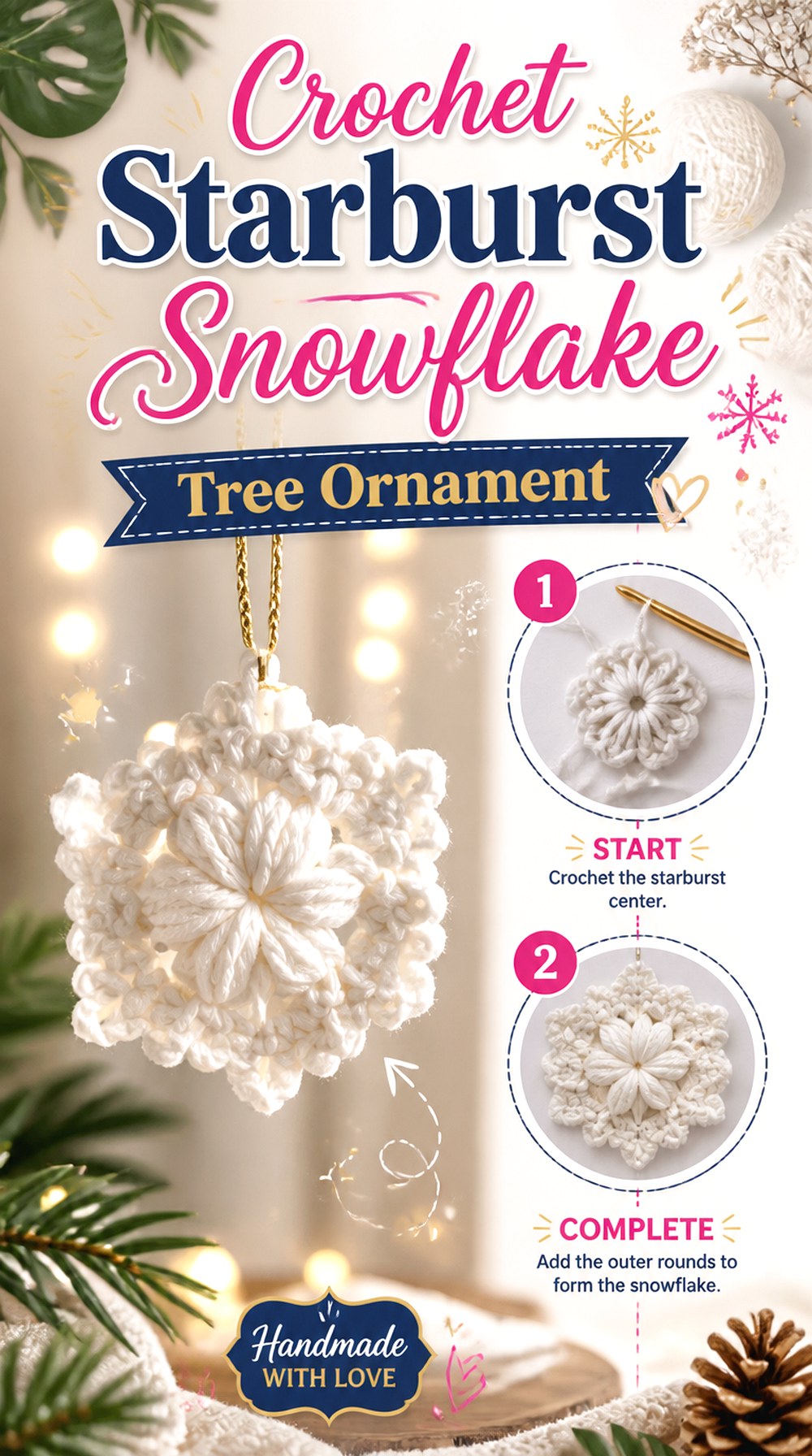
The Crochet Starburst Snowflake Tree Ornament sits visually between a pointed star and a traditional branching snowflake. MUSHYY’s tutorial presents the finished piece specifically as a snowflake ornament, with a bold radial silhouette that reads clearly without the delicate web of a thread-lace design.
This is useful if your holiday decor already contains stars and you want the crochet pieces to connect those shapes with a winter snowflake theme. The more graphic outline can also remain visible against patterned backgrounds where very fine lace would disappear. Since the motif carries visual weight through its pointed form, embellishment can stay restrained. Try the completed snowflake in its final setting before deciding whether it needs anything beyond a simple hanging loop.
Use the Star-Like Outline to Bridge Ornament Styles
Trees often contain a mix of stars, baubles, snowflakes, bells, and figurines. A snowflake with a strong starburst silhouette can visually connect the pointed shapes without looking like another identical star.
For a cohesive display, repeat one yarn color already present elsewhere on the tree. The construction supplies enough distinction that color does not need to do all the work.
Keep the Center From Disappearing Into the Background
A graphic snowflake benefits from clear contrast at its center and points. Against a pale wall or frosted tree, white yarn can become subtle; against evergreen branches, the same motif may read immediately.
Test the ornament in its actual location before making a full set. Changing to a slightly more contrasting shade may improve visibility more effectively than making the motif larger.
Original Tutorial and Creator Credit
Creator: MUSHYY
14. Crochet Oversized Statement Snowflake Ornament
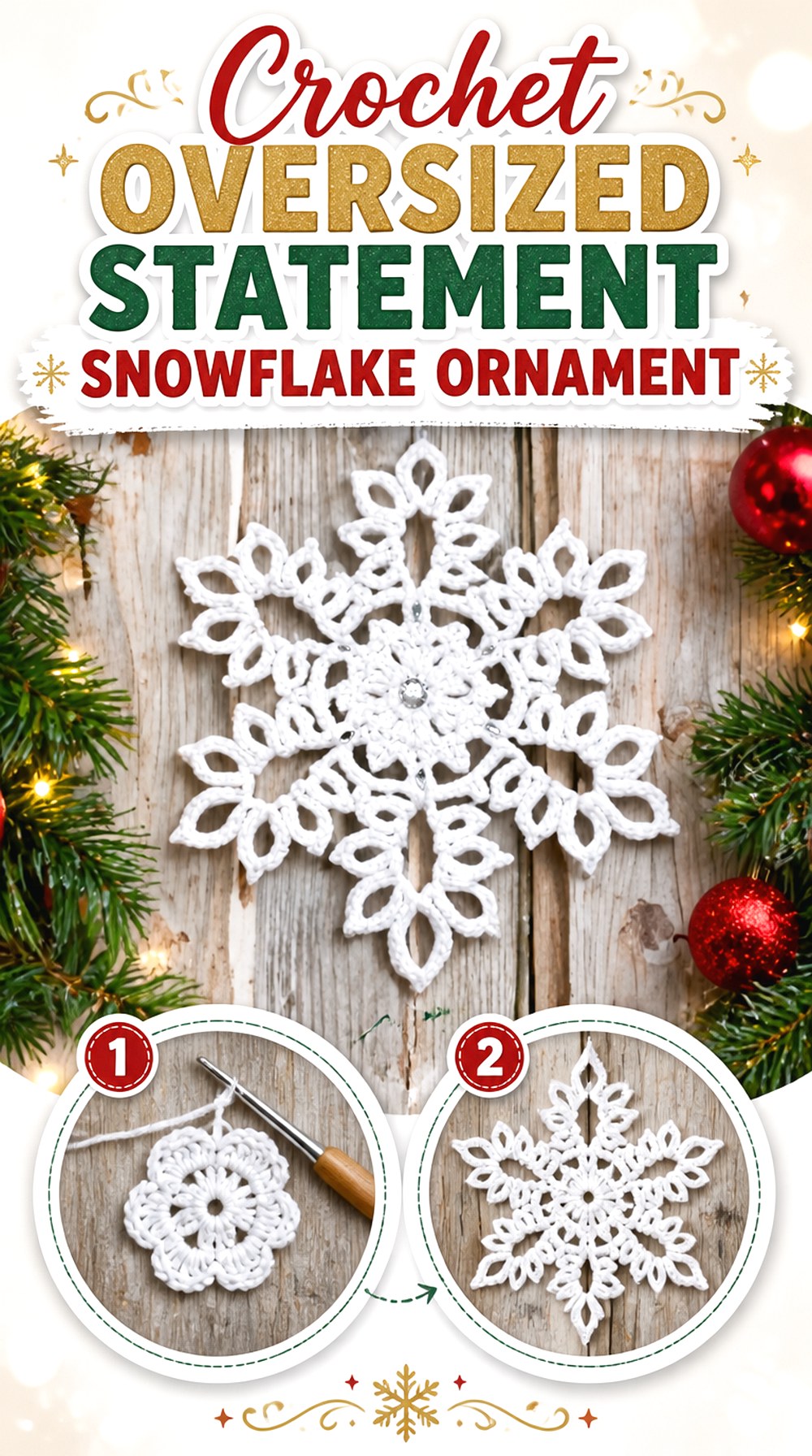
The Crochet Oversized Statement Snowflake Ornament changes the scale of the idea completely. Bag-O-Day Crochet demonstrates a snowflake approximately 14 inches across, turning what is normally a small tree accent into a piece with enough presence for a window, wall, door arrangement, or other prominent holiday display.
This is the option to consider when dozens of small ornaments are not the goal. One large crochet snowflake can establish a focal point, particularly in a room using oversized wreaths or substantial greenery. At this scale, however, gravity and shaping matter more. A small curl that goes unnoticed on a tiny motif can become obvious across a much larger diameter, so allocate space for finishing as well as crocheting.
Large Snowflakes Need a Flat Shaping Area
Before starting an oversized motif, think about where it will be blocked or stiffened. The finished piece needs enough room for all of its arms to spread without folding against furniture or overlapping the edge of a small mat.
Prepare the shaping surface before the ornament is wet or treated. That makes it easier to align opposite points and check the full silhouette from above rather than improvising after finishing has begun.
Match the Display Support to the Ornament’s Scale
A large snowflake should not depend on a flimsy branch tip if its size or finished weight makes that impractical. Consider a window hook, wall display, wreath frame, or sturdy greenery where the ornament can remain fully visible.
Test the hanging point before final display. The snowflake should hang without one section folding forward or the support disappearing under the ornament’s width.
Statement Scale Reduces the Need for Extra Embellishment
An oversized crochet piece already attracts attention through proportion. Beads, tassels, or heavy glitter are optional rather than necessary.
If your room includes many competing holiday textures, keeping the large snowflake in a restrained color can help it read as a graphic winter shape. In a minimal space, a stronger contrast may be enough to make it the main seasonal feature.
Original Tutorial and Creator Credit
Creator: Bag-O-Day Crochet
15. Crochet Mini Two Round Snowflake Ornament
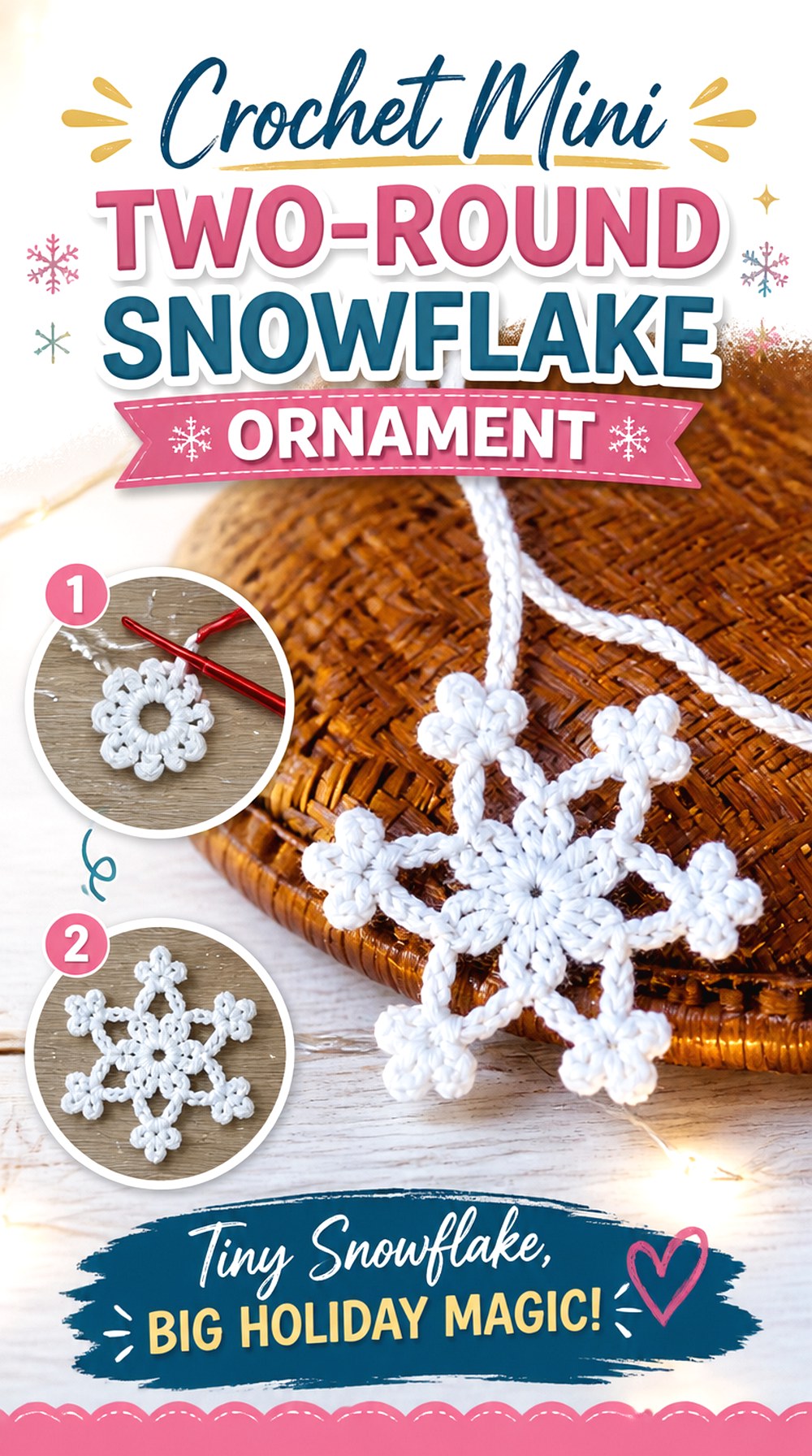
The Crochet Mini Two-Round Snowflake Ornament takes the opposite approach from the oversized design. Moara Crochet demonstrates a very compact snowflake construction, making this a useful direction when the ornament needs to stay small enough for mini trees, narrow garlands, package accents, or clustered displays.
Tiny motifs can be effective in quantity because they add repeated winter shapes without occupying much visual space individually. They also make yarn choice especially noticeable: a change in thickness represents a larger proportion of the whole ornament than it would on a big motif. If you want a collection that stays genuinely miniature, make a sample with your intended material rather than assuming the tutorial’s scale will survive every substitution.
Small Scale Makes Yarn Thickness More Important
When a motif contains only a limited number of rounds, thicker yarn can transform a delicate snowflake into a noticeably chunkier object. That may be useful, but it changes the reason for choosing this design.
If miniature scale matters, compare your first finished piece with the branch, tag, or garland where it will be used. Adjust materials before making multiples rather than discovering later that the entire batch is larger than planned.
Tiny Snowflakes Work Well as Repeated Accents
One miniature flake may disappear on a full-size tree, but a deliberate group can create rhythm. Repeat them across several nearby branches, alternate them through a garland, or use them as small accents alongside larger handmade ornaments.
Keep the hanging loops proportionate. An oversized loop can visually double the length of a very small snowflake and make the crochet itself feel secondary.
Original Tutorial and Creator Credit
Creator: Moara Crochet
16. Crochet Tiny Thread Snowflake Ornament
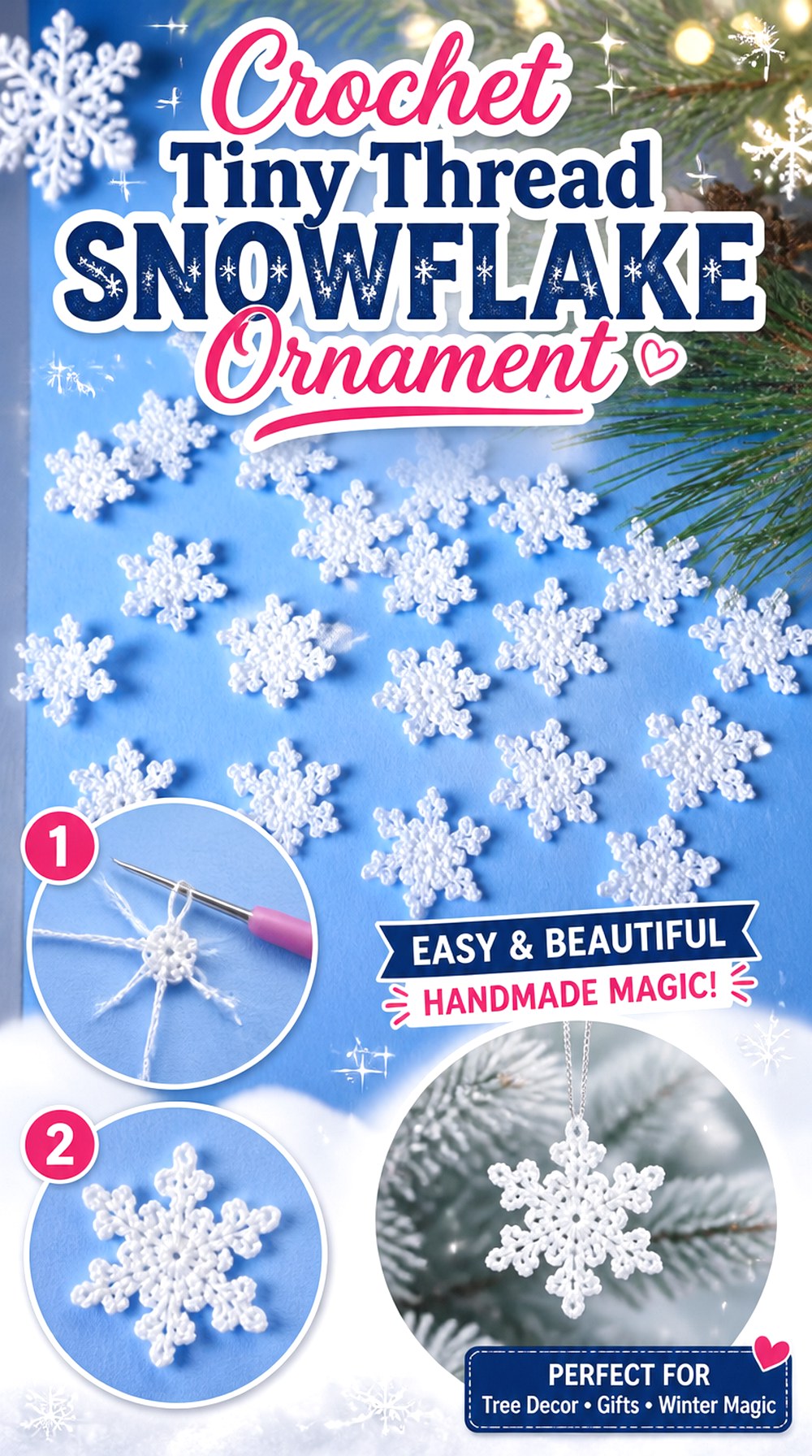
The Crochet Tiny Thread Snowflake Ornament emphasizes miniature lace rather than chunky yarn. GoldenLucyCrafts presents a small snowflake and demonstrates the motif in a way that makes the stitches visible while showing how delicate the design can become in finer material.
This direction suits readers who want understated ornaments, gift accents, or small flakes that can fill the spaces between larger decorations. Fine thread also makes the edge details feel proportionally sharper, but it asks more of the finishing stage because tiny points can curl or disappear. Instead of judging the motif while it is still relaxed from the hook, shape one complete sample and view it against the intended background.
Miniature Lace Rewards Close Placement
A tiny thread snowflake is most effective where its detail can actually be seen. Place it toward the outer tree branches, on a small tabletop display, or somewhere viewers naturally come closer.
If the ornament will sit high across a large room, consider whether a bigger design would communicate the snowflake shape more clearly. The smallest option is not automatically the best use of delicate stitch work.
Use the Demonstration to Learn the Shape, Then Assess Your Thread
The tutorial uses a format that makes the stitch structure easier to see, while the finished concept can be made at a much smaller scale. That is helpful when fine thread itself would make instructional details difficult to follow on screen.
When changing material, remember that the resulting density and stiffness can change too. Finish a trial piece before deciding whether your miniature version needs additional blocking support.
Original Tutorial and Creator Credit
Creator: GoldenLucyCrafts
17. Crochet Puff Stitch Snowflake Motif Ornament

The Crochet Puff-Stitch Snowflake Motif Ornament uses raised texture near the center to keep a small winter motif from looking completely flat. Ichigocrochet’s tutorial presents a compact snowflake with a puff-textured center, giving the eye a clear focal point before the design moves outward into its branches.
This works well when you like small ornaments but still want texture to show from a moderate viewing distance. It can also break up a collection dominated by thread lace because the center catches light differently. Since puff stitches add density, compare the weight and appearance of the middle with the outer arms after blocking; the goal is a balanced snowflake rather than a center that visually overwhelms its points.
Let the Puffy Center Supply the Ornament’s Texture
Once the center already has raised dimension, extra surface decoration is not essential. Too few extra botanical or glossy embelling pop? Keep beads or glitter restrained if you want the puff detail to remain visible.
A simple hanging loop and contrasting backdrop may provide all the separation the motif needs. This makes the texture, rather than additional trim, the primary source of interest.
Check That the Outer Arms Still Read From a Distance
A dense center can attract the eye more strongly than delicate branches. Hang your finished sample and step back. If the snowflake starts to look like a textured circle, the background may be too white or the yarn you chose may be obscuring the open outer shape.
Contrast and careful blocking can restore the balance without changing the crochet construction itself.
Original Tutorial and Creator Credit
Creator: Ichigocrochet
18. Crochet Simple Branch Tip Snowflake Ornament
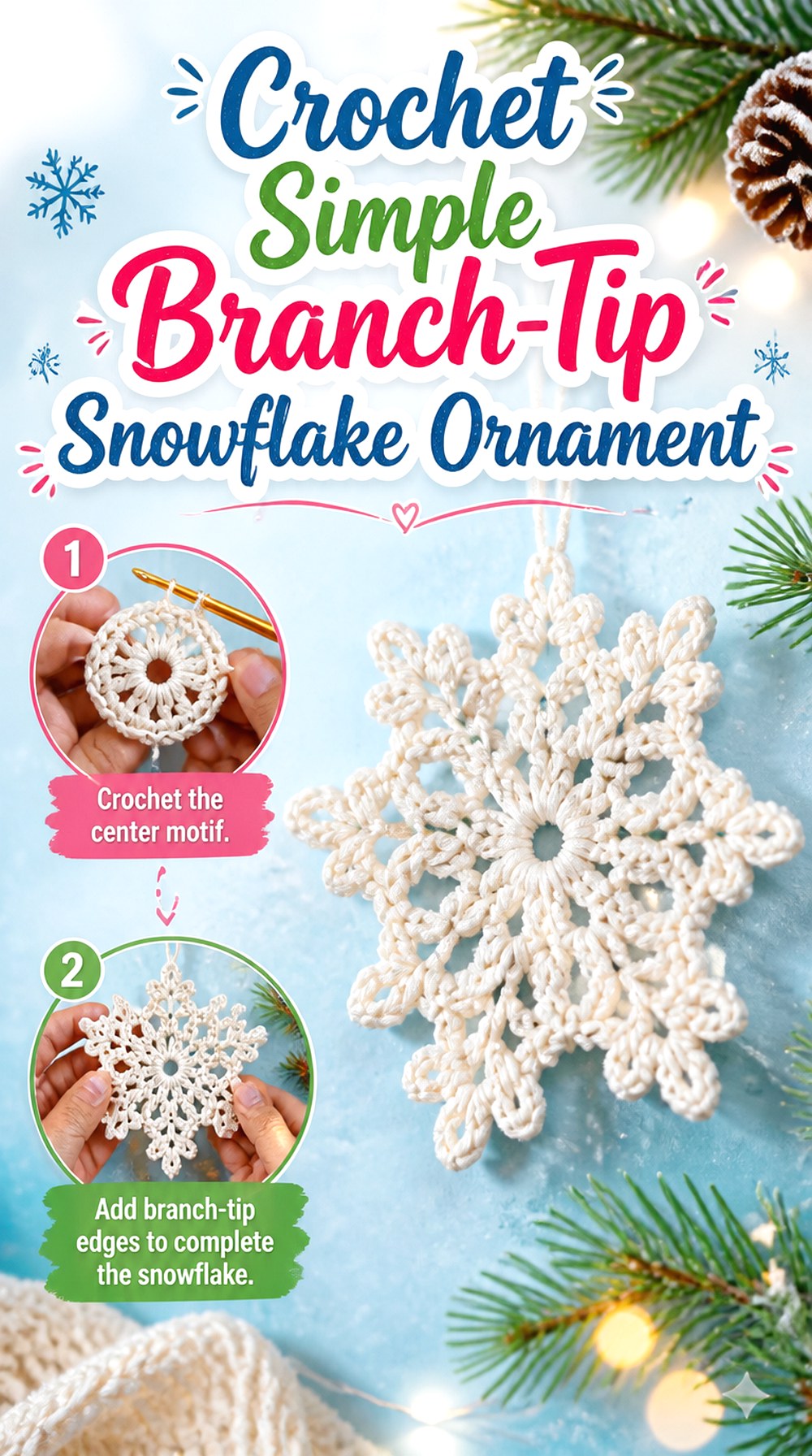
The Crochet Simple Branch-Tip Snowflake Ornament is a restrained option for a collection that needs a straightforward winter motif without additional beads, tassels, layered parts, or bulky structure. Erfin R. Tangdilintin’s tutorial focuses directly on a crocheted snowflake ornament, so the finished result can be judged as hanging decor from the beginning.
This type of design is useful when you plan to repeat the snowflake many times or mix it with more elaborate feature ornaments. Its main job is to provide a clear snowflake silhouette and handmade texture. Color changes can create variety, but first make sure the edge shape remains visible against your tree or display background.
A Restrained Shape Can Support Busier Decorations
Not every ornament needs to be the focal point. A simpler snowflake can occupy spaces between patterned baubles, ribbon, lights, and dimensional crochet pieces without competing with them.
For a cohesive look, repeat the same snowflake in one or two shades already used elsewhere. The quiet motif then becomes a visual connector rather than an unrelated additional decoration.
Finish the Points Before Judging the Design
Freshly crocheted snowflakes can curl or look less symmetrical than they will after shaping. Lay the piece flat, arrange the branches, and evaluate its silhouette only after completing the appropriate finish for your yarn.
This is especially important with simpler designs because there are fewer decorative elements to distract from uneven spacing. Clean shaping becomes part of the ornament’s character.
Original Tutorial and Creator Credit
Creator: Erfin R. Tangdilintin
19. Crochet Decorative Lace Snowflake Ornament

The Crochet Decorative Lace Snowflake Ornament is designed for readers who want more visual detail than a basic radial motif while keeping the finished piece flat. Handmade with love’s tutorial presents a winter snowflake suitable for holiday decoration and hanging use, with open areas that preserve a lace-like look.
This style can fill the space between very simple flakes and complicated statement pieces. It has enough outer detail to look decorative on its own but does not require a separate bauble or dangling embellishment. That makes display planning relatively flexible. Use it where both the overall snowflake outline and some of the internal openings can be seen, rather than burying it deep among heavily decorated branches.
Let Open Areas Separate the Ornament From the Tree
Evergreen branches naturally provide a dark background that can make pale lace stand out. Take advantage of that contrast by positioning the motif near the outer layer of the tree rather than against several other white decorations.
If your tree is flocked or very pale, try a slightly deeper winter shade instead. The goal is enough contrast to preserve the internal lace spaces from normal viewing distance.
Use One Decorative Snowflake as a Finishing Reference
If you make a set, fully finish the first motif and keep it nearby while shaping the others. Compare point direction and overall spread rather than trying to duplicate every tiny handmade variation.
A shared silhouette makes the collection look coordinated even when tension causes minor differences. Consistency in hanging-loop length also helps several snowflakes sit at comparable depths on the tree.
Original Tutorial and Creator Credit
Creator: Handmade with love
20. Crochet Sparkle Yarn Six Point Snowflake Ornament

The Crochet Sparkle-Yarn Six-Point Snowflake Ornament creates shimmer through the yarn itself rather than an applied glitter finish. Crochet For You’s updated six-point design is demonstrated with a glamour-style yarn that adds a metallic or sparkling effect directly to the crocheted fabric.
That distinction matters for planning. If you like the way lights catch sparkle but do not want to coat the finished snowflake with another product, a reflective yarn can supply the effect as you crochet. Because decorative strands sometimes change stitch visibility, inspect the sample under normal room light as well as tree lights. The snowflake shape should remain readable even when the sparkle becomes less noticeable during daytime.
Sparkle Should Support the Silhouette
A reflective yarn attracts attention, but it cannot compensate for a snowflake whose points disappear into a similarly colored background. Choose the yarn first for the combination of crochet definition and display contrast, then treat the sparkle as an added effect.
If the decorative strand is visually busy, a relatively simple hanger helps prevent several competing shiny elements from collecting in one small ornament.
Use Reflective Yarn When You Want a Built-In Finish
The creator demonstrates the updated snowflake using a yarn selected for its glittering appearance. This creates a different route from adding glitter after blocking.
Either approach can suit seasonal decor, but yarn-based sparkle travels with the fabric itself. Make a sample before buying or committing large quantities, because reflective fibers can look different under daylight, warm tree lights, and cool LEDs.
Original Tutorial and Creator Credit
Creator: Crochet For You
21. Crochet Macramé Cord Folksy Snowflake Ornament

The Crochet Macramé-Cord Folksy Snowflake Ornament replaces delicate thread with a much heavier-looking fiber, producing one of the most texturally distinct pieces in this collection. Raji’s Craft Hobby demonstrates the snowflake with three-ply cotton macramé thread and a satin ribbon or decorative string for hanging. The creator lists the finished example at about six inches.
This style works well with rustic greenery, natural wood, neutral ornaments, and other decorations that can visually support a chunkier handmade texture. It is also large enough to function as a noticeable accent rather than tiny filler. Because the cord supplies considerable body on its own, judge whether additional stiffening is actually needed after completing and hanging your sample.
Chunky Cord Changes the Character of the Snowflake
Macramé cord makes the crochet look more substantial than fine lace thread. The thicker strands emphasize the physical construction of the motif, creating a folksy or rustic effect rather than a fragile doily-like appearance.
That extra visual weight is useful on a large tree or wreath, but it may be too much for a miniature display. Compare the completed sample with surrounding ornament sizes before repeating it across the entire tree.
Make the Ribbon Proportionate to the Heavier Motif
Raji’s Craft Hobby uses ribbon or decorative string as the hanging element. A very fine loop can look visually disconnected from a chunky cord snowflake, while an excessively decorative ribbon may compete with the texture.
Hold several options against the finished ornament before tying the permanent hanger. The best proportion should look intentional without distracting from the snowflake itself.
Give a Chunkier Ornament a Strong Hanging Position
The creator’s finished example is listed at about six inches, so this is not a tiny thread flake. Place it where the full outline can be seen rather than squeezing it between close branches.
If used on a tree, test the branch under the complete ornament before decorating the surrounding area. For wreath or wall use, leave enough open background around the arms to preserve the snowflake silhouette.
Original Tutorial and Creator Credit
Creator: Raji’s Craft Hobby
How to Choose Among These 21 Crochet Snowflake Ornament Styles
For delicate tree filler, start with the tiny thread, mini two-round, openwork, or picot-edge options. They preserve negative space and work especially well where viewers can see the stitch detail. The classic six-point and simpler hanging snowflakes are better choices when you want repetition without making every ornament a focal point.
For something more distinctive, compare the Celtic-knot design, puff-textured motifs, sparkle-yarn snowflake, glittered finish, or Bella Coco’s bead-and-tassel version. Each introduces interest in a different way instead of simply changing color.
The bauble cover, macramé-cord snowflake, and oversized Bag-O-Day design make the largest departures from traditional flat lace. Choose these when dimension, fiber weight, or display scale matters more than creating a uniform set of small snowflakes.
Conclusion
The most useful way to choose among these crochet snowflake ornament ideas is to start with the display rather than the motif. Tiny thread and openwork flakes suit delicate collections, puffed or chunky versions add texture, and glitter, beads, tassels, or sparkle yarn introduce finishing detail without requiring every ornament to use a different crochet shape. For stronger focal points, the covered bauble, Celtic-knot snowflake, macramé-cord design, and oversized snowflake offer noticeably different forms.
Make one sample before committing to multiples, then judge its scale, contrast, hanging balance, and need for blocking or stiffening in the actual display location. Use the original tutorials linked with each idea for the creators’ exact construction details.
Frequently Asked Questions
Do crochet snowflake ornaments have to be stiffened?
No. Whether stiffening is useful depends on the design, yarn, density, and the shape you want. A chunky or relatively structured motif may hold an acceptable outline after ordinary blocking, while a fine openwork snowflake with long points may benefit from additional support. Complete one sample first and hang it before deciding. If you use a stiffening product, make sure it is appropriate for your material and follow that product’s instructions rather than assuming every yarn should receive the same treatment.
What yarn works well when I want crisp snowflake details?
Look first at stitch definition and the finished structure you want. Smooth yarn or crochet thread generally makes small points, open spaces, and raised details easier to see than very fuzzy yarn. Thickness changes the character too: fine thread produces lace-like flakes, medium yarn gives a more substantial ornament, and macramé cord can create a chunky decorative piece. There is no single required fiber for every design, so sample the motif with your chosen yarn before planning an entire set.
Should I block a crochet snowflake before attaching its hanging loop?
It often makes planning easier. Blocking first lets you see the snowflake’s final orientation and identify which point should face upward. You can then position the loop so the motif hangs naturally rather than twisting one arm into place. Some tutorials incorporate their own finishing sequence, so follow the original creator where a specific method matters. For independently adapted flat motifs, the important checkpoint is to decide on orientation only after the snowflake has been shaped evenly.
Can I make a snowflake larger by switching to thicker yarn?
Changing yarn and hook can change finished scale, but it can also alter density, openness, drape, and the proportion of small decorative details. A design that looks delicate in thread may become much more graphic in thicker yarn. Treat a material change as a sample rather than a guaranteed scaling formula. Crochet one complete motif, finish it the way you intend to use it, and compare the result with the tree, wreath, window, or package where it will be displayed.
How can I stop crochet snowflake ornaments from looking uneven?
First compare corresponding arms and open spaces before the ornament is fully finished. Uneven tension, curled points, or inconsistent shaping can make a symmetrical motif look off-center even when the crochet is structurally complete. Blocking can help distribute the motif more evenly, and some designs may benefit from appropriate stiffening. Avoid pulling one point dramatically farther simply to force a larger diameter. A balanced silhouette and similar spacing around the center are usually more important than maximum size.
How should crochet snowflake ornaments be stored after the holidays?
Make sure the ornaments are completely dry before packing them away. Flat lace snowflakes can be stored with their points supported so they are not sharply folded, while rigid, glittered, beaded, tassel, or macramé versions may need extra space to prevent crushing and abrasion. Avoid placing heavy decorations directly on top of delicate motifs. When unpacking the following season, inspect the hanging loops and reshape soft pieces as needed before returning them to the tree or display.


