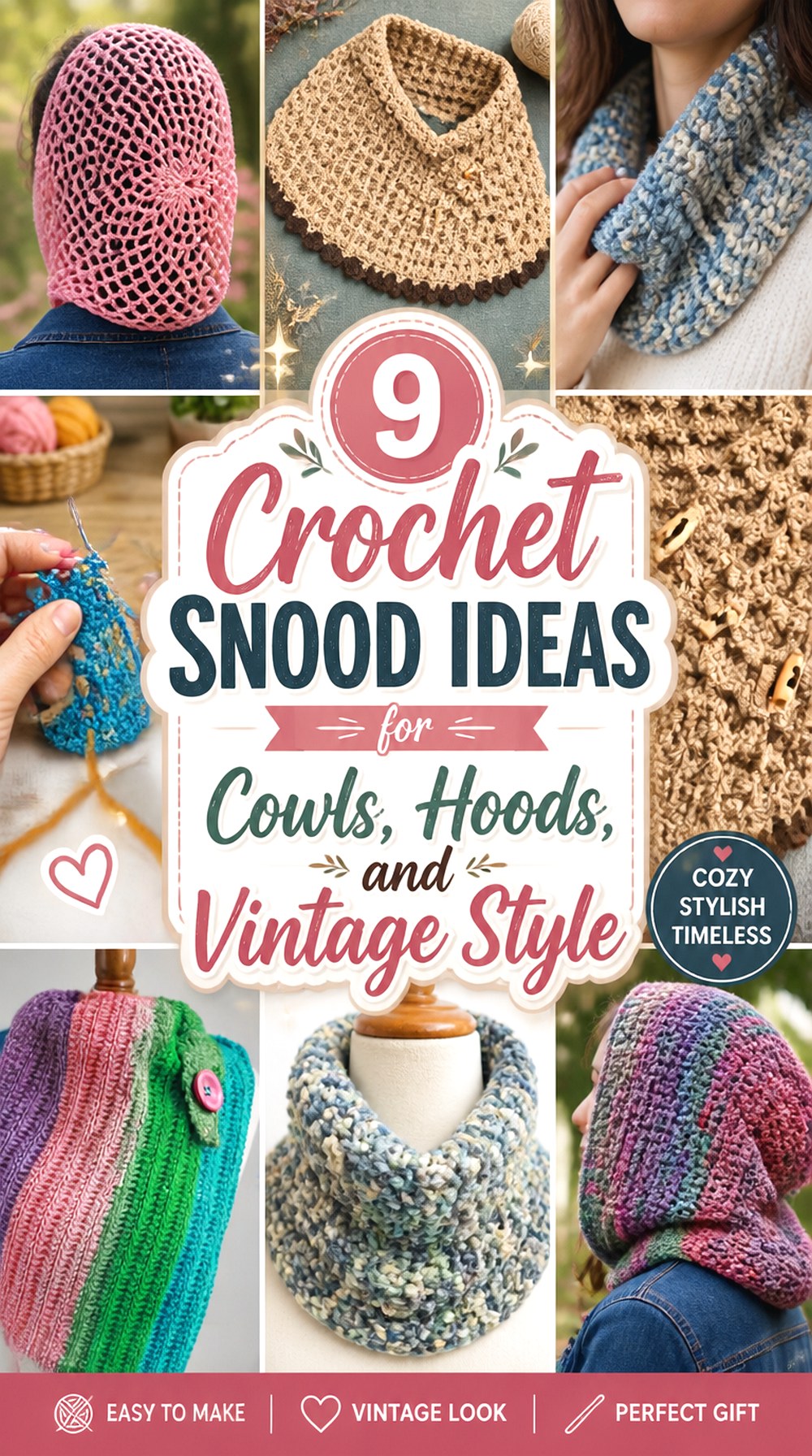

“Crochet snood” can describe several noticeably different accessories. Some are compact neck warmers, others are long loops that wrap twice, and hooded versions can cover both the head and neck. The term is also used for traditional mesh hair snoods, so this collection includes that vintage interpretation as well.
These nine ideas focus on those structural differences rather than simply changing yarn colors. You can compare a chunky hood against a draping infinity loop, a fitted turtleneck against an adjustable buttoned cowl, and a scarf-and-hood hybrid against a classic double-wrap snood. Along the way, the practical notes cover opening size, fabric weight, drape, bulk, shaping, and the measurements worth checking before committing your yarn.
Quick List
- Crochet Chunky Hooded Snood
- Crochet Scoodie with Long Scarf Ends
- Crochet Double-Wrap Snood
- Crochet Super-Bulky Ribbed Cowl Snood
- Crochet Granny-Stitch Shaped Snood
- Crochet Buttoned Cowl Snood
- Crochet Interwoven Turtleneck Snood
- Crochet Infinity Scarf Snood
- Crochet Vintage Hair Snood
Decide What Kind of Snood You Actually Want
The biggest choice comes before yarn or color: decide where the finished piece needs to sit. A short cowl mainly warms the neck. A long-loop snood provides more styling freedom but needs enough circumference to wrap comfortably. A hooded snood adds head coverage, while a scoodie combines a hood with scarf ends that can be arranged separately.
Those differences affect more than appearance. A snug opening may work well on a neck cowl but become inconvenient if it has to pass over glasses, a hairstyle, or a bulky collar. Hood depth also needs room for the back of the head without pulling the neck section upward.
A vintage hair snood is a different category entirely. Its job is to contain hair rather than insulate the neck, so lighter fabric, mesh behavior, and edge fit matter much more than warmth.
Fit and Drape Matter More Than Decorative Texture
Before starting a neck snood, compare the proposed opening with an accessory you already find comfortable. A single-loop cowl normally needs to clear the head without becoming so wide that it loses its neck-warming function. A double-wrap design needs substantially more length because the same loop has to circle twice without feeling restrictive.
Hooded styles deserve an additional checkpoint. Look at hood depth, face opening, and the transition between hood and neck. Dense, stiff fabric can make a hood stand away from the face, while softer fabric tends to collapse and drape.
For a useful non-pattern planning check, measure an existing cowl or hood flat and compare those dimensions with the tutorial information when dimensions are supplied. Do not assume two tutorials labeled “adult snood” will produce the same amount of ease.
Match Yarn Behavior to the Snood Shape
Thicker yarn can create a substantial winter accessory, but increasing yarn thickness also increases bulk. That is especially noticeable where a snood folds under the chin or wraps around the neck twice. A lofty fabric may feel comfortable in a short cowl yet become excessive in a long double loop.
Lighter yarn generally gives a long snood more opportunity to fall into soft folds. Open granny-style fabric creates still another result: more visible texture and movement, but less of a solid barrier than dense crochet.
Whatever style you choose, pay attention to the fabric rather than yarn weight alone. Hook choice, stitch structure, fiber, and individual tension can all change flexibility. If the tutorial provides gauge or finished measurements, use those rather than assuming a yarn substitution will behave identically.
1. Crochet Chunky Hooded Snood

This version combines a generous hood and neck cowl into one continuous-looking winter accessory. The hood gives it substantially more coverage than a standard tube snood, while the deep neck section can fill the space above a coat collar. It is a strong option when you want one piece that can stay around the neck after the hood is lowered instead of carrying a separate hat and cowl.
The supporting Treasurie tutorial uses chunky/bulky yarn and builds a hooded cowl around half double crochet, so the finished fabric has a straightforward, substantial character rather than delicate openwork.
Check the Hood Opening Before Adding More Bulk
Chunky yarn takes up physical space around the face. A hood that appears generously proportioned when lying flat can feel closer once the fabric folds around hair, ears, and a coat collar. Before treating extra thickness as an automatic advantage, think about how you normally wear a hood. Someone with voluminous hair or glasses may prefer more room around the face than someone wanting a close-fitting winter layer.
Keep the Neck Section Comfortable Under a Coat
A deep crochet cowl can fill an awkward gap at the neckline of outerwear, but too much rigid fabric can bunch where the coat closes. Consider the jackets you expect to pair with the snood. If their collars are already high or heavily insulated, a softer neck fold may be more useful than a tall, firm one. This is one reason fabric drape is worth assessing before completing the entire piece.
This Shape Prioritizes Continuous Coverage
Choose a hooded snood when head-to-neck coverage matters more than multiple wrapping options. Unlike an infinity loop, you do not need to rearrange a second wrap every time the piece is pulled over the head. The trade-off is that hood proportions become part of the fit. If you mainly want a decorative loop around the neck, one of the cowl-focused ideas below requires less fabric around the head.
2. Crochet Scoodie with Long Scarf Ends

A scoodie changes the snood concept by attaching scarf coverage to a defined hood. Instead of relying on a closed loop around the neck, the long scarf portions can hang vertically, cross at the front, or be arranged over outerwear. That makes the silhouette much more flexible than a fixed cowl and gives color blocking more room to become part of the design.
Andrea Quinteros presents the project specifically as a scarf-and-hood hybrid and demonstrates shaping, seaming, and the scarf portion in a complete tutorial. The source also shows both multicolor and solid-color possibilities.
Scarf Length Changes More Than the Appearance
Longer ends can provide more wrapping and styling choices, but they also add yarn weight that hangs from the lower hood area. Think about whether you want the scarf to remain mostly decorative or provide real neck coverage. Before extending a tutorial simply because you have extra yarn, compare the proposed length with a scarf you actually wear. More length is only useful if it suits your preferred wrapping style.
Color Placement Can Clarify the Scoodie Shape
Because this accessory contains visibly different hood and scarf areas, contrasting colors can make its construction especially clear. A strong color division emphasizes the transition, while a single shade makes the silhouette more unified. If using multiple colors, consider where the change will sit when the hood is down as well as up. A placement that looks balanced from the front may read differently across the back.
Leave Enough Hood Room for Real Wear
A hood needs more than a head-circumference measurement. Depth from the forehead area toward the back of the head influences whether it sits naturally or pulls. Hairstyle matters too. When checking fit during construction, use the hairstyle and outer layers you are likely to wear with the finished scoodie rather than evaluating it only against bare hair and a lightweight shirt.
Original Tutorial and Creator Credit
Creator: Andrea Quinteros
3. Crochet Double Wrap Snood

A long circular snood creates the familiar pooled look by giving you enough fabric to wear the loop long or wrap it again around the neck. This is a very different experience from a short fitted cowl: the extra circumference lets the fabric form larger folds and makes the accessory more adaptable to different necklines.
The tutorial from Наталья Котова Вязание крючком и спицами specifically demonstrates a snood intended for two wraps and also notes that the concept can be made for one or two turns. The source provides its own finished dimensions and materials, which should be consulted before making substitutions.
Loop Length Determines Whether Two Wraps Feel Natural
A double-wrap snood needs enough circumference for the second loop to pass over the head and settle without pulling at the throat. At the same time, excessive length can make both loops fall lower than intended. Instead of treating “double wrap” as a universal size, compare the tutorial dimensions with the circumference of an infinity scarf you already like and account for differences in fabric stretch.
Snood Width Controls the Amount of Pooling
Length decides how often the snood wraps; width controls how much fabric stacks vertically. A broad loop creates deeper folds around the neck, while a narrower band gives a cleaner scarf-like line. If you often wear coats with large lapels or tall collars, picture the two layers together. A very wide snood may compete for space even when its circumference is comfortable.
A Second Wrap Magnifies Yarn Characteristics
Texture, weight, and scratchiness become more noticeable when the same fabric sits in two layers near the neck. This makes yarn feel especially important for long-loop snoods. Before buying enough material for a large project, hold a swatch against the neck and fold it over itself. That simple comparison gives a better idea of the final bulk than judging a single flat layer.
Original Tutorial and Creator Credit
Creator: Наталья Котова Вязание крючком и спицами
4. Crochet Super Bulky Ribbed Cowl Snood

This compact snood replaces long, cascading folds with a thick ribbed band that sits close to the neck. Its visual interest comes from the raised, knit-like texture rather than an elaborate silhouette, making it a useful contrast to the hooded and double-loop projects.
Maisie and Ruth’s tutorial uses super-bulky yarn and a back-loop ribbing effect, with the cowl formed from a crocheted rectangle that becomes a closed neck piece. The creator also specifically advises matching gauge when substituting another super-bulky yarn, an important point because yarns sharing the same broad weight category can still produce different fabric.
Ribbing Still Needs to Clear the Head
Stretchy-looking ribs do not guarantee unlimited stretch. The finished opening still has to pass comfortably over the widest part of the head without forcing the seam or distorting the edge. If you alter the dimensions, test the opening before permanently finishing it. A close neck fit is useful only when putting on and removing the snood remains practical.
Super-Bulky Yarn Concentrates Volume
The advantage of a compact bulky cowl is that most of the fabric stays exactly where warmth is wanted. The compromise is less room for the material to fall away from the body. If you dislike substantial fabric directly beneath the chin, compare this style with the softer double-wrap or infinity options. If you prefer a strong collar-like shape, the added body can be an advantage.
Give the Seam the Same Attention as the Ribbing
A ribbed surface attracts the eye, but the join can determine how polished and comfortable the finished cowl feels. Check whether the seam remains flat enough when positioned against the neck. You can also decide where you want it to sit when worn—at the back, side, or another less visible location—before fastening off and weaving in the final ends.
Original Tutorial and Creator Credit
Creator: Maisie and Ruth
5. Crochet Granny Stitch Shaped Snood

This snood brings recognizable granny-style clusters into a wearable neck shape rather than using a dense solid fabric. The open spaces create more visual lightness, while shaping toward the neck distinguishes it from a completely straight tube. It is a good direction when stitch pattern and color movement are as important as insulation.
Crochet with Clare’s tutorial is specifically for a granny-stitch cowl, and the video includes a section devoted to decreasing toward the neck. That shaping detail makes the project meaningfully different from a basic straight infinity loop.
The Taper Gives the Lower Edge More Freedom
A shaped snood can sit broader over the upper chest while becoming closer around the neck. That helps the fabric occupy two different areas without requiring the entire piece to have the same circumference. When evaluating this silhouette, check where you want the widest portion to fall in relation to a coat neckline. Too much flare can disappear beneath outerwear; too little may remove the shaped effect.
Open Granny Fabric Trades Density for Movement
Clustered openwork generally lets more air pass through than a tightly packed solid crochet fabric. That can be a positive choice for transitional weather or indoor wear, especially if a heavy cowl feels excessive. For very windy conditions, however, visual thickness should not be confused with a completely solid barrier. Choose the structure according to how you expect to use the finished snood.
Color Changes Follow the Shaping
Granny-style fabric gives color transitions plenty of visibility. Stripes can emphasize the changing circumference, while a gradual color-changing yarn can soften those lines. Before selecting a strongly striped plan, consider which shade will frame the face and which will sit across the lower edge. Those areas are more prominent than colors appearing only briefly in the middle of the fabric.
Original Tutorial and Creator Credit
Creator: Crochet with Clare
6. Crochet Buttoned Cowl Snood
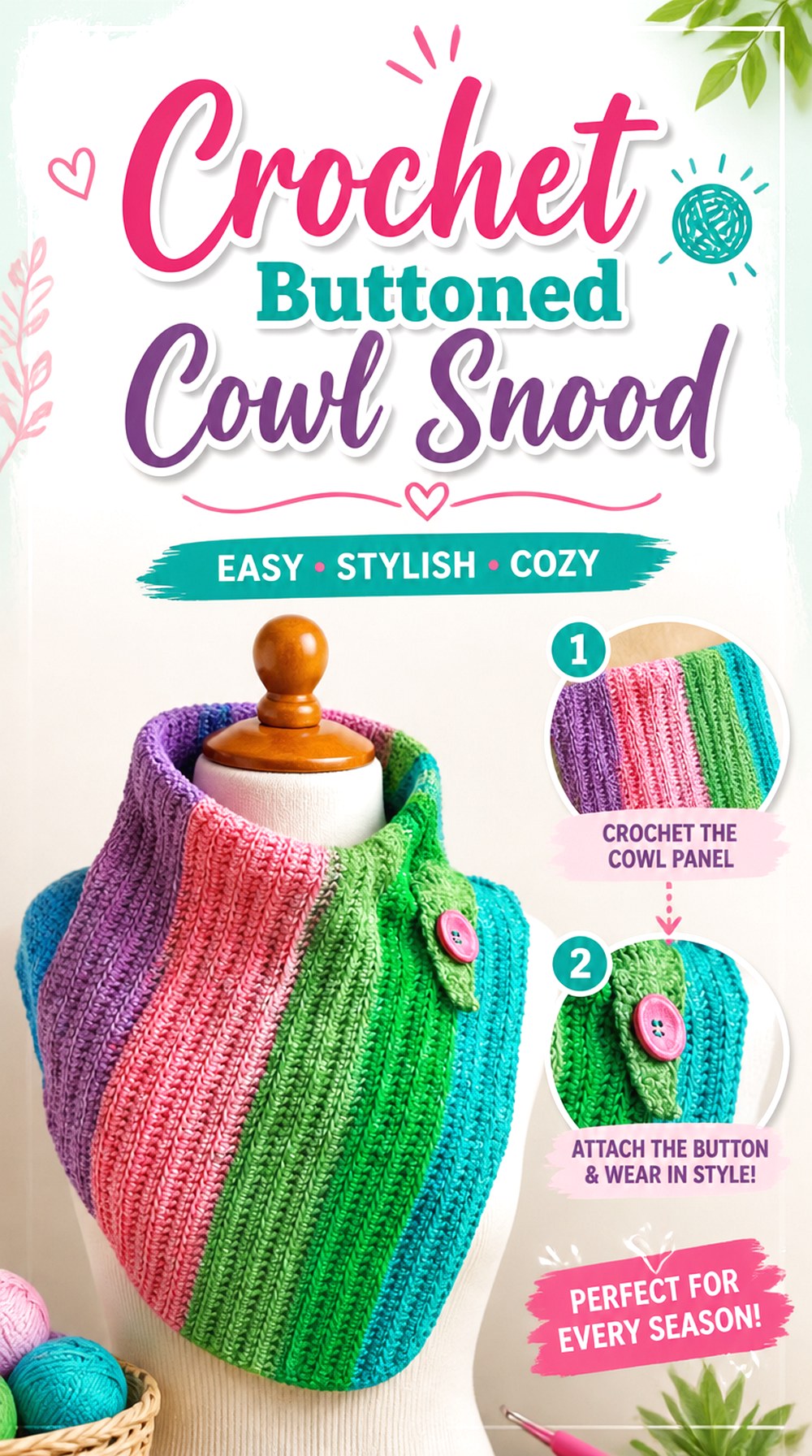
A buttoned cowl creates a more defined front focal point than a plain circular snood. Instead of letting all the fabric fall evenly around the neck, the button helps organize the overlapping shape and keeps the finished piece visually directional. This makes it appealing when you want a neck warmer that reads more like a small accessory garment than a continuous scarf tube.
Nana’s Crafty Home describes the Easy Breezy Day design as an ombré button cowl and explains that a decorative button holds the arrangement together. The accompanying video demonstrates the project and its finishing.
Button Placement Controls the Front Silhouette
Moving a closure changes how much the fabric overlaps and where the upper edge sits. Before sewing on a button, arrange the nearly finished cowl around the neck and check the overlap from both the front and side. This is more informative than choosing placement only while the piece lies flat. Also make sure the position does not create an uncomfortable hard point against the throat or collarbone.
An Ombre Yarn Can Make the Overlap More Visible
Self-changing color has a different effect in an overlapping cowl than in a continuous symmetrical tube. The front layer may display one section of the color sequence while another portion peeks out beneath it. If that contrast matters to you, preview how the fabric will fold before final placement. A solid color produces a quieter shape and puts more attention on texture and button choice.
Treat the Button as Functional Hardware
A button may be decorative, but if it helps hold the cowl arrangement in place, its attachment deserves more attention than a purely ornamental accent. Match the button size to the intended fastening arrangement described by the creator and secure it appropriately. If you plan to change the original button concept, confirm that the crochet fabric can support the new size and weight without sagging or stretching.
Original Tutorial and Creator Credit
Creator: Nana’s Crafty Home | Tonya Bush
7. Crochet Interwoven Turtleneck Snood

Instead of relying on a single tube or straightforward textured band, this snood uses an interwoven outer structure with a defined turtleneck section. The contrast creates a statement surface around the lower neck while retaining a closer collar above it. Visually, it sits between a decorative cowl and a structured winter neck warmer.
The Crochet Crowd tutorial explicitly demonstrates an interwoven cowl with a turtleneck and includes separate attention to the woven strips and neck area. The source also provides pattern-specific gauge and yarn information, so anyone substituting materials should compare those details with the original pattern.
Interwoven Fabric Creates Uneven Thickness by Design
Where strips cross, multiple layers occupy the same area. That creates more dimension than an ordinary flat stitch pattern, but it also means the lower cowl will not feel uniformly thin. Consider whether that sculptural quality works with your usual outerwear. It may stand out beautifully over a simple coat while feeling crowded beneath a close-fitting zipped collar.
The Turtleneck Needs Its Own Fit Check
The decorative lower section may attract most of the attention, but comfort depends heavily on the neck opening. A turtleneck-style finish should feel intentional rather than restrictive. If you alter yarn, hook, or tension, pay particular attention to the opening because a substitution that looks acceptable in the loose woven area may behave very differently in the closer neck section.
Keep the Woven Arrangement Consistent
This is one of the projects where finishing directly affects the visible design. If the interwoven sections twist unpredictably or sit at inconsistent angles, the overall structure can look accidental rather than geometric. When following the tutorial, pause at the arrangement stage and compare both sides before securing everything. It is easier to correct orientation before the final edging or finishing is complete.
Original Tutorial and Creator Credit
Creator: The Crochet Crowd
8. Crochet Infinity Scarf Snood

An infinity-style snood emphasizes length and drape rather than a fixed collar shape. The continuous loop can hang longer when left open or create more volume when wrapped, giving it a scarf-like appearance without loose ends. Compared with the compact ribbed and buttoned cowls above, this version is better suited to readers who want the accessory itself to form visible folds.
The Craft & Crochet tutorial is specifically presented as a crochet scarf, infinity scarf, and cowl, with the finished project designed as a continuous loop.
Decide How Low You Want the Unwrapped Loop to Fall
An infinity snood’s total circumference affects both ways it is worn. Extra length makes the single loop hang lower, but it also changes the size of each layer once wrapped. Before enlarging the tutorial, drape a tape measure or existing infinity scarf around yourself to estimate where the lowest point will sit. That gives a more useful target than choosing circumference from a number alone.
Soft Drape Helps the Two Layers Settle
A long infinity loop usually benefits from fabric that can fold rather than forming a rigid ring. If substituting yarn, make a sufficiently large swatch to see how it bends under its own weight. A yarn that produces an attractive firm fabric in a basket or hat may not create the same graceful folds in a scarf-length snood. Hook size and stitch tension influence this just as much as fiber choice.
Watch for an Accidental Twist at the Join
A deliberate twist can be part of some infinity designs, but an unintended one changes how the loop hangs. Before permanently joining any project that is supposed to remain untwisted, lay out the fabric and confirm the edges are oriented as intended. This is particularly important with a long piece because a single unnoticed turn can be difficult to detect while the material is gathered in your lap.
Original Tutorial and Creator Credit
Creator: Craft & Crochet
9. Crochet Vintage Hair Snood

The final idea uses the older hair-accessory meaning of “snood.” Instead of wrapping the neck, this crochet mesh contains the hair at the back of the head, creating a distinctly vintage silhouette. It requires a different planning mindset from every other project in this collection: lightness, mesh expansion, hair volume, and the fit of the outer edge matter more than warmth.
Stitch ‘N Fiction’s tutorial explores a vintage-inspired crochet snood and identifies fingering-weight wool, a small crochet hook, and round elastic among the materials used for the featured project.
Size the Mesh for the Hair It Must Contain
Head circumference alone does not tell you how much room a hair snood needs. Hair length, thickness, curls, braids, and the intended hairstyle can substantially change the required volume at the back. Before adapting a tutorial, estimate the amount of hair that will actually sit inside the mesh. A snood can fit around the head edge yet still be too shallow for the hairstyle.
The Edge Should Secure Without Over-Tightening
A hair snood needs enough hold to remain in position, but adding stronger elastic is not automatically the solution to slipping. An overly tight edge can simply become uncomfortable. Follow the tutorial’s edge concept first and assess the fit around the hairstyle you intend to wear. If substituting elastic or another finishing method, confirm that it stretches and recovers appropriately before incorporating it.
Lighter Yarn Supports the Vintage Silhouette
This project benefits from a completely different type of fabric than a winter cowl. Fine yarn and open mesh reduce bulk around the head and allow the contained hair to define the finished shape. Replacing that with substantially heavier yarn could make the accessory stiffer and visually heavier. If you want to substitute material, prioritize similar fabric behavior rather than matching color alone.
Which Crochet Snood Shape Fits Your Goal?
| Snood idea | Main coverage | Finished character | Most important checkpoint |
|---|---|---|---|
| Chunky Hooded Snood | Head and neck | Deep, substantial hood | Face opening and hood bulk |
| Scoodie | Head, neck, and scarf coverage | Hood with loose ends | Hood depth and scarf length |
| Double-Wrap Snood | Neck | Soft layered loops | Total loop circumference |
| Super-Bulky Ribbed Cowl | Neck | Close, thick collar | Head clearance and stretch |
| Granny-Stitch Shaped Snood | Neck and upper chest | Open, tapered texture | Drape and lower-edge flare |
| Buttoned Cowl Snood | Neck | Directional overlapping front | Button and overlap placement |
| Interwoven Turtleneck Snood | Neck | Sculptural and structured | Turtleneck comfort |
| Infinity Scarf Snood | Neck and upper chest | Long flowing loop | Wrapped versus unwrapped length |
| Vintage Hair Snood | Hair | Light mesh accessory | Hair volume and edge fit |
Conclusion
Choose the snood by the kind of coverage you actually need. The chunky hood and scoodie make sense when head coverage is important, while the double-wrap and infinity designs give you more drape and styling flexibility. A short ribbed cowl keeps the shape compact, the granny version feels visually lighter, and the buttoned or interwoven options put more emphasis on structure. The vintage hair snood is the clear choice when your goal is hair containment rather than warmth.
Once you have chosen the silhouette, check fit and fabric behavior before making major yarn substitutions. Use the original tutorials for exact creator-specific construction details, measurements, and finishing rather than treating this roundup as a replacement for their instructions.
Frequently Asked Questions
Is a crochet snood the same thing as a crochet cowl?
Sometimes. “Snood” is commonly used for a circular neck accessory that overlaps with what many crocheters call a cowl or infinity scarf. It can also describe a hood-and-neck accessory, and historically it can mean a net-like hair covering. When choosing a tutorial, look at the finished object rather than relying on the word “snood” alone. The shape tells you much more about fit and function.
How do I know whether a crochet snood is long enough to wrap twice?
Look for the tutorial’s finished circumference or length and compare it with a double-wrap scarf you already find comfortable. The loop must pass over your head during the second wrap without becoming restrictive at the neck. Stretch also matters, so two snoods with the same circumference can behave differently. If measurements are not supplied, confirm the creator’s sizing guidance before altering the project.
What yarn gives a crochet snood the best drape?
There is no single yarn that works for every snood. Long infinity and double-wrap styles usually benefit from fabric that folds comfortably, while a short collar or sculptural cowl may suit more body. Fiber, yarn construction, hook size, and tension all affect the result. Instead of choosing by yarn weight alone, crochet a swatch and see how it hangs, folds, and feels against the neck.
How should I check the fit of a hooded crochet snood?
Check more than head circumference. The hood needs enough depth from the face toward the back of the head, sufficient room for your normal hairstyle, and a comfortable transition into the neck section. Try it with the coat, collar, glasses, or hairstyle you expect to wear. A hood can technically fit the head yet still pull backward or bunch at the neck if its proportions are wrong.
Can I turn any crochet cowl into a hooded snood?
Not automatically. A cowl provides neck circumference, while a functional hood also needs adequate height, depth, face opening, and shaping or construction that lets it sit around the head. Simply making a cowl taller may produce a tube that can be pulled upward, but it may not behave like a shaped hood. Starting with a tutorial designed as a hooded cowl is more predictable.
How can I stop a super-bulky crochet snood from feeling too stiff?
First check whether your fabric is denser than the tutorial’s intended result. Yarn within the same labeled weight category can vary considerably, and personal tension can make the fabric firmer. A suitable swatch lets you evaluate flexibility before investing in the entire cowl. Avoid automatically enlarging the hook without checking the source pattern, since changing fabric density can also change finished measurements and the way the opening fits.
Can I use the same yarn for a hair snood and a winter neck snood?
You can sometimes substitute yarn, but the two accessories ask very different things from the fabric. A winter neck snood may benefit from thickness and insulation, while a vintage hair snood generally needs lighter mesh that can contain hair without creating excessive bulk. If you change the yarn used in a hair-snood tutorial, compare the resulting mesh size, stretch, weight, and edge behavior before completing the full accessory.