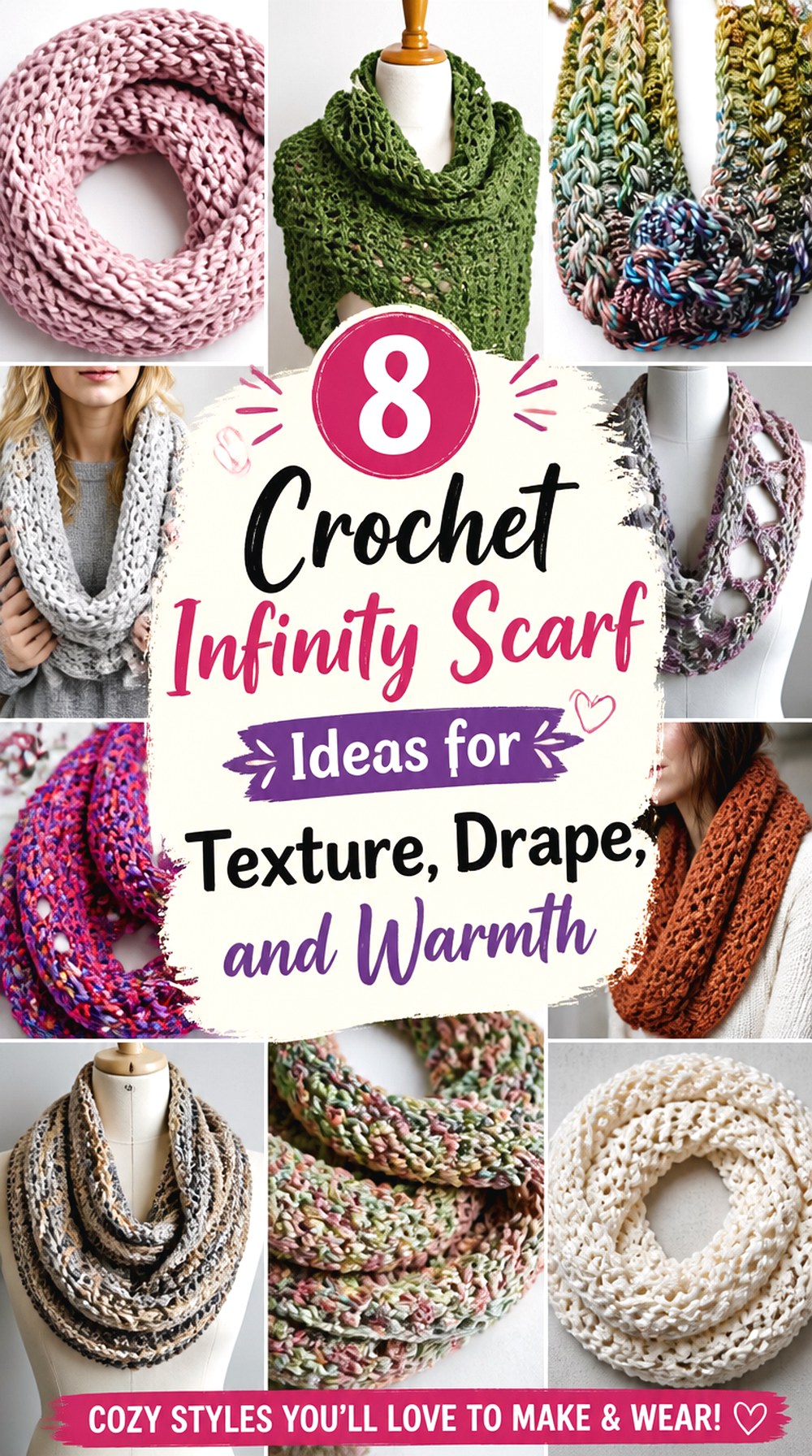

Infinity scarves can look deceptively similar when they are folded into a loop, but their construction and fabric can be very different. A thick winter scarf behaves nothing like a fine fan-lace version, while planned pooling, hairpin lace, ribbing, and a Möbius twist each create their own visual effect and wearing experience.
These eight crochet infinity scarf ideas focus on those useful differences rather than color changes alone. You’ll find options for substantial cold-weather layers, lighter decorative loops, unusual crochet techniques, and scarves designed around color or texture. The guidance also highlights what to check before changing yarn, circumference, width, or construction so you can choose a tutorial that fits the way you actually want to wear the finished scarf.
Quick List
- Crochet Super-Bulky Double-Wrap Infinity Scarf
- Crochet Ribbed Knit-Look Infinity Scarf
- Crochet Planned-Pooling Argyle Infinity Scarf
- Crochet Butterfly-Stitch Infinity Cowl
- Crochet Adult-and-Child Infinity Scarf
- Crochet Fine-Yarn Fan-Lace Infinity Scarf
- Crochet Braided Hairpin-Lace Infinity Scarf
- Crochet Möbius Twist Infinity Scarf
Choose the Loop Style Before the Stitch Pattern
Think first about how the scarf should sit around the neck. A long infinity scarf needs enough circumference to form relaxed overlapping loops, while a shorter cowl-style version keeps more of its fabric close to the neck. A Möbius design behaves differently again because the twist is built into the construction rather than added while styling.
Width matters too. A wide scarf can create substantial volume after it is doubled, especially in thick yarn. A narrower piece may be more comfortable under a coat or jacket.
Before committing to the full project, use the tutorial’s stated measurements when available or compare the developing scarf with a similar accessory you already wear comfortably. Changing both width and circumference at once makes the final volume harder to predict.
Yarn Weight Changes More Than Warmth
Moving from fine yarn to super-bulky yarn affects thickness, stitch definition, flexibility, and the amount of fabric gathering around the neck. A super-bulky infinity scarf can create substantial visual volume with relatively simple stitches, while lightweight yarn allows fan, lace, and openwork details to remain visible without producing the same bulk.
Fiber behavior also matters. Some yarns relax and drape readily; others produce firmer fabric. A very fuzzy yarn can soften the appearance of textured stitches, while a smoother yarn may show ribbing, pooling, or lace structure more clearly.
When substituting yarn, do not rely on color alone. Compare yarn weight, fiber behavior, fabric density, and the creator’s finished result before deciding whether the substitution will still produce the style you want.
Plan Circumference Around How Many Times You Want to Wrap It
Infinity scarves are closed loops, so circumference directly affects styling. A generous loop may hang long when worn once and sit closer to the neck when doubled. A shorter loop may function more like a cowl and have little room for additional wrapping.
If you are adapting a flat scarf that is joined at the ends, checking length before seaming gives you a useful opportunity to judge the final fit. For in-the-round or Möbius constructions, the initial circumference may be established much earlier, making that first sizing decision more important.
Also remember that thicker fabric takes up physical space. Two scarves with the same circumference can feel quite different when one uses fine yarn and the other uses dense super-bulky fabric.
1. Crochet Super Bulky Double Wrap Infinity Scarf

This substantial infinity scarf direction is built around the kind of thick fabric that creates an obvious winter layer rather than a light decorative loop. CJ Design’s tutorial covers both an infinity scarf and a cowl using super-bulky yarn, giving readers a useful visual comparison between a longer loop and a more compact neck accessory.
Choose this style when you want the yarn itself to provide much of the visual impact. Because thick yarn produces depth quickly, small changes in width can noticeably change how much fabric gathers around your neck. It is especially worth checking the finished volume if you expect to wear the scarf beneath a fitted coat.
Super-Bulky Fabric Magnifies Every Width Decision
Adding what seems like a small amount of width in thick yarn can create considerably more bulk once the scarf is wrapped twice. Before automatically making the piece wider, consider whether you want a tall, protective neck layer or a softer loop that can spread over a jacket collar.
If you substitute another yarn, compare the resulting fabric rather than assuming every yarn with the same general weight will behave identically. Loft, stiffness, and stitch density can all affect the finished volume.
Compare the Scarf and Cowl Silhouettes Before Committing
Because the source tutorial demonstrates scarf and cowl options, it is useful for deciding whether you truly need a long double-wrap loop. A cowl concentrates warmth near the neck, while a longer infinity scarf gives you more styling flexibility.
Think about your outerwear as part of the decision. A voluminous scarf can work comfortably over an open coat but may feel crowded beneath a close-fitting collar. The more compact option can make more sense when layering space is limited.
2. Crochet Ribbed Knit Look Infinity Scarf
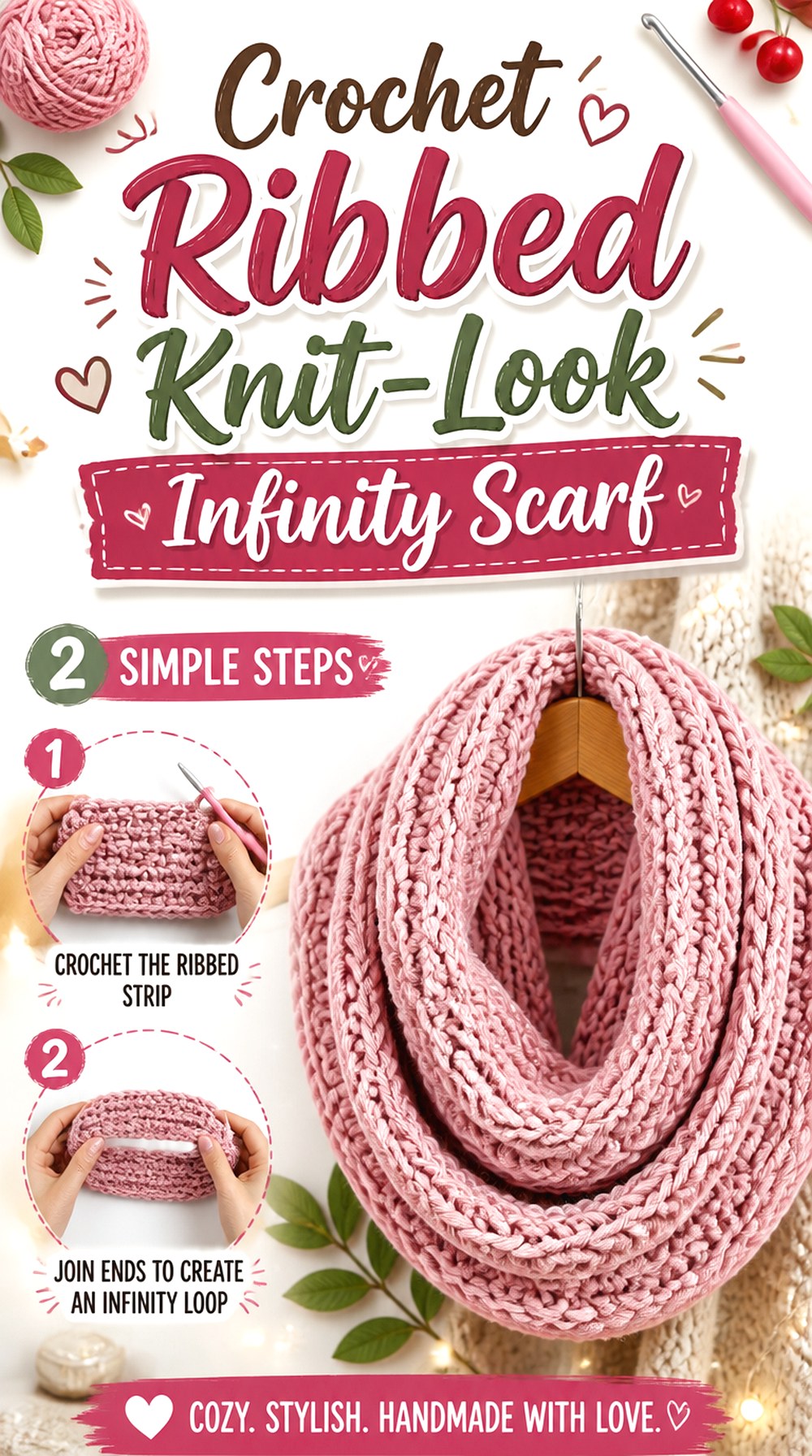
For a cleaner, more linear appearance, a knit-look crochet infinity scarf shifts attention from open spaces to repeated ridges. Amanda Love Santos describes her finished scarf as chunky with a knit-scarf look, making this a useful direction for readers who prefer simple visual structure over decorative lace.
Ribbed fabric is particularly effective in solid or restrained colors because light and shadow across the ridges become part of the design. The main decision is how much flexibility you want. A scarf that looks pleasantly structured when flat still needs enough movement to curve, overlap, and settle naturally after it is looped around the neck.
A Knit-Look Texture Benefits From Visible Stitch Definition
Highly textured ribbing can disappear in very fuzzy or heavily variegated yarn. If the raised lines are the feature that attracts you to this scarf, a yarn that lets individual ridges remain visible will usually communicate the design more clearly.
That does not mean the yarn needs to be completely smooth. The useful checkpoint is whether you can still see the ribbed structure after making a small sample and gently relaxing the fabric.
Too Much Firmness Can Fight the Double Wrap
A ribbed infinity scarf can look beautifully defined while still needing enough flexibility to bend around the neck. Amanda Love Santos specifically notes that overly tight crochet can make the scarf shorter than intended, which reinforces the importance of watching tension in this style.
When adapting a ribbed scarf, compare the developing fabric in a curved position rather than judging it only while it lies flat. A stiff rectangle may become awkward once it has to form two overlapping loops.
Solid Color and Texture Can Do the Same Visual Job
Complex color changes are not necessary when strong ribbing already provides contrast. A restrained color lets the shadows between ridges define the surface, while multicolored yarn can make those lines less dominant.
Decide which feature should lead before buying yarn. If texture is the priority, keep the color treatment relatively quiet. If the yarn itself has dramatic changes, consider whether a less visually assertive stitch pattern might display it more effectively.
Original Tutorial and Creator Credit
Creator: Amanda Love Santos
3. Crochet Planned Pooling Argyle Infinity Scarf

Planned pooling turns the yarn’s color sequence into the main design element. Yarnspirations’ infinity scarf tutorial uses the technique to create an argyle-like patterned surface from variegated yarn rather than relying on random color placement.
This is a very different project choice from simply selecting a multicolored yarn for an ordinary scarf. The color repeat and crochet tension have to cooperate for the visual pattern to develop consistently. It suits readers who enjoy watching color placement emerge and who are willing to pay closer attention to the relationship between their yarn and their stitches.
Color-Repeat Consistency Matters More Here
With ordinary variegated crochet, a shift in color placement may simply create a different stripe or patch. Planned pooling is less forgiving because the relationship between successive color sections is what produces the recognizable design.
Before substituting yarn, confirm that the new yarn has a repeat suitable for planned pooling rather than assuming any multicolor skein will produce the same effect. A beautiful yarn can still be a poor match for this particular technique.
Circumference and Pattern Placement Need to Work Together
An infinity scarf eventually becomes a loop, so the beginning and end of the patterned fabric meet visually. Even when you follow the creator’s construction, pay attention to how the color design looks near that meeting point.
If you change the scarf’s length, do not think only about fit. You may also alter where the color sequence ends. That means a sizing adjustment can become a design adjustment, which is one reason to preview the developing pattern before making major changes.
Let the Argyle Effect Carry the Design
Planned pooling already creates strong visual movement. Additional decorative borders, multiple competing textures, or unrelated color accents can make the scarf feel busier than intended.
If the pooling effect is your reason for choosing this project, give it enough visual space to read clearly. A straightforward finishing treatment can keep attention on the patterned yarn arrangement rather than adding another focal point.
Original Tutorial and Creator Credit
Creator: Yarnspirations
4. Crochet Butterfly Stitch Infinity Cowl

The butterfly-stitch option brings a decorative motif into a compact neck accessory. The Crochet Crowd’s tutorial specifically uses the Butterfly Stitch in an infinity cowl, creating a stronger motif-based surface than the plain chunky and ribbed options in this collection.
This design is worth considering when you want the stitch pattern to remain noticeable even after the scarf bunches around the neck. The repeated motif supplies visual detail without turning the accessory into a highly open lace piece. Because the scarf is worn close to other clothing, think about how much surface texture you want against coats, sweaters, jewelry, and long hair.
Motif Spacing Changes the Visual Density
A recognizable stitch motif needs enough definition to remain visible after the scarf is folded or gathered. Yarn with extreme fuzz or very busy color changes may soften the butterfly shapes, while clearer stitch definition can make the repeat easier to see.
Before changing materials, look at the finished tutorial piece and decide whether the motif itself or the overall color is what attracts you. That distinction should guide the yarn substitution.
Decorative Openings Can Affect Everyday Wear
Textured and partially open stitch patterns can interact differently with jewelry, bag hardware, or exposed zippers than dense fabric. That does not make them impractical, but it is worth noticing where the larger spaces sit once the cowl is worn.
If you frequently wear necklaces or coats with prominent hardware, check the finished fabric for openings that might catch. For uncomplicated layering, a smoother outer surface may be preferable.
Original Tutorial and Creator Credit
Creator: The Crochet Crowd
5. Crochet Adult and Child Infinity Scarf

Not every infinity scarf needs to be planned as a single adult size. Jayda InStitches’ Hot Chocolate Infinity Scarf tutorial specifically presents versions for adults and children, making it useful when your main concern is understanding how the proportions should change between wearers rather than simply changing yarn color.
The tutorial also centers on one yarn cake and a large crochet hook. Instead of assuming a reduced adult scarf automatically becomes a good child version, pay attention to both circumference and width. A scarf can be shorter yet still feel disproportionately bulky if the depth remains unchanged.
Child Proportions Need More Than a Shorter Loop
When adapting wearable accessories for smaller bodies, circumference is only one part of the silhouette. A very wide scarf can create too much fabric around a smaller neck even if its overall loop length has been reduced.
Use the creator’s child-specific guidance rather than scaling dimensions by guesswork. If you substitute yarn, reassess the resulting thickness as well, since a denser or loftier fabric changes the amount of bulk.
A Large Hook Can Change Drape as Much as Speed
Jayda InStitches highlights the use of a large crochet hook in the project. A larger hook can help produce more openness and movement with compatible yarn, but copying only the hook size while changing the yarn may not recreate the same fabric.
Judge substitutions by the sample they produce. If the scarf feels rigid, simply matching the tutorial’s hook number is not enough evidence that the new yarn-and-hook combination behaves correctly.
Cake Yarn Makes Color Placement Part of the Planning
When using yarn with built-in color changes, the scarf’s circumference and width influence where those sections appear in the finished accessory. A change that looks dramatic while the scarf lies flat may become much less obvious once it is doubled and gathered.
Before adding manual color changes, see what the yarn is already doing. The simplest version can often make better use of long transitions because the crochet texture and the yarn are not competing for attention.
Original Tutorial and Creator Credit
Creator: Jayda InStitches
6. Crochet Fine Yarn Fan Lace Infinity Scarf

Fiber Flux’s Berry Smoothie Cowl takes the opposite material direction from a bulky winter scarf. The design uses fine yarn and repeated fan shapes to create a lighter, more delicate infinity loop that can be worn long or wrapped again around the neck.
That makes it a useful option when you like the continuous-loop format but do not want the visual weight of thick yarn. The open fan structure also gives the scarf a more decorative character, so it can work as part of an outfit rather than functioning only as a heavy cold-weather layer.
Fine Yarn Keeps Repeated Fans From Becoming Heavy
A stitch pattern with multiple stitches gathered into decorative groups naturally creates concentrated areas of fabric. Using finer yarn keeps those repeated fans from accumulating the same bulk they would have in a much thicker material.
If you substitute a heavier yarn, expect more than a simple increase in scale. The scarf may become warmer, wider-looking, and less fluid. Sampling one fan repeat can quickly show whether the new fabric still has the lightness that attracted you to the design.
Blocking Can Make Openwork Easier to Read
Open crochet often looks less orderly immediately after it leaves the hook. Appropriate blocking for the chosen fiber can help the spaces and repeated shapes settle into a clearer arrangement.
The goal is not to force the scarf into an unnaturally rigid form. Instead, compare the relaxed fabric with the appearance you want and follow the yarn’s care instructions. Fibers respond differently to water, heat, and handling, so do not assume one blocking method suits every substitution.
Decide Whether You Want One Long Loop or Two Layers
Fiber Flux describes the finished piece as wearable either in one long loop or wrapped twice like a cowl. Those two arrangements display the fan pattern differently.
A single loop emphasizes length and lets more of the lace remain visible. Doubling it creates greater density around the neck and overlaps the motifs. If the decorative stitch is your main priority, judge the scarf in the wearing position you expect to use most often.
Original Tutorial and Creator Credit
Creator: Fiber Flux
7. Crochet Braided Hairpin Lace Infinity Scarf

Hairpin lace immediately separates this scarf from standard hook-only infinity scarf projects. B.Hooked Crochet’s tutorial uses a hairpin lace loom together with a crochet hook to create long open loops that are assembled into a braided-looking infinity scarf.
Choose this direction because you want the technique and structure, not because you simply need another circular scarf. The finished surface has larger, more deliberate openings and an interlaced appearance that ordinary dense crochet does not reproduce. It is also the project in this collection where access to a specialty tool becomes part of the decision.
Loom Spacing Sets the Scale of the Lace
The width of a hairpin lace loom influences the length of the loops and therefore the visual scale of the strip. Changing the setup can alter the finished appearance even when the yarn itself remains the same.
Before experimenting with a different loom width, understand the creator’s assembly method and how the strips relate to one another. The project depends on more than producing attractive individual loops; those loops ultimately have to cooperate during joining.
Even Braiding Keeps the Finished Loop Balanced
The striking feature of this scarf comes from the way the hairpin strips interact. If some areas are pulled much more tightly than others during assembly, the visual rhythm can become uneven and the scarf may not settle as smoothly.
Lay the work out periodically instead of evaluating only the few loops currently in your hands. This makes it easier to notice whether one section is contracting or whether the braid is beginning to skew.
Yarn Halo Can Either Soften or Hide the Structure
A yarn with some halo can give hairpin lace a soft, blended appearance, but excessive fuzz can obscure the open loops and interlaced construction that make the technique distinctive.
If you want the architecture to remain obvious, test whether the yarn lets you see individual loops at normal viewing distance. If you prefer a softer effect, some halo may be desirable. The important point is choosing intentionally rather than discovering after assembly that the feature you wanted has disappeared.
This Project Requires a Specialty Tool
Unlike the standard infinity scarves in this roundup, this construction calls for a hairpin lace loom in addition to a crochet hook. B.Hooked’s accompanying project information confirms the loom-based construction.
That extra tool is worthwhile if learning hairpin lace is part of your goal. If you only want a quick conventional scarf, however, one of the hook-only projects will require less setup.
Original Tutorial and Creator Credit
Creator: B.Hooked Crochet
8. Crochet Möbius Twist Infinity Scarf

A Möbius scarf is not simply an ordinary infinity scarf twisted after you put it on. Its twist is part of the actual loop construction. Häkelwelt’s tutorial demonstrates an infinity scarf built around a Möbius loop, making this the clearest choice in the roundup when construction geometry is the feature you want to explore.
The resulting twist gives the fabric a natural change in orientation as it travels around the loop. It can make a relatively straightforward stitch pattern visually interesting without requiring separate motifs, color pooling, or specialty lace strips. The crucial checkpoint comes early: the twist needs to be intentional and correctly positioned.
The Twist Is Structural, Not Just a Styling Trick
An ordinary infinity scarf can be crossed before it is placed over the head, but that does not make its construction Möbius. In this project, the twist belongs to the continuous crocheted form itself.
That difference matters if you are choosing the tutorial specifically to learn a new construction method. Follow the creator’s setup closely instead of adapting the beginning from a standard circular scarf and adding an arbitrary twist later.
Check the Foundation Before Building More Fabric
A misplaced or accidental twist in a normal circular project is usually a problem; in a Möbius scarf, a specific twist is intentional. That makes the early setup easy to misunderstand.
Inspect the developing loop before investing substantial work in additional width. Confirm that the fabric follows the same orientation shown by the creator. Fixing a foundational problem early is far easier than discovering it after the scarf has become wide.
Drape Helps the Möbius Shape Read Clearly
The twist becomes easier to see when the fabric can curve and fold naturally. Extremely rigid crochet may still form the correct geometry, but it can make the scarf feel more sculptural and less fluid around the neck.
When considering yarn substitutions, look for a balance between enough stitch definition to see the construction and enough flexibility for the loop to settle. A small fabric sample can tell you more about that balance than yarn thickness alone.
Original Tutorial and Creator Credit
Creator: Häkelwelt
Which Crochet Infinity Scarf Style Should You Choose?
For maximum winter volume, start with the super-bulky double-wrap option. The ribbed scarf is a better fit when you want clean texture without lace, while the butterfly stitch adds a more decorative surface.
Choose planned pooling when color placement is the challenge you want to explore. The adult-and-child design is more useful when you are comparing proportions for different wearers. Fiber Flux’s fan-lace version suits a lighter, more decorative scarf.
The two most technique-driven choices are especially distinct. Hairpin lace introduces a loom and an assembled lace structure, while the Möbius scarf changes the geometry of the loop itself. Those projects make more sense when learning a different construction method is part of the appeal.
Conclusion
The most useful way to choose among these eight crochet infinity scarf ideas is to decide what should define the finished piece. Pick super-bulky fabric for substantial volume, ribbing for strong linear texture, planned pooling for controlled color, butterfly or fan stitches for decorative detail, or the adult-and-child option when proportion is the main concern.
Hairpin lace and Möbius construction offer the biggest departure from a conventional crocheted loop, so they are strong choices when you want to explore a different technique. Once you have selected the shape and fabric behavior you prefer, use the original tutorials for exact construction details and verify any measurements or materials before making significant substitutions.
Frequently Asked Questions
How long should a crochet infinity scarf be?
There is no single ideal circumference because the answer depends on whether you want a close cowl, a long hanging loop, or enough length for multiple wraps. Yarn thickness also changes how a given circumference feels around the neck. Use the tutorial’s finished dimensions when supplied and compare them with an infinity scarf you already find comfortable before changing the length.
Can I use a different yarn weight for an infinity scarf tutorial?
Sometimes, but changing yarn weight can alter width, circumference, drape, stitch definition, and overall bulk at the same time. This is especially noticeable when converting a fine lace scarf to bulky yarn or doing the reverse. Make a sample first and check the creator’s gauge or sizing information where available rather than assuming the original measurements will remain unchanged.
What is the difference between a crochet cowl and an infinity scarf?
The terms are sometimes used loosely, but a cowl generally sits closer to the neck, while an infinity scarf commonly has a longer closed circumference that allows additional wrapping. Some tutorials offer both possibilities. Focus on the finished circumference and wearing style rather than relying only on the project name when deciding whether a design suits you.
How can I stop a crochet infinity scarf from feeling too bulky?
Look at both yarn thickness and scarf width. A wide strip of super-bulky crochet can become very substantial once doubled around the neck. Reducing width may help more than simply shortening the scarf. You can also choose a lighter yarn or a more open stitch pattern, but remember that those substitutions may change the proportions of the original design.
Is planned pooling the same as using ordinary variegated yarn?
No. Planned pooling intentionally coordinates the yarn’s repeating color sequence with the crochet fabric so a recognizable color pattern develops. Ordinary variegated yarn can be crocheted without controlling where each color lands. If you want the argyle-style appearance of a planned-pooling scarf, confirm that your chosen yarn and the tutorial are suitable for that technique.
Do I need special equipment to crochet every infinity scarf here?
No. Most of these ideas use standard crochet tools appropriate to the yarn selected. The hairpin-lace infinity scarf is the major exception because its construction uses a hairpin lace loom as well as a crochet hook. The Möbius option uses conventional crochet tools but introduces a different loop construction rather than a specialty loom.