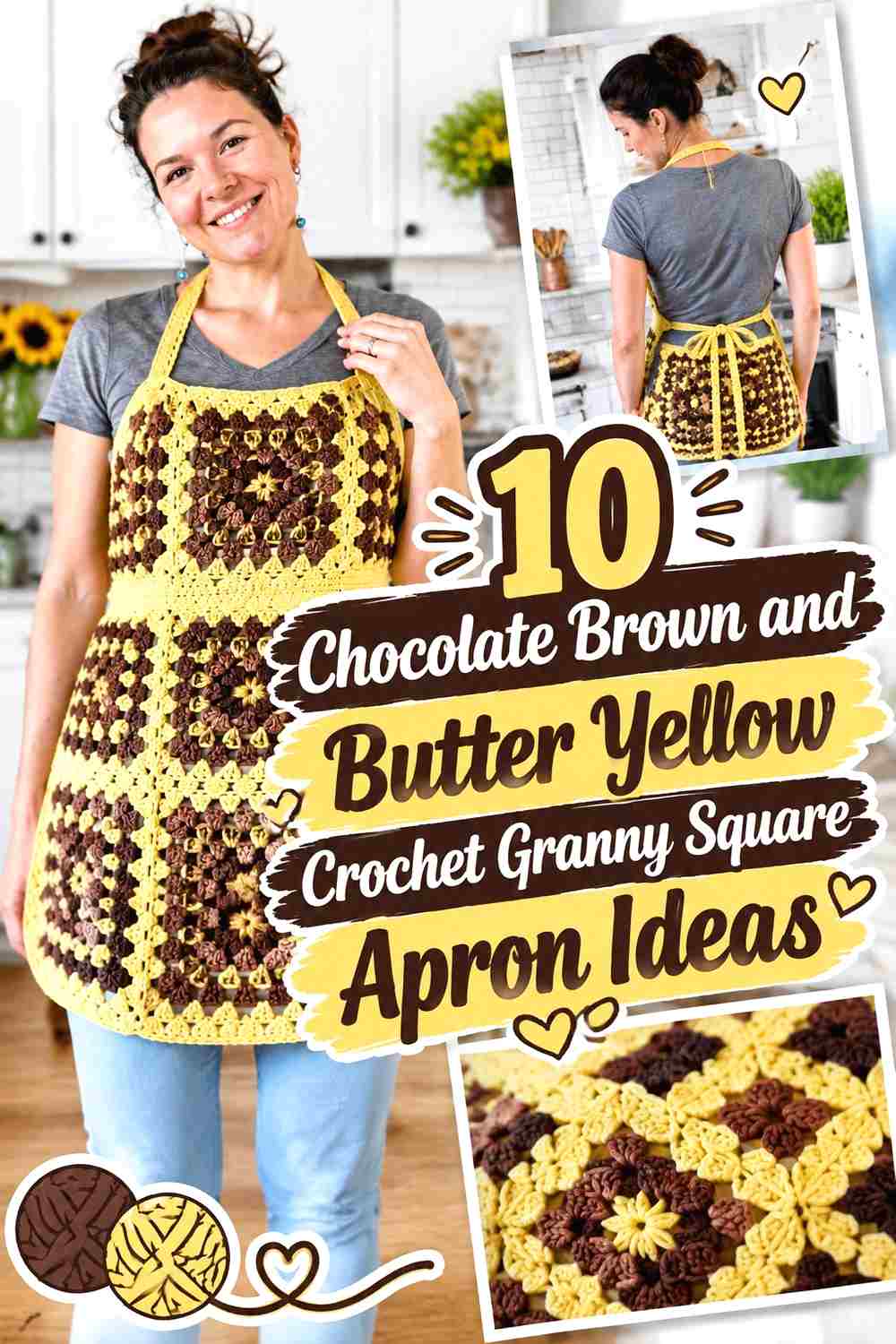

Chocolate brown and butter yellow give a crochet granny square apron a clear dark-and-light palette with plenty of room for controlled variation. Chocolate brown can ground the motif grid, while butter yellow can brighten centers, outer rounds, pockets, borders, or ties without needing to cover half of the apron.
An apron also has several natural color zones that are more useful than random striping. Depending on the construction, you can coordinate the upper section, main apron panel, waistline, pockets, side edges, lower border, and ties. The granny squares themselves add another level of control because their centers and outer rounds can reverse the same two colors.
The 10 ideas below use those areas differently. Two projects can use similar granny squares yet look substantially different because butter yellow moves from the motif centers to the joining, pocket, hem, or waist. The credited tutorials provide apron, granny-square, or joining construction references; the chocolate brown and butter yellow arrangements are independent color plans.
Quick List
- Chocolate Brown Center Crochet Granny Square Apron With Butter Yellow Frames
- Butter Yellow Center Crochet Granny Square Apron With Chocolate Brown Frames
- Alternating Chocolate Brown And Butter Yellow Crochet Granny Square Apron
- Chocolate Brown Crochet Granny Square Apron With Butter Yellow Joining
- Butter Yellow Crochet Granny Square Apron With Chocolate Brown Joining
- Chocolate Brown Crochet Granny Square Apron With Butter Yellow Waist And Ties
- Butter Yellow Crochet Granny Square Apron With Chocolate Brown Lower Border
- Chocolate Brown Crochet Granny Square Apron With Butter Yellow Pocket Motifs
- Chocolate Brown And Butter Yellow Crochet Granny Square Apron With Reversed Motifs
- Chocolate Brown Butter Yellow And Cream Crochet Granny Square Apron
Decide Whether Chocolate Brown or Butter Yellow Should Lead the Apron
Judge the palette across the complete apron rather than one square. A small butter yellow center repeated through every motif can become a strong visual pattern, while chocolate brown outer rounds can still make the finished apron predominantly dark.
Reversing the arrangement creates a lighter result because outer rounds occupy more surface. If butter yellow surrounds every chocolate brown center, the yellow can become the main field even when both shades appear in every square.
Use Chocolate Brown and Butter Yellow at Structural Apron Boundaries
The waistline, lower edge, side borders, and ties are natural places to repeat color without interrupting every motif. A chocolate brown waist can ground a butter-yellow-heavy panel, while butter yellow ties can connect lighter motif centers with the apron edges.
Consider all of these finishing areas together. Butter yellow at the waist, ties, pockets, and border can collectively become dominant even if chocolate brown covers most of the individual granny squares.
Plan Chocolate Brown and Butter Yellow Joins Before Making Every Square
A visible joining color can alter the entire motif grid. Butter yellow joining creates light divisions between chocolate-brown-heavy squares. Chocolate brown joining does the opposite, giving lighter motifs a strong framework.
Lay several finished squares side by side before deciding. The outer round and joining color need to work together because both affect how clearly each motif remains visible after assembly.
1. Chocolate Brown Center Crochet Granny Square Apron With Butter Yellow Frames
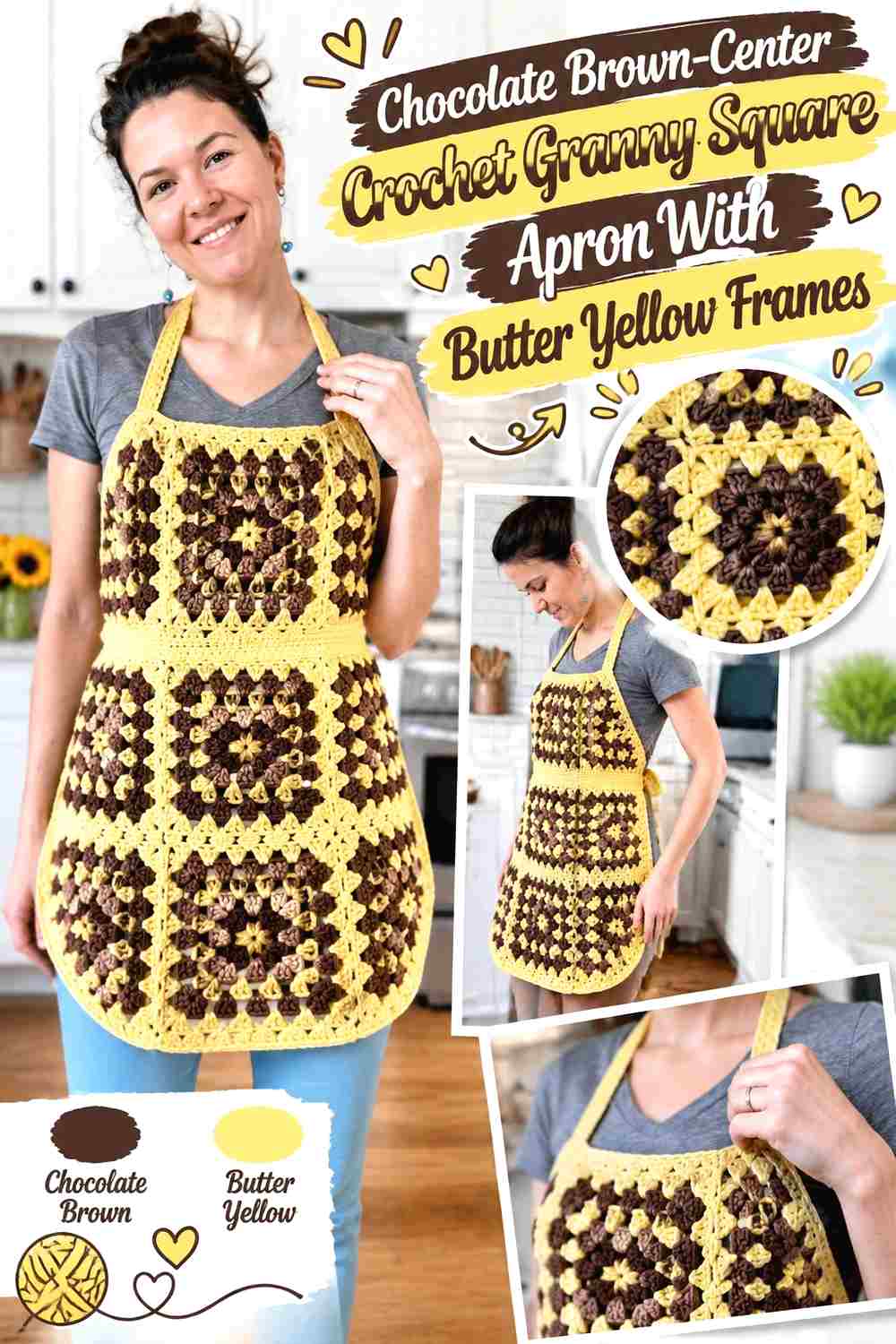
Begin each granny square in chocolate brown and move into butter yellow toward the outside. Repeated dark centers create focal points across the apron, while the lighter outer rounds keep those centers visually separated. An apron made from granny-square units gives this repeated center-and-frame treatment plenty of room to establish a clear pattern.
Chocolate Brown Centers Give the Granny Square Apron Visual Weight
Keep chocolate brown in the same central position throughout the main apron panel. Repetition creates an organized grid of dark focal points rather than isolated brown patches.
Butter Yellow Frames Separate Chocolate Brown Apron Motifs
Use butter yellow through the outer portion of each square when you want the individual motifs to remain obvious after joining. The lighter surrounding color prevents adjacent brown centers from visually merging.
Chocolate Brown Can Return Around Butter Yellow Apron Edges
If the completed motif panel becomes lighter than intended, use chocolate brown at the side or lower border. Repeating the darkest shade at the perimeter reconnects the edge with the square centers.
Creator Credit: Off the Beaten Hook
2. Butter Yellow Center Crochet Granny Square Apron With Chocolate Brown Frames
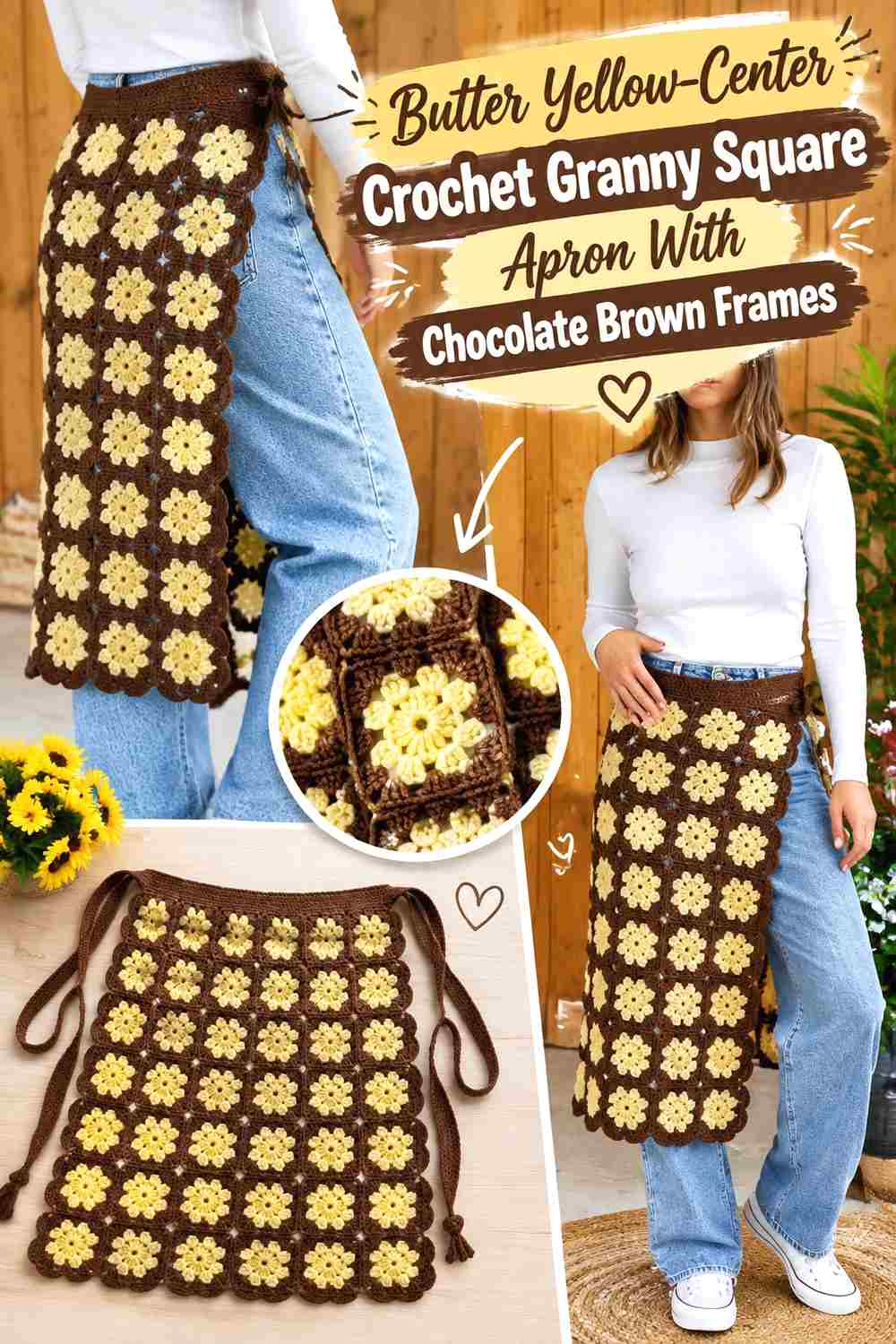
Reverse the first arrangement by putting butter yellow in each center and chocolate brown through the outer rounds. Because the darker shade occupies the larger portion of every motif, the finished apron remains strongly brown while yellow becomes a repeated highlight.
Butter Yellow Centers Brighten Chocolate Brown Granny Square Apron Motifs
Repeat the yellow centers consistently across the apron. Small light focal points can remain noticeable against the deeper outer rounds without requiring large yellow sections.
Chocolate Brown Frames Connect Butter Yellow Apron Centers
Finishing each motif in brown gives neighboring squares a common dark boundary. Once assembled, the apron can read as a chocolate brown field containing repeated butter yellow centers.
Butter Yellow Should Remain Large Enough Inside Chocolate Brown Squares
If each motif has several brown rounds, a very small yellow center may lose its importance. Extend butter yellow through another inner area when you want the light focal points to remain clearly visible.
Creator Credit: даша загоруйко
3. Alternating Chocolate Brown And Butter Yellow Crochet Granny Square Apron
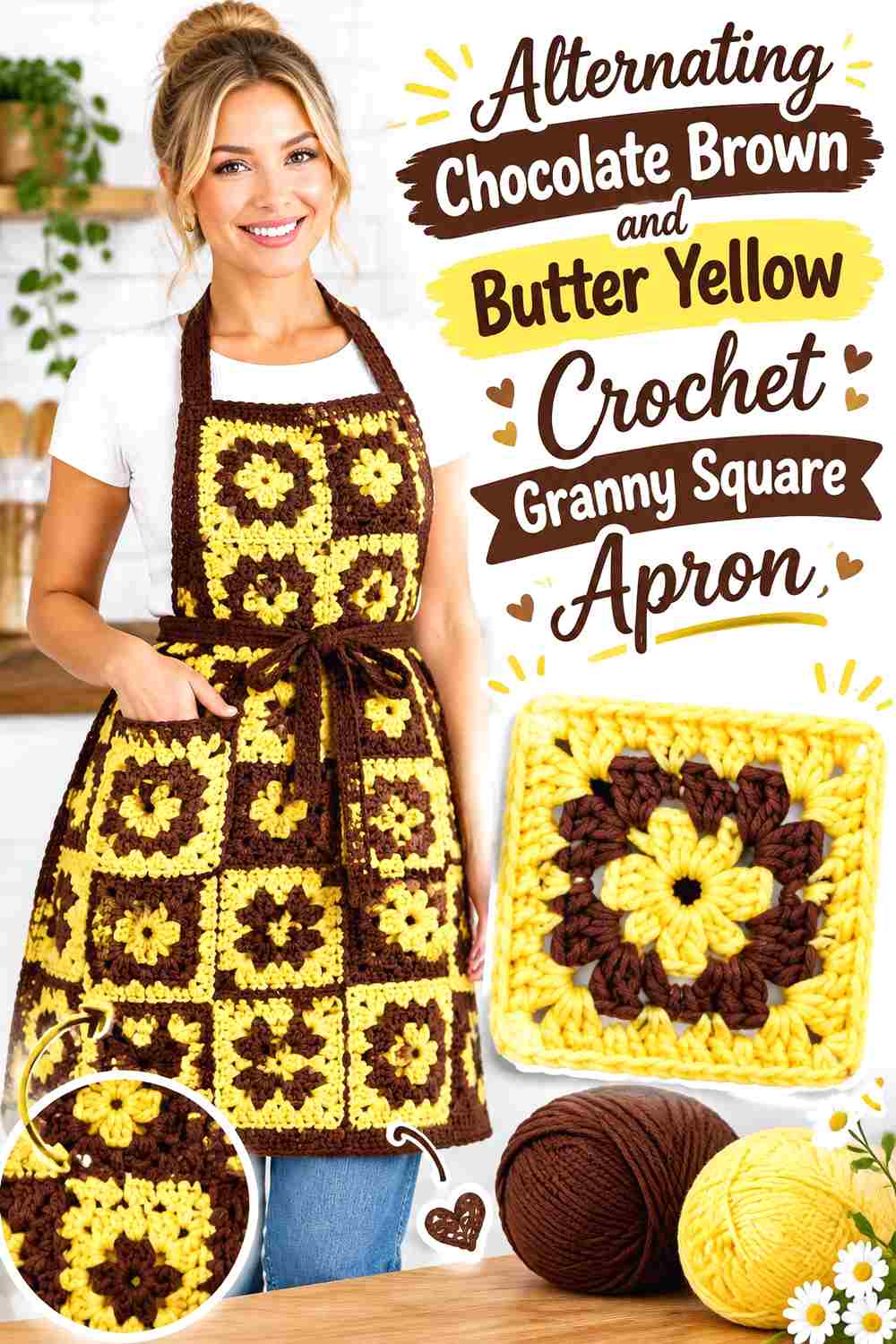
Create two versions of the same granny square: one chocolate-brown-dominant and one butter-yellow-dominant. Alternate them through the apron panel so the variation comes from color balance rather than unrelated motif constructions.
Chocolate Brown-Dominant Squares Can Alternate With Butter Yellow Apron Squares
Keep the underlying granny square consistent while reversing which color occupies the larger area. This produces a controlled checkerboard-like rhythm without introducing another hue.
Butter Yellow Squares Should Repeat Chocolate Brown Details
Include chocolate brown in the centers, outer rounds, or another consistent position within the yellow-heavy motifs. That repetition keeps the two square versions related.
Chocolate Brown and Butter Yellow Need a Planned Apron Sequence
Lay out the complete panel before joining. Check both the horizontal and vertical relationships so identical dominant squares do not accidentally cluster in one part of the apron.
Creator Credit: The Secret Yarnery
4. Chocolate Brown Crochet Granny Square Apron With Butter Yellow Joining
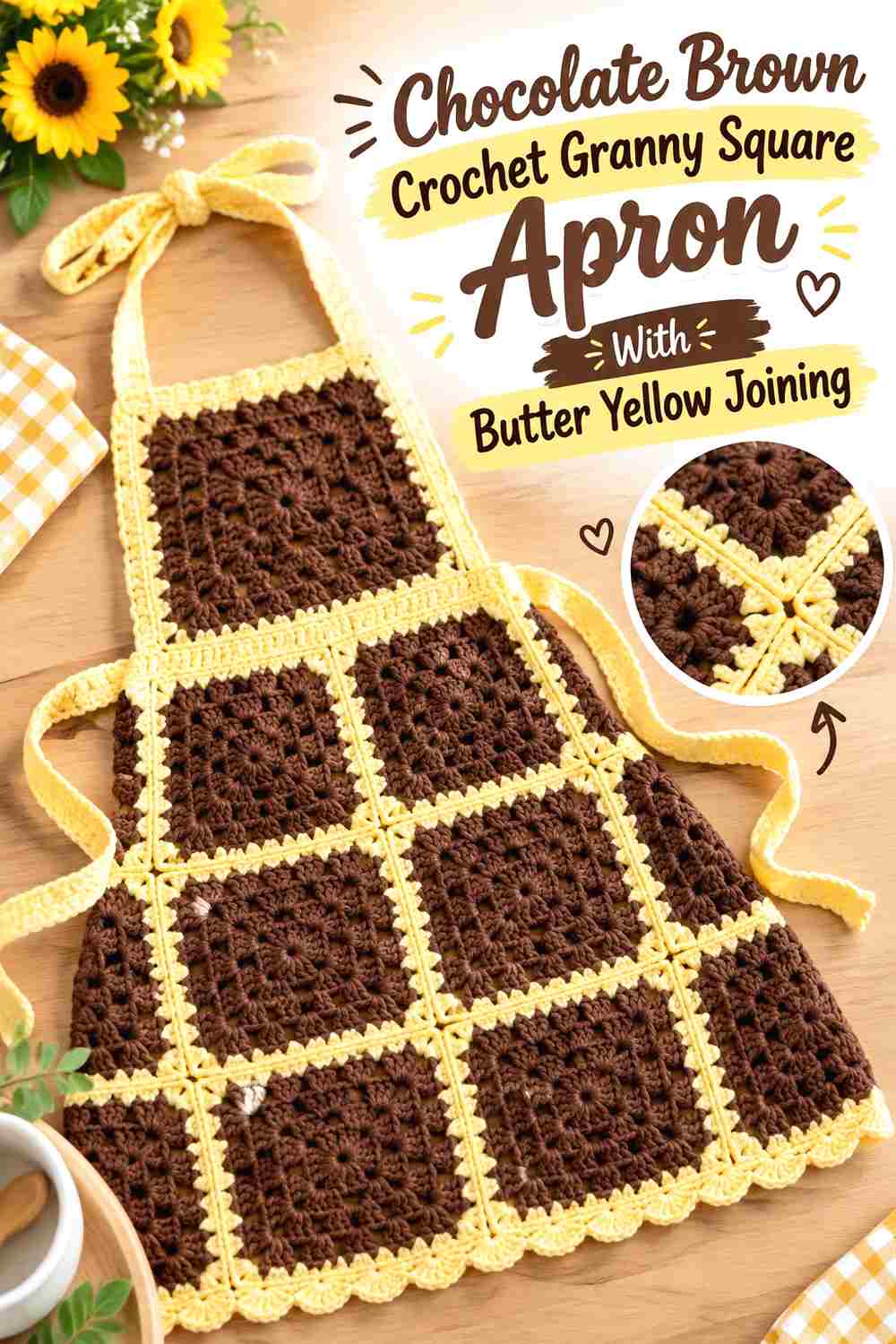
Keep the motifs predominantly chocolate brown and use butter yellow specifically at the joins. This makes the connecting lines part of the color design and allows the square grid to remain visible across a dark apron panel.
Chocolate Brown Can Fill Most of Each Granny Square Apron Motif
Use broad brown areas when you want the apron to have a grounded main field. Traditional granny clusters already provide internal pattern, so every round does not need a color change.
Butter Yellow Joining Can Outline Chocolate Brown Apron Squares
A visible yellow join places a light boundary between neighboring brown motifs. This is especially useful when all of the squares finish with the same chocolate brown outer round.
Chocolate Brown Should Remain Wider Than Butter Yellow Join Lines
Keep the joining treatment proportional to the squares. If the yellow connection becomes visually broad, the apron can shift from brown-dominant motifs to a yellow-grid design.
Creator Credit: Bella Coco
5. Butter Yellow Crochet Granny Square Apron With Chocolate Brown Joining
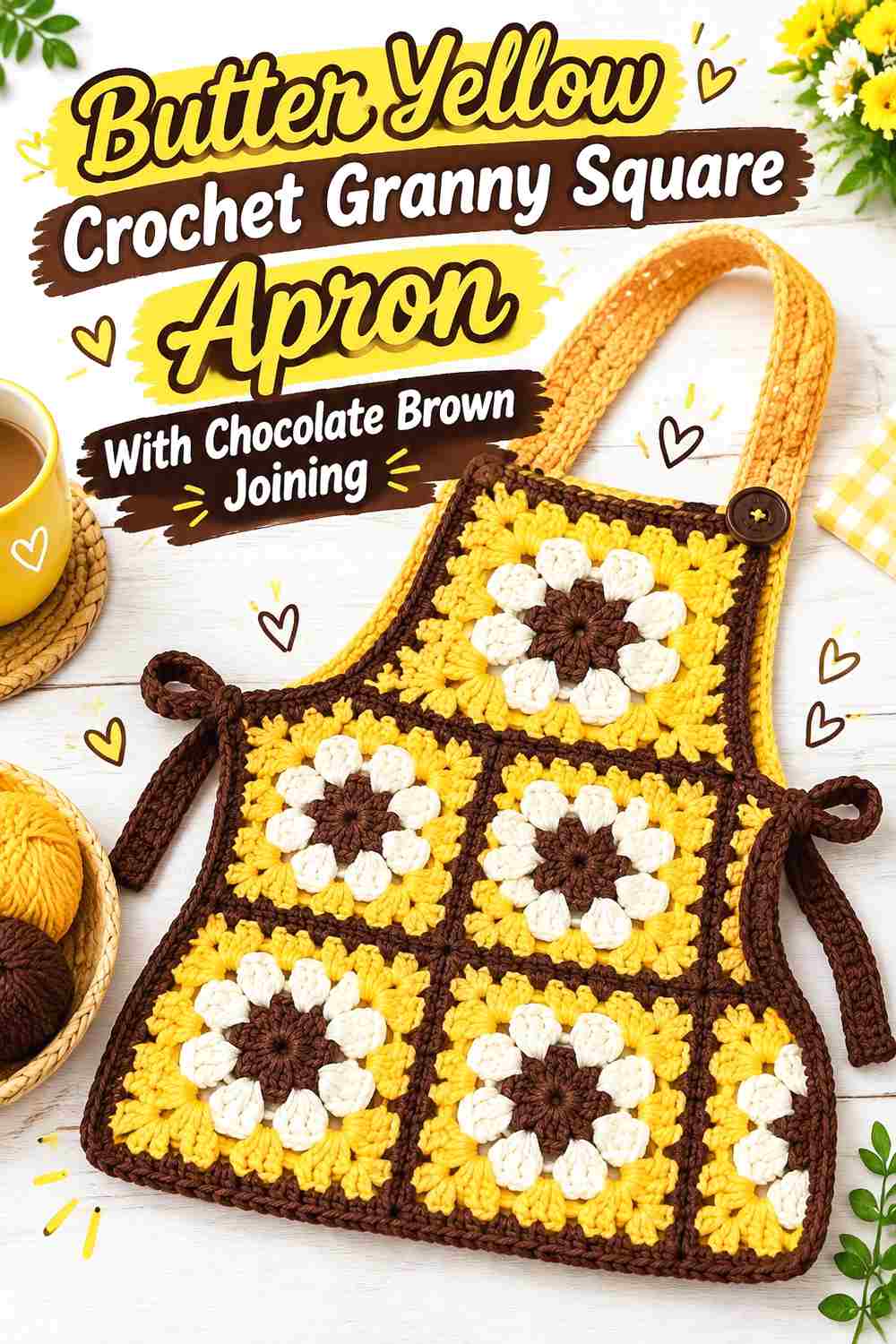
Make the motifs butter-yellow-heavy and connect them with chocolate brown. The darker joining lines organize the lighter squares and give the apron panel a stronger structural grid.
Butter Yellow Can Carry the Main Granny Square Apron Surface
Give yellow the largest areas of the motifs when you want a lighter overall apron. Keeping several rounds in the same shade also allows the granny texture to provide detail without constant color changes.
Chocolate Brown Joining Can Define Butter Yellow Apron Motifs
A dark join gives each light square a clear boundary. Because the join repeats across the entire panel, relatively narrow brown lines can still have significant visual weight.
Butter Yellow Should Remain Visible Beside Strong Chocolate Brown Joins
Avoid combining broad brown outer rounds with equally prominent brown joining when yellow should lead. Preserve enough uninterrupted butter yellow for the lighter color hierarchy to remain clear.
Creator Credit: Hooked by Robin
6. Chocolate Brown Crochet Granny Square Apron With Butter Yellow Waist And Ties
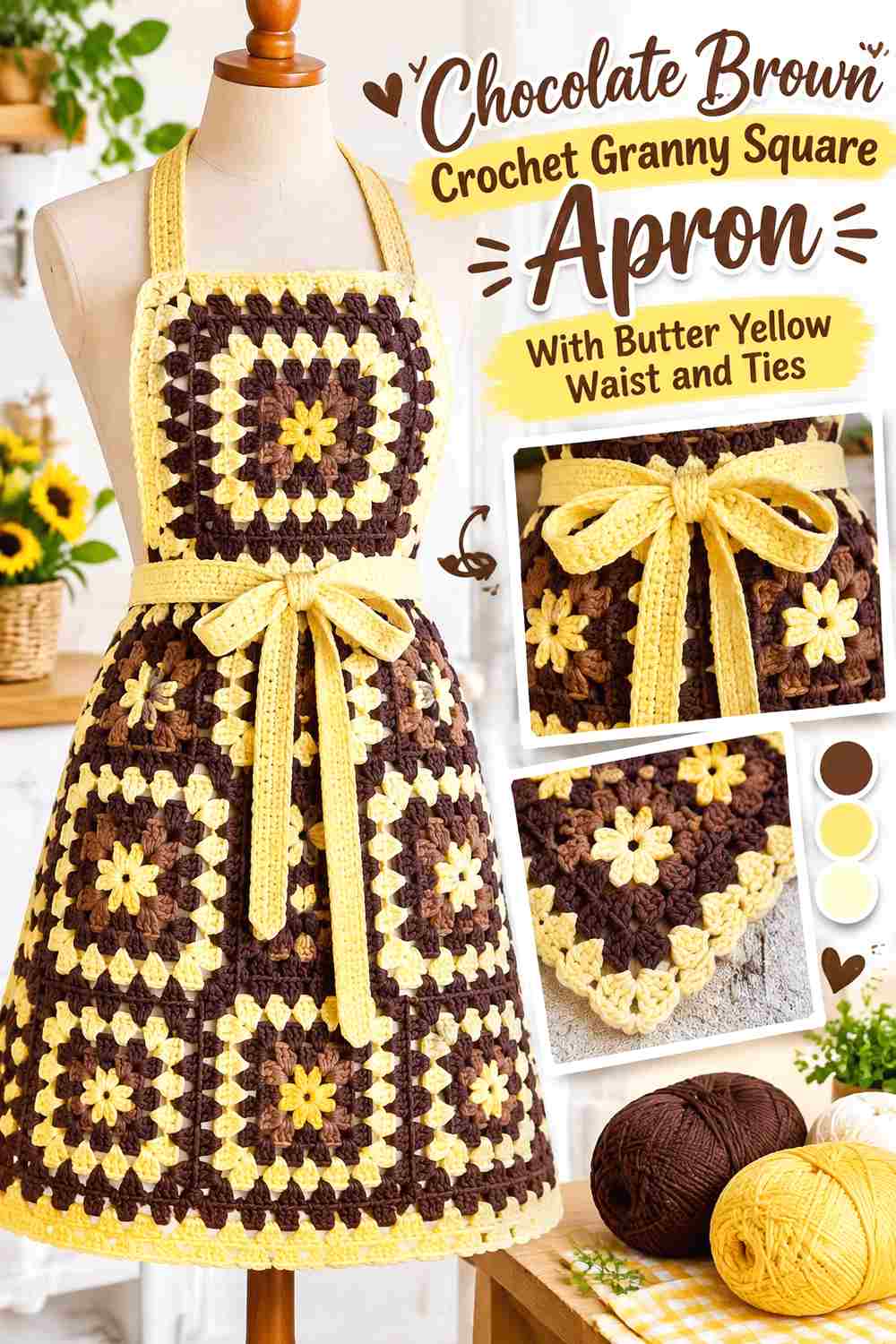
Keep the granny-square panel chocolate-brown-dominant and move most of the butter yellow to the waistline and ties. This gives the lighter shade a practical structural location instead of scattering it through every square.
Chocolate Brown Can Keep the Granny Square Apron Panel Grounded
Use chocolate brown through the largest motif areas so the main panel remains clearly darker than its finishing details.
Butter Yellow Can Define the Chocolate Brown Apron Waist
A continuous yellow waistline creates a strong horizontal break across the motif grid. Because this area spans much of the apron width, the yellow can remain relatively restrained elsewhere.
Chocolate Brown Can Repeat at the Ends of Butter Yellow Apron Ties
If the ties are strongly yellow, a small return of chocolate brown can connect them with the main panel. Alternatively, retain yellow alone when you want the waist and ties to function as one uninterrupted accent.
Creator Credit: Ophelia Talks Crochet
7. Butter Yellow Crochet Granny Square Apron With Chocolate Brown Lower Border
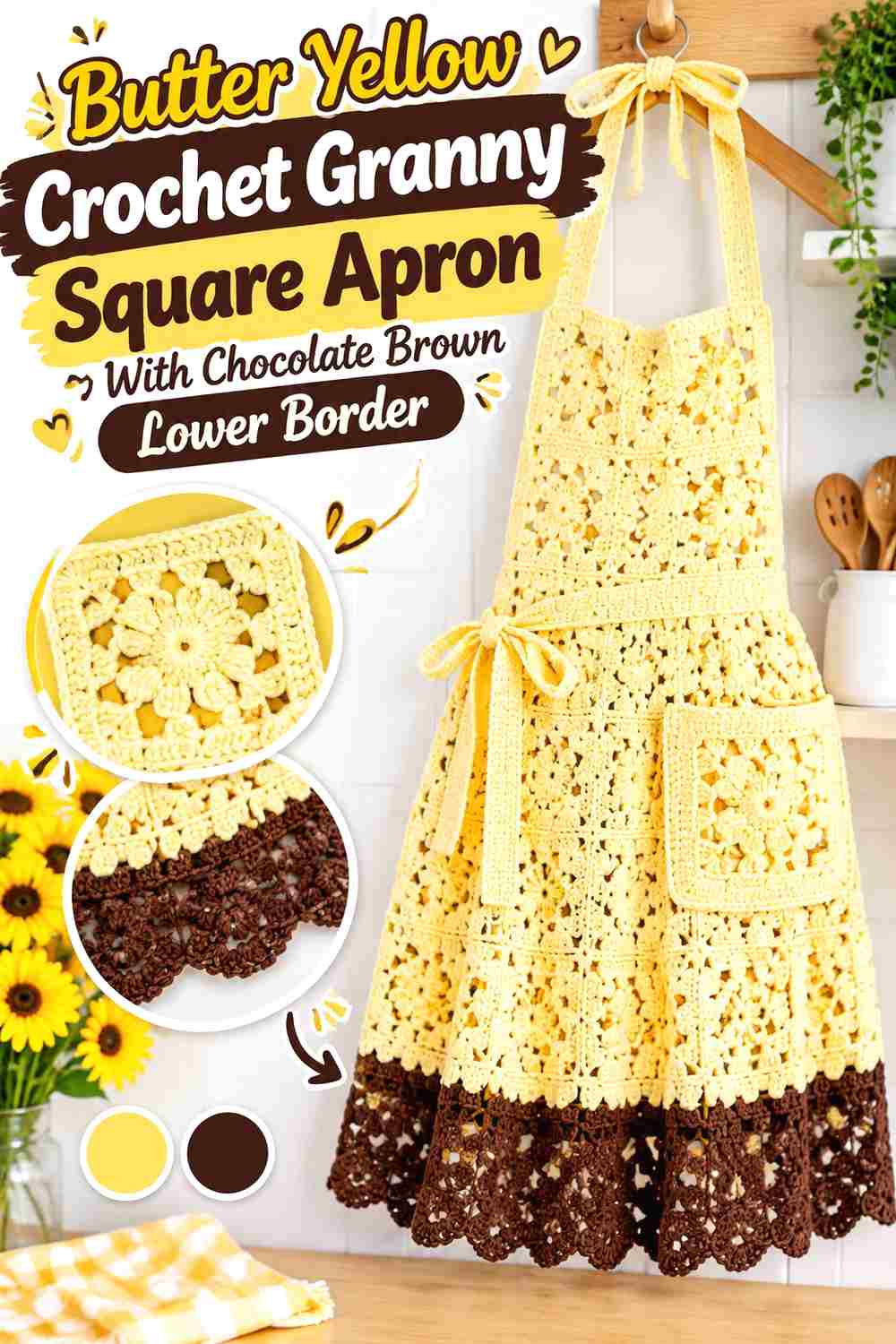
Use butter yellow through most of the visible motif panel and concentrate chocolate brown along the bottom. The deeper border gives the lighter squares a defined endpoint and shifts visual weight toward the lower edge.
Butter Yellow Can Keep the Granny Square Apron Panel Light
Repeat yellow through the larger portions of each motif so the main field remains visibly lighter even after the dark border is added.
Chocolate Brown Can Anchor the Butter Yellow Apron Hem
A continuous brown lower edge creates a clear boundary below the granny squares. This is more purposeful than scattering small brown accents randomly across the panel.
Butter Yellow Should Repeat Near a Wide Chocolate Brown Border
If the lower border becomes substantial, bring butter yellow into a finishing detail or the lowest motif round. This prevents the brown hem from looking disconnected from the apron above.
Creator Credit: HappyBerry Crochet
8. Chocolate Brown Crochet Granny Square Apron With Butter Yellow Pocket Motifs
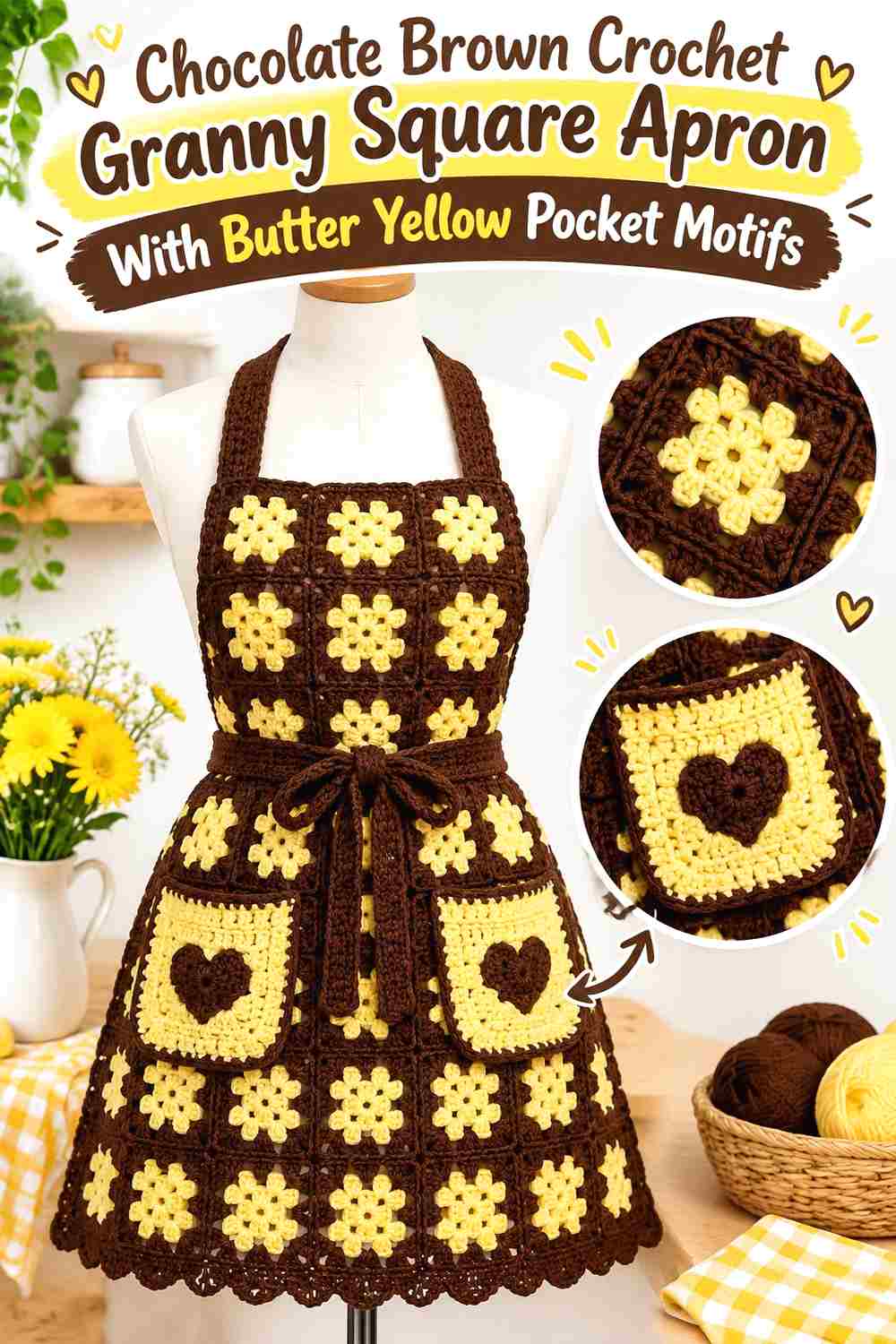
Keep the main apron panel chocolate-brown-heavy and use butter yellow more prominently in the pocket area. The pockets then become focal motifs without requiring the entire apron to alternate between equal amounts of both shades.
Chocolate Brown Can Create a Consistent Field Behind Butter Yellow Pockets
Use similar brown placement across the main apron squares so the brighter pocket motifs have a stable background.
Butter Yellow Pocket Squares Can Stand Out Against Chocolate Brown
Give the pocket motifs substantially more yellow than their surrounding squares. A meaningful difference in color proportion makes the pockets look intentional rather than accidentally mismatched.
Chocolate Brown Should Repeat Inside Butter Yellow Pocket Motifs
Include brown in the pocket centers, frames, or another consistent area. Repeating the main color helps the brighter pockets remain connected to the rest of the apron.
Creator Credit: Jayda InStitches
9. Chocolate Brown And Butter Yellow Crochet Granny Square Apron With Reversed Motifs
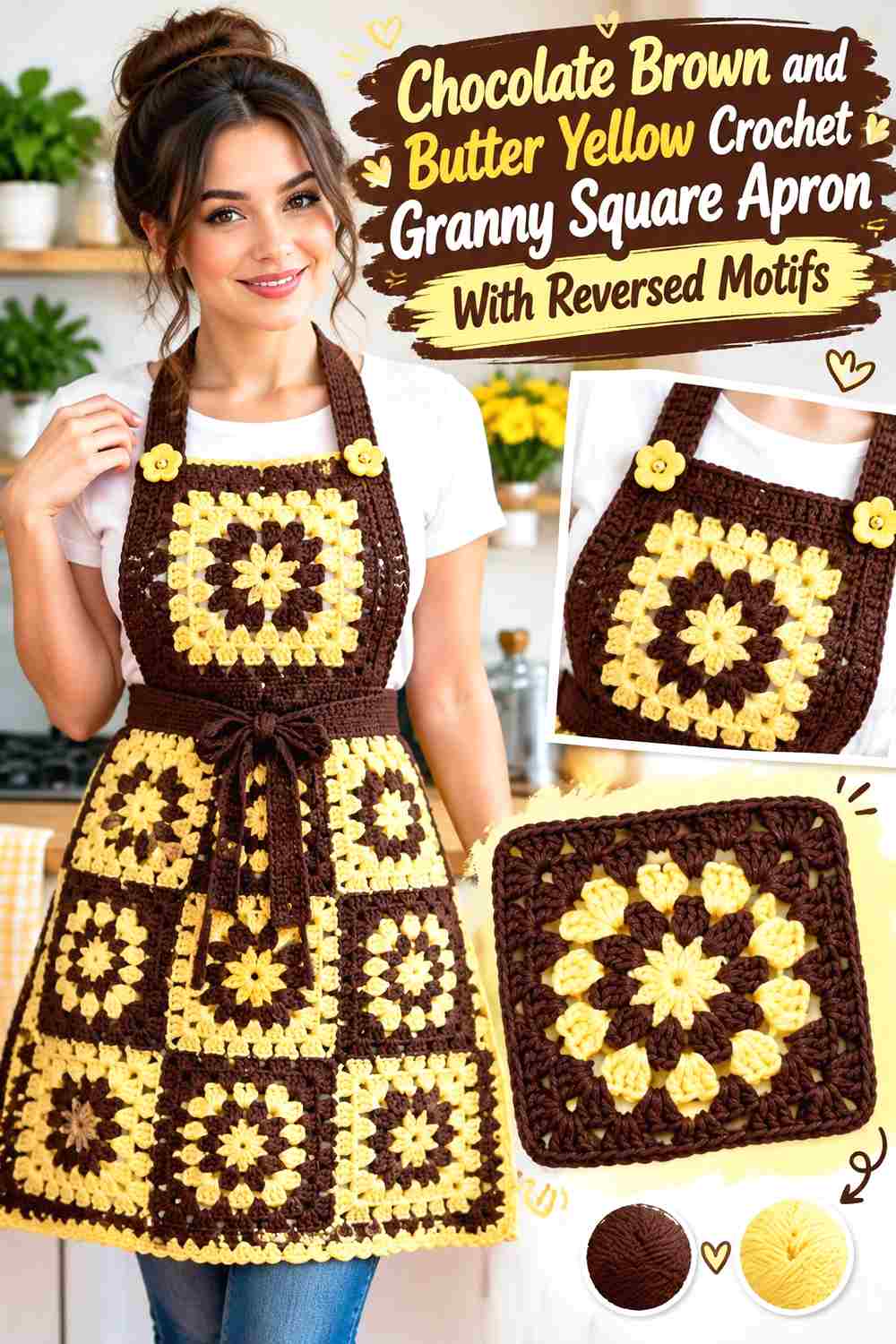
Make two matching motifs with opposite color order. One can begin chocolate brown and finish butter yellow, while the other begins butter yellow and finishes chocolate brown. This creates variety using only the original pair.
Chocolate Brown Centers Can Alternate With Butter Yellow Apron Centers
Changing the center color establishes variation immediately. Repeat the reversal in a deliberate sequence instead of distributing the motifs randomly.
Butter Yellow Outer Rounds Can Balance Chocolate Brown Outer Rounds
Outer rounds occupy more surface than centers, so check their distribution separately. An apron with too many yellow-framed motifs in one area can appear visually uneven even when the centers alternate correctly.
Chocolate Brown and Butter Yellow Reversed Motifs Need a Consistent Join
Choose one joining color after laying out the complete apron. A consistent join can unify motifs whose outer rounds intentionally alternate.
Creator Credit: Crochet with Clare
10. Chocolate Brown Butter Yellow And Cream Crochet Granny Square Apron
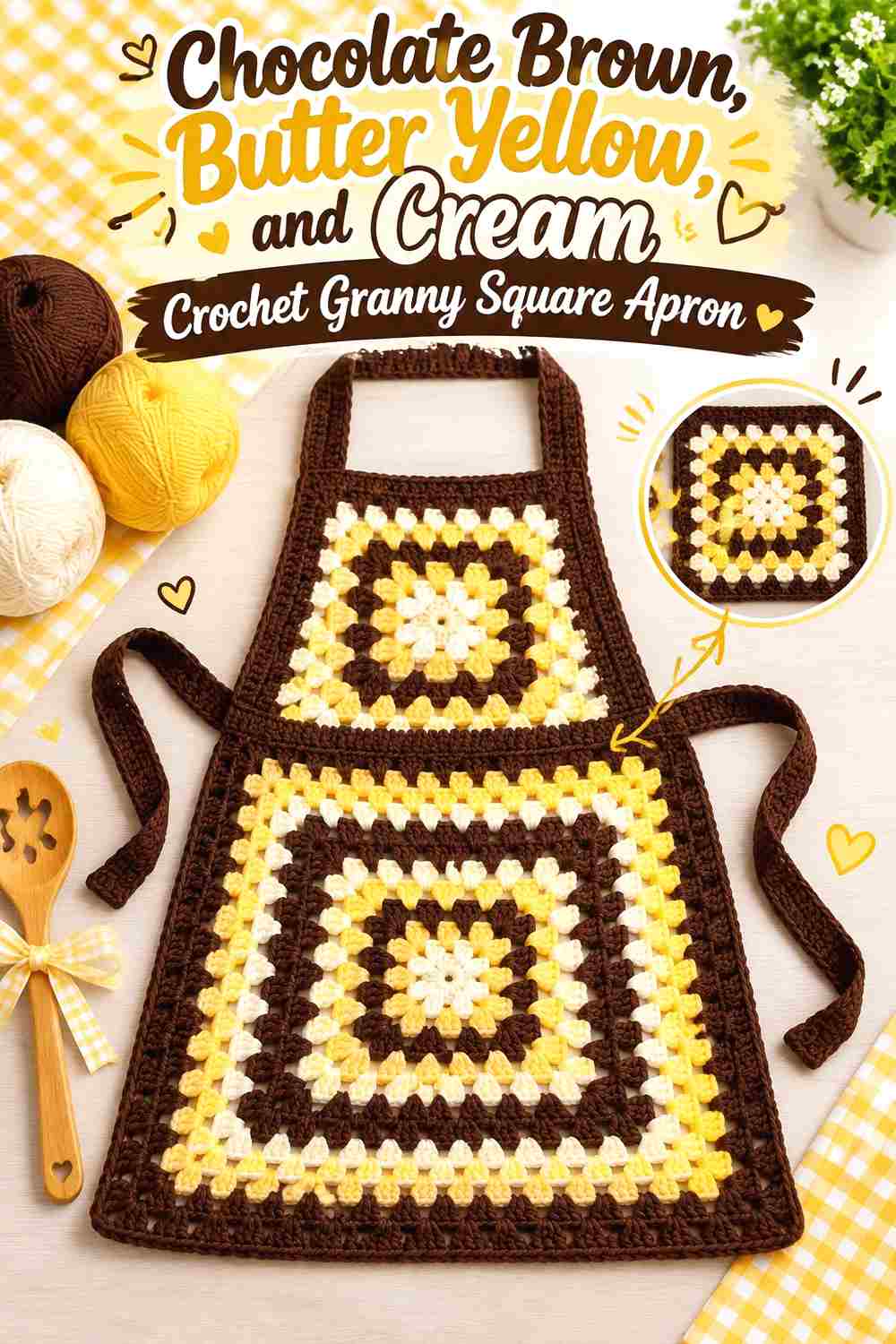
Cream adds a much lighter neutral without competing with chocolate brown or butter yellow for the same role. Keep chocolate brown as the darkest anchor, butter yellow as the warm focal shade, and cream as controlled separation.
Chocolate Brown Should Remain the Dark Anchor Beside Butter Yellow and Cream
Repeat brown in an important location such as the outer rounds, joining, waistband, or lower border. This keeps the apron grounded once two lighter shades are present.
Cream Can Separate Chocolate Brown and Butter Yellow Granny Square Rounds
Use cream between the two core colors when a lighter boundary would help individual rounds remain distinct. This is particularly useful in motifs containing several color changes.
Butter Yellow Should Stay More Prominent Than Cream in the Chocolate Brown Apron
If butter yellow is meant to remain the defining accent, give it a repeated focal location such as motif centers, pockets, or the waistline. Use cream more selectively so the apron does not become a brown-and-cream design with incidental yellow.
Creator Credit: Bag-O-Day Crochet
Comparing the 10 Chocolate Brown and Butter Yellow Granny Square Apron Directions
The chocolate-brown-center and butter-yellow-center designs change the focal point inside every motif, while changing the outer rounds has a larger effect on overall color dominance because those rounds occupy more surface.
The alternating and reversed-motif versions distribute both colors throughout the panel. The joining versions instead make assembly visible: butter yellow can outline dark motifs, while chocolate brown can organize lighter squares.
Waist and tie placement concentrates yellow at the upper structural boundary, while the brown lower-border idea places visual weight at the hem. Pocket motifs offer a smaller focal area that can carry more butter yellow without changing the whole apron.
The cream variation adds the widest value range. Cream works most effectively when it separates the dark brown and warm yellow rather than competing with butter yellow for every focal position.
Conclusion
Chocolate brown and butter yellow can create distinctly different crochet granny square aprons without requiring unrelated motif constructions. Chocolate brown can sit in the centers, dominate outer rounds, form joins, define the hem, or provide a consistent background for lighter pockets. Butter yellow can take those same positions when a brighter apron is preferred.
Think beyond the individual granny square when planning the palette. The waistline, ties, joins, pockets, side edges, and lower border can all change which color appears dominant after assembly.
For a clear two-color result, assign each shade a repeatable job and check several motifs together before making the entire set. If cream is introduced, use it as a lighter separator so chocolate brown and butter yellow remain the recognizable core pair.
Frequently Asked Questions
Should Chocolate Brown or Butter Yellow Dominate a Crochet Granny Square Apron?
Either can lead. Chocolate brown creates a deeper apron and makes smaller butter yellow details more noticeable. Butter yellow produces a lighter field and allows brown to function as a strong frame, join, waistline, or border.
Should Butter Yellow Go in the Center or Outer Rounds of Chocolate Brown Granny Squares?
Use butter yellow in the centers when you want repeated light focal points. Put it in the outer rounds when you want the yellow to occupy more surface and make each square appear lighter.
What Color Should Join Chocolate Brown and Butter Yellow Granny Squares?
Butter yellow joining can separate chocolate-brown-heavy motifs, while chocolate brown can create a stronger framework around yellow-heavy squares. Choose after placing several completed motifs together.
Where Can Butter Yellow Go on a Chocolate Brown Granny Square Apron?
Useful locations include motif centers, outer rounds, visible joins, the waistline, ties, pockets, and lower edging. Concentrating yellow in one or two repeatable locations usually creates a clearer result than scattering small accents everywhere.
Can the Apron Pockets Use More Butter Yellow Than the Main Granny Squares?
Yes. Giving the pockets a higher proportion of butter yellow can turn them into focal motifs. Repeat some chocolate brown inside them so they remain connected to the main apron panel.
How Can I Check Chocolate Brown and Butter Yellow Contrast?
Compare the actual yarns side by side and view them from a short distance. A grayscale photo can also help show whether their light-dark difference remains strong when hue is removed.
What Third Color Works With Chocolate Brown and Butter Yellow Crochet?
Cream can extend the light side of the palette and provide separation between the two core shades. Keep it in a supporting role if chocolate brown and butter yellow should remain the defining pair.