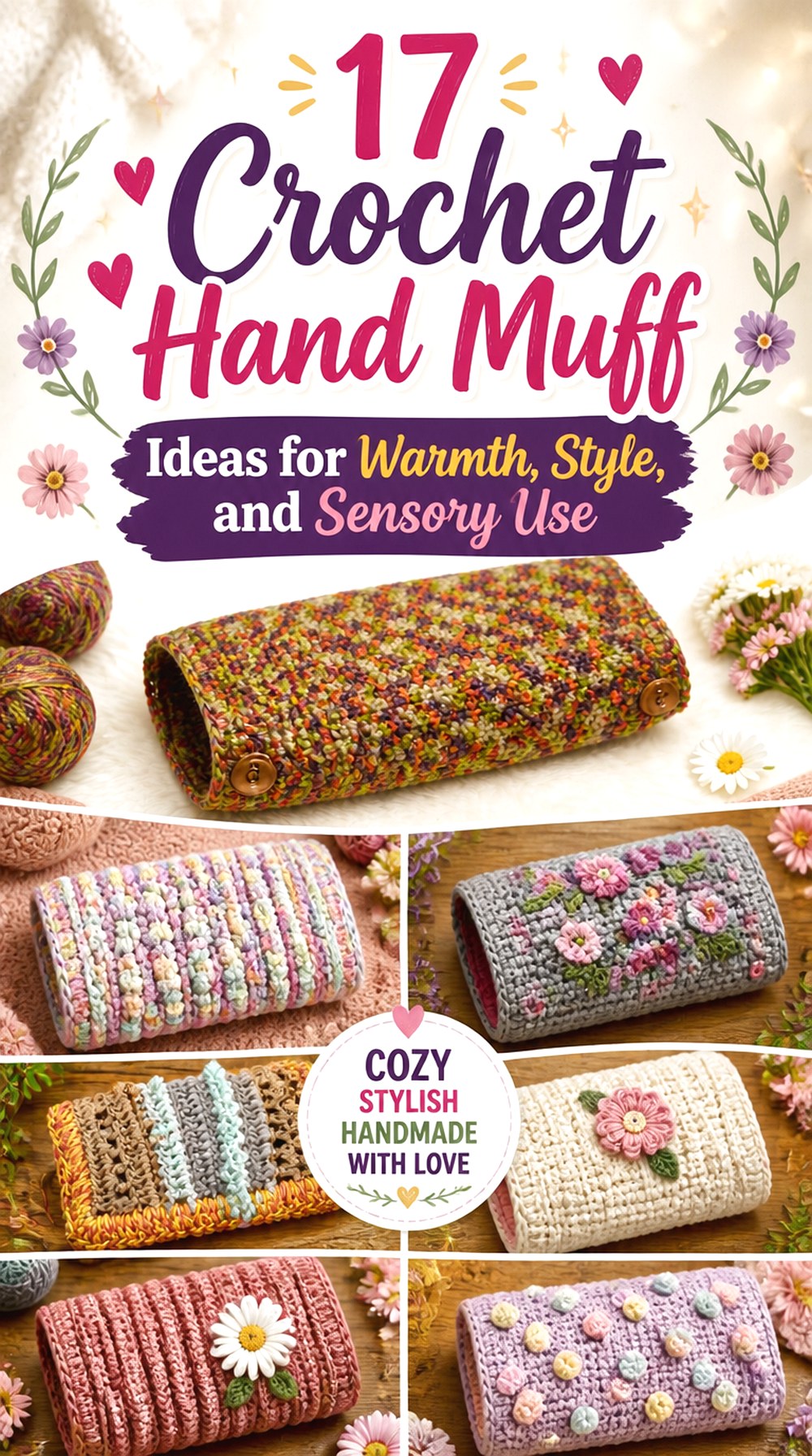

A crochet hand muff can be much more than a simple tube for keeping both hands warm. Traditional versions lean into cozy winter styling, while modern variations add hidden storage, decorative openings, carrying cords, plush texture, or formal details. A separate branch of hand-muff design uses tactile crochet surfaces and activity elements for sensory or care settings.
These 17 crochet hand muff ideas cover both sides of the category. You can compare classic cold-weather shapes with bridal and purse-style muffs, then explore twiddle and fidget versions where texture, attachment choices, and intended recipient become the bigger decisions. The focus is on helping you choose a construction that suits its real purpose while leaving the exact crochet instructions to each original creator.
Quick List
- Crochet Rainbow Vintage Hand Muff
- Crochet Hidden-Pocket Hand Muff Purse
- Crochet Bridal Winter Hand Muff
- Crochet Ruffled-Edge Hand Muff
- Crochet Loop-Texture Winter Hand Muff
- Crochet One-Piece Texture-Sampler Twiddle Muff
- Crochet Two-Panel Decorated Twiddle Muff
- Crochet Color-and-Texture Twiddle Muff
- Crochet Scrap-Yarn Sensory Hand Muff
- Crochet Mixed-Texture Fiddle Hand Muff
- Crochet Bobble Fidget Sensory Hand Muff
- Crochet Care-Setting Twiddle Hand Muff
- Crochet Multi-Example Activity Hand Muff
- Crochet Bobble-Texture Donation Fidget Muff
- Crochet Flower-Accent Sensory Hand Muff
- Crochet Planned-Design Sensory Hand Muff
- Crochet Plain-Base Fiddle Hand Muff
Choose the Hand Muff by Purpose Before You Choose the Texture
Start with the job the muff needs to perform. A classic winter muff benefits from a comfortable opening and a body that does not collapse so much that finding the second opening becomes awkward. A bridal muff has another priority: its scale and texture need to sit comfortably beside formal clothing without overwhelming the overall look. A muff purse adds storage, so pocket position and carrying balance become important.
Sensory and twiddle muffs belong in a different decision group. Their tactile surfaces are intentional rather than merely decorative, and the recipient or receiving organization may have specific requirements for attachments, laundering, dimensions, or materials. That makes a heavily embellished sensory muff unsuitable as a direct substitute for every ordinary winter muff, even when the underlying tube shape looks similar.
Openings, Structure, and Carrying Details Change How a Muff Works
The two openings deserve as much attention as the center of the muff. They need enough room for hands to enter and leave comfortably, including over the clothing the person will actually wear. A decorative ruffle or thick loop texture can make an opening look smaller or bulkier, while a very loose edge may let cold air into a winter version.
The center structure matters too. Dense crochet generally creates a more substantial barrier than very open fabric, while thick surface texture can add volume and weight. A pocket, zipper, neck cord, or wrist strap changes the balance again. Before adding any carrying detail to another tutorial, consider where it will attach, whether it pulls the muff out of shape, and whether it reduces usable hand space inside.
Sensory Hand Muffs Need a Separate Safety Check
Sensory muffs often combine crochet texture with loops, bobbles, flowers, ribbons, buttons, beads, zippers, or other objects. Older tutorials may demonstrate attachments that suited the creator’s project but are not automatically appropriate for every current recipient or facility.
If the muff will be donated or used in a care environment, ask the receiving organization what it currently accepts before adding detachable or hard elements. For a person who may pull strongly, mouth objects, or catch fingers in cords, attachment choice deserves particular attention. When requirements are uncertain, integrated crochet texture—such as bobbles, ridges, loops made as part of the fabric, or firmly worked surface motifs—can offer tactile variety without relying as heavily on separately attached pieces.
1. Crochet Rainbow Vintage Hand Muff

This colorful version brings the traditional hand muff back as a recognizable winter accessory rather than turning it into a pair of wrist warmers. Bixby Legend presents it specifically as an old-fashioned hand warmer, making it a useful reference when you want the classic shared tube with an opening at each side.
The multicolor approach gives the simple silhouette more presence without requiring complicated external decoration. It can work particularly well when the muff itself is intended to be the statement accessory, although the color transitions should still be planned around the finished tube rather than judged only while the fabric is flat.
The Simple Tube Puts Opening Comfort First
Without pockets, ruffles, or sensory attachments competing for space, the main checkpoint is how comfortably both hands move through the muff. Compare the finished opening with the wearer’s hands and with any coat sleeves likely to sit near it. An opening that feels fine against bare wrists may behave differently over winter clothing, so test the real layering situation before treating the fit as settled.
Rainbow Color Can Emphasize Uneven Proportions
Strong color changes naturally draw attention to the muff’s width, length, and seam placement. If you adapt the palette, decide whether you want repeated stripes, larger color blocks, or a more irregular stash-inspired effect before joining the final shape. A deliberate color rhythm can make the uncomplicated construction look finished; too many tiny unrelated changes can make the silhouette visually busier than necessary.
2. Crochet Hidden Pocket Hand Muff Purse
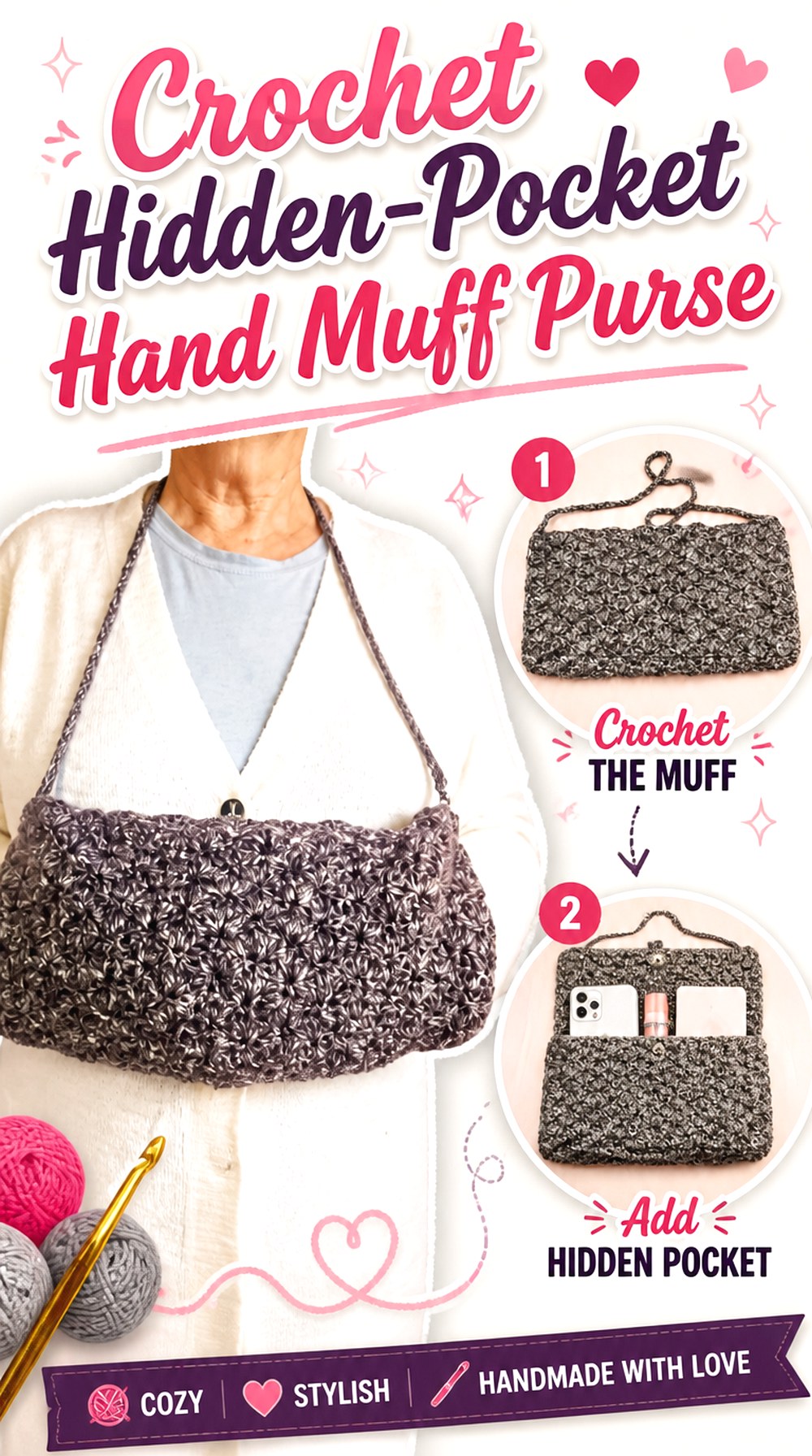
A concealed purse compartment turns this hand muff into a more functional cold-weather accessory. JoannesWeb combines the hand-warming tube with a hidden bag area and carrying cord, so the finished piece can hold small belongings while both hands share the central warmer.
That combination makes this option meaningfully different from a decorative muff. Storage, access, and balance become part of the design. It is worth deciding what you realistically need to carry before enlarging or modifying the pocket, because every extra layer or object competes with the space that makes the muff comfortable to use.
A Hidden Pocket Should Not Steal the Hand Space
Pocket placement matters more here than on an ordinary crochet purse. A compartment that bulges too far into the center can make it awkward to slide hands past stored items. When adapting the idea, place the intended contents inside before deciding the muff feels roomy enough. A phone-sized object, for example, affects the interior differently from a few flat cards or keys.
Carrying the Muff Changes Its Balance
The tutorial incorporates a cord so the muff can be carried rather than constantly held. If you change that feature, think about where the weight will sit when the pocket contains something. Attachment points that are too close together can encourage the body to fold, while a very long strap can make the muff swing during walking. Reinforcement matters more once the crochet is supporting both the muff and stored belongings.
Original Tutorial and Creator Credit
Creator: JoannesWeb
3. Crochet Bridal Winter Hand Muff

A bridal hand muff replaces the everyday winter look with a more formal accessory that can accompany a cold-weather ceremony, wedding portrait session, or other dressed-up event. The Stitch Sessions – Crochet & Conversation tutorial is specifically presented as a winter bridal muff, giving this idea a clear occasion-focused direction rather than simply changing the color of a regular hand warmer.
For this type of project, restraint often matters. The muff may be photographed beside a bouquet, dress details, jewelry, and outerwear, so proportion and surface texture can have more impact than adding many separate embellishments.
Formal Styling Makes Proportion More Noticeable
A very oversized muff can visually compete with a bouquet or obscure important dress details when the hands are held in front of the body. Before changing the scale, consider how the finished accessory will be carried in photographs as well as how it feels during outdoor use. A proportion that looks luxurious in isolation may feel much larger once it is placed against fitted formal clothing.
Choose Embellishment Around the Outfit
If you want to add pearls, flowers, ribbons, or another bridal detail, first look at what is already happening on the dress and accessories. A heavily embellished gown may pair more cleanly with understated crochet texture, while a simple outfit leaves more room for a decorative muff. Any add-on should also be attached securely enough to tolerate being handled repeatedly rather than existing only for a photograph.
Original Tutorial and Creator Credit
Creator: The Stitch Sessions – Crochet & Conversation
4. Crochet Ruffled Edge Hand Muff
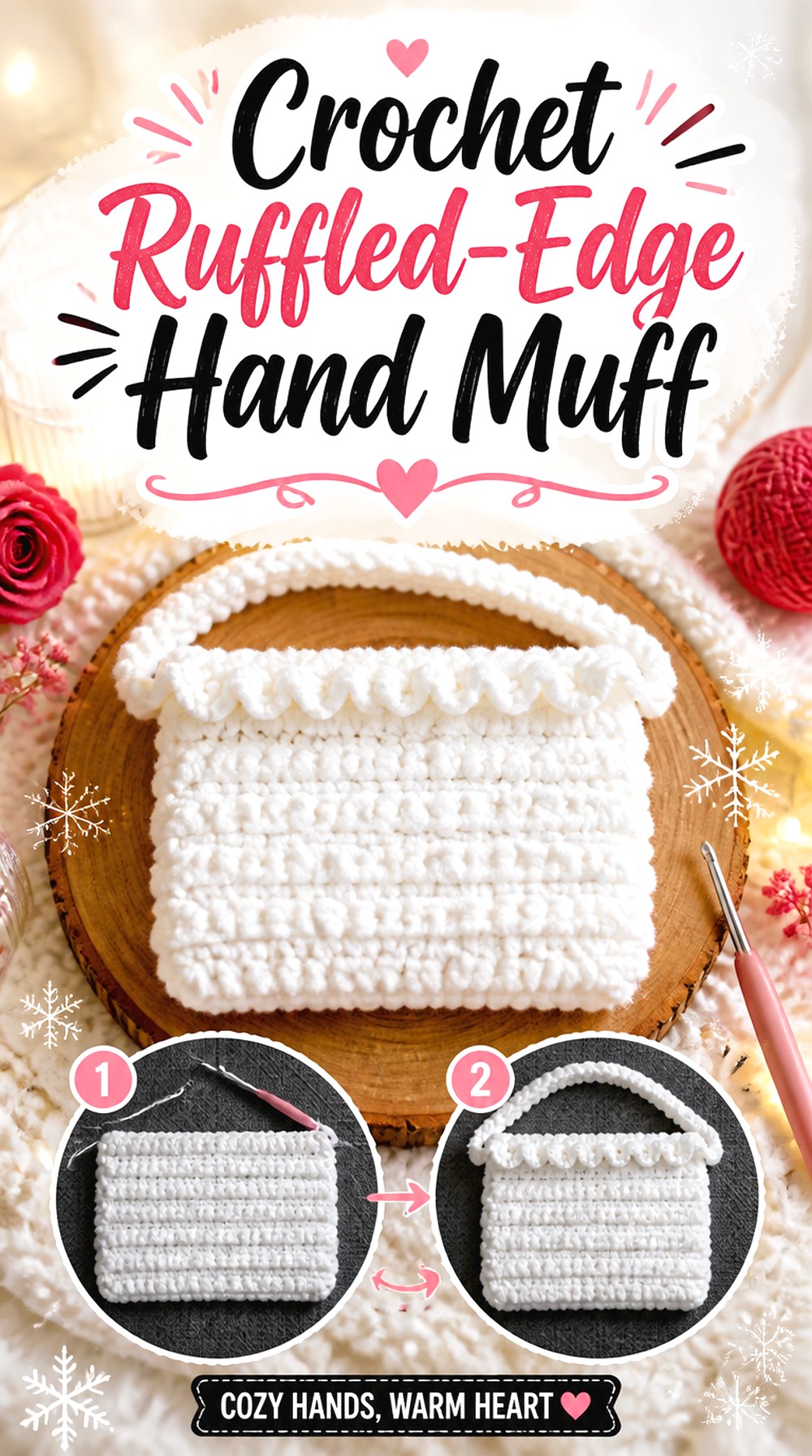
This crochet muff makes its openings part of the design. Häkelfreuden’s tutorial features a prominent ruffle pattern, creating a softer, more decorative edge than the plain openings found on a basic tube.
The ruffle gives the muff enough visual detail that it does not need many additional accents. That makes it a useful direction for someone who wants a distinctly feminine or romantic winter accessory without converting the piece into a bridal-only design. The main planning issue is keeping the decorative edge attractive without letting it interfere with hand movement.
Ruffles Add Volume Exactly Where Hands Enter
A fuller border can look generous while the muff is lying flat but feel crowded once a hand, sleeve cuff, and ruffle occupy the same area. If adapting the trim, test the opening before making the edging substantially deeper or denser. The goal is to preserve the visual frame around the hands without creating a border that folds inward every time the muff is used.
Let the Edge Be the Main Decorative Feature
When the opening already has strong texture and movement, additional surface decorations can compete with it. A calmer central body can make the ruffled ends more intentional. If you want more color variation, consider whether it is clearer to emphasize the border, the center, or both; giving every area equal visual weight may reduce the impact of the ruffle itself.
Original Tutorial and Creator Credit
Creator: Häkelfreuden
5. Crochet Loop Texture Winter Hand Muff
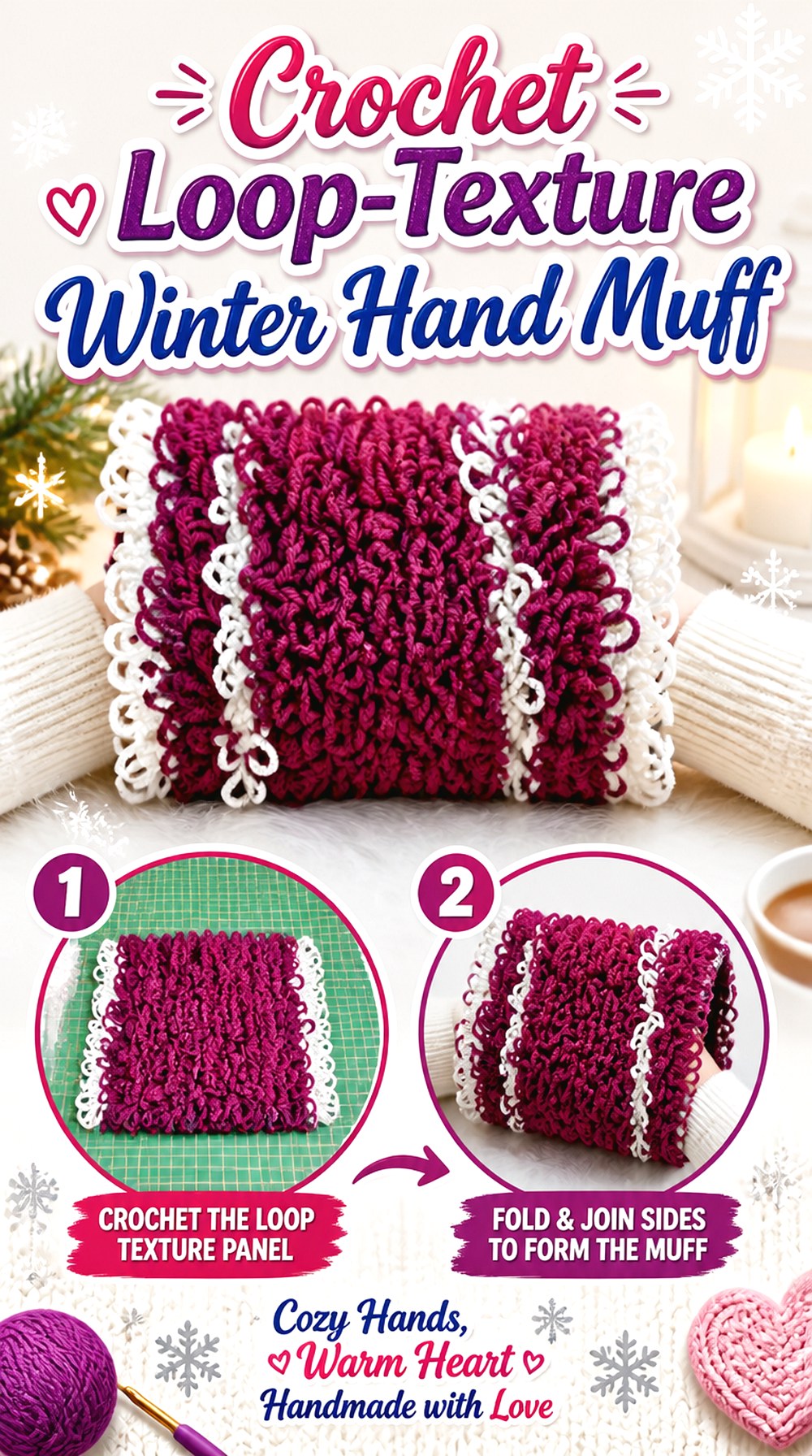
Looped crochet gives this hand muff a shaggy, tactile exterior that is immediately different from smooth or shell-textured versions. ilonciaLu’s tutorial identifies the project as a muff hand warmer worked with a loop-style texture, and the creator also points viewers toward a separate cord tutorial as a possible complement.
This is a strong option when surface texture is the main attraction. Because loops project away from the underlying fabric, however, the muff can look fuller than a smooth piece with similar basic proportions. That extra visual volume should be considered before adding more trim.
Long Surface Loops Need Practical Placement
Raised loops are attractive because they create depth, but projecting yarn can encounter coat hardware, jewelry, bag fasteners, or rough hook-and-loop closures more easily than a smooth surface. Think about the environments where the muff will actually be carried. If snagging is a concern, keep the most dramatic texture away from areas that repeatedly rub against other accessories.
A Cord Can Turn It Into a Carrying Accessory
A hanging cord can be useful when the wearer needs both hands free temporarily, but it also changes how the muff rests against the body. If you decide to add one, test its length with the coat or jacket it will accompany and make sure the attachment areas are secure. Avoid assuming a decorative cord can automatically support pulling, swinging, or added pocket weight.
Original Tutorial and Creator Credit
Creator: ilonciaLu
6. Crochet One Piece Texture Sampler Twiddle Muff
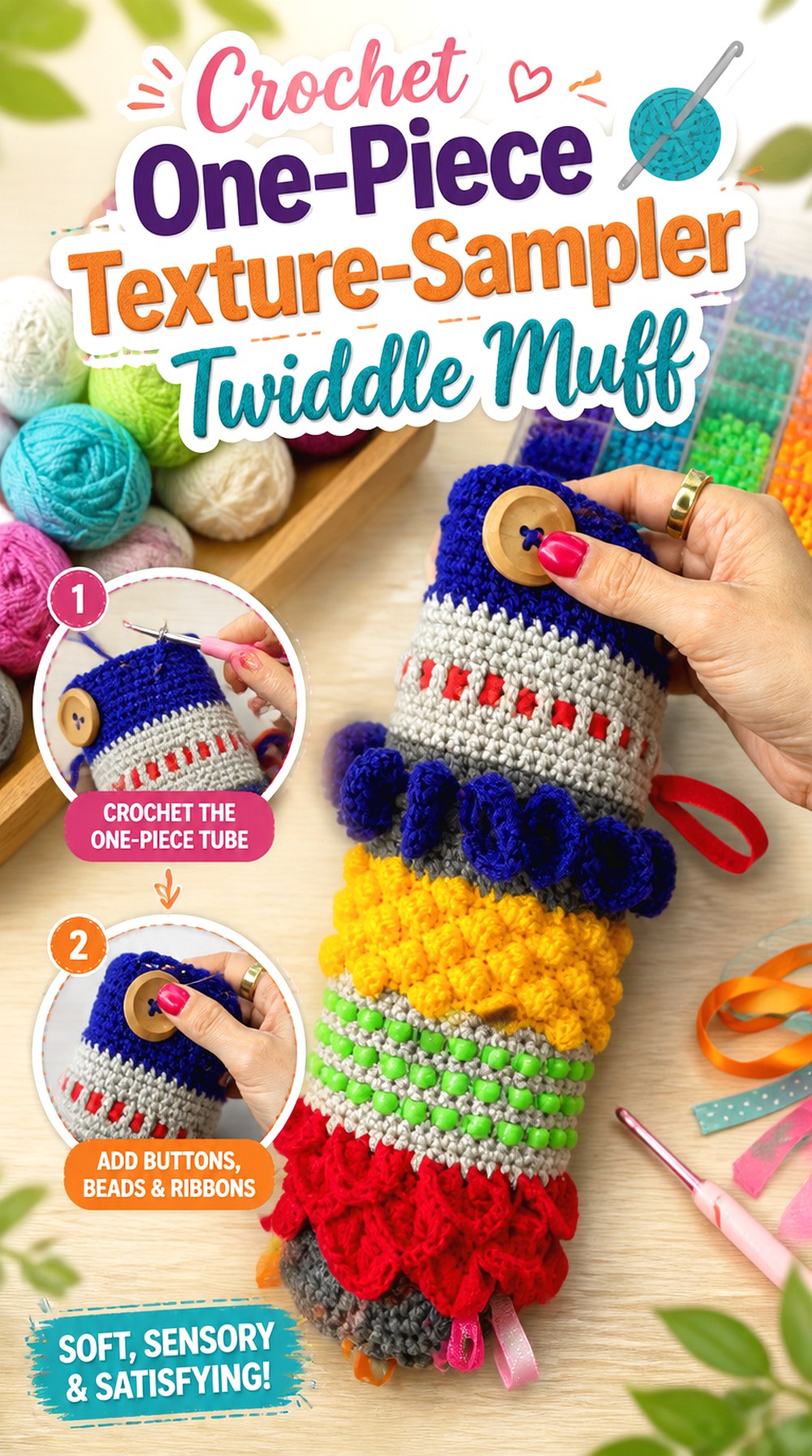
Heart Hook Home’s twiddle muff is built around a series of different crochet textures and colors worked into one main piece. The accompanying pattern describes it as a one-piece design that uses multiple stitch textures before the fabric becomes the finished muff.
That makes this an interesting direction for anyone who wants tactile variety to come from the crochet fabric itself rather than relying entirely on objects added later. It can also make planning easier because you can assess how each textured area sits beside the next before the muff is put into its final form.
Texture Zones Need Enough Contrast to Be Distinct
If every section has approximately the same height, softness, and density, changing stitch names may not create much tactile difference in the finished muff. When adapting a sampler concept, compare neighboring sections with your fingers rather than judging them only by color. Raised areas, ridges, flatter bands, and dimensional motifs can create clearer tactile transitions than color changes alone.
One Main Piece Simplifies the Big Joining Decision
A one-piece base means there are fewer separate body panels to coordinate, but the final seam still deserves attention. Before closing the muff, look at where the most dimensional areas will land and whether the seam interrupts a tactile feature. You can also check that any additions placed before assembly will remain accessible rather than disappearing into an uncomfortable position after the tube is formed.
Review Added Objects Separately From the Crochet Fabric
The source design allows personalization with additional tactile materials. Those details should be evaluated independently for the intended recipient. A component that looks engaging in a craft sample may not meet a particular care facility’s current requirements. If you are uncertain, the substantial stitch-made texture already gives this construction a reason to work without loading every section with separate objects.
Original Tutorial and Creator Credit
Creator: Heart Hook Home
7. Crochet Two Panel Decorated Twiddle Muff
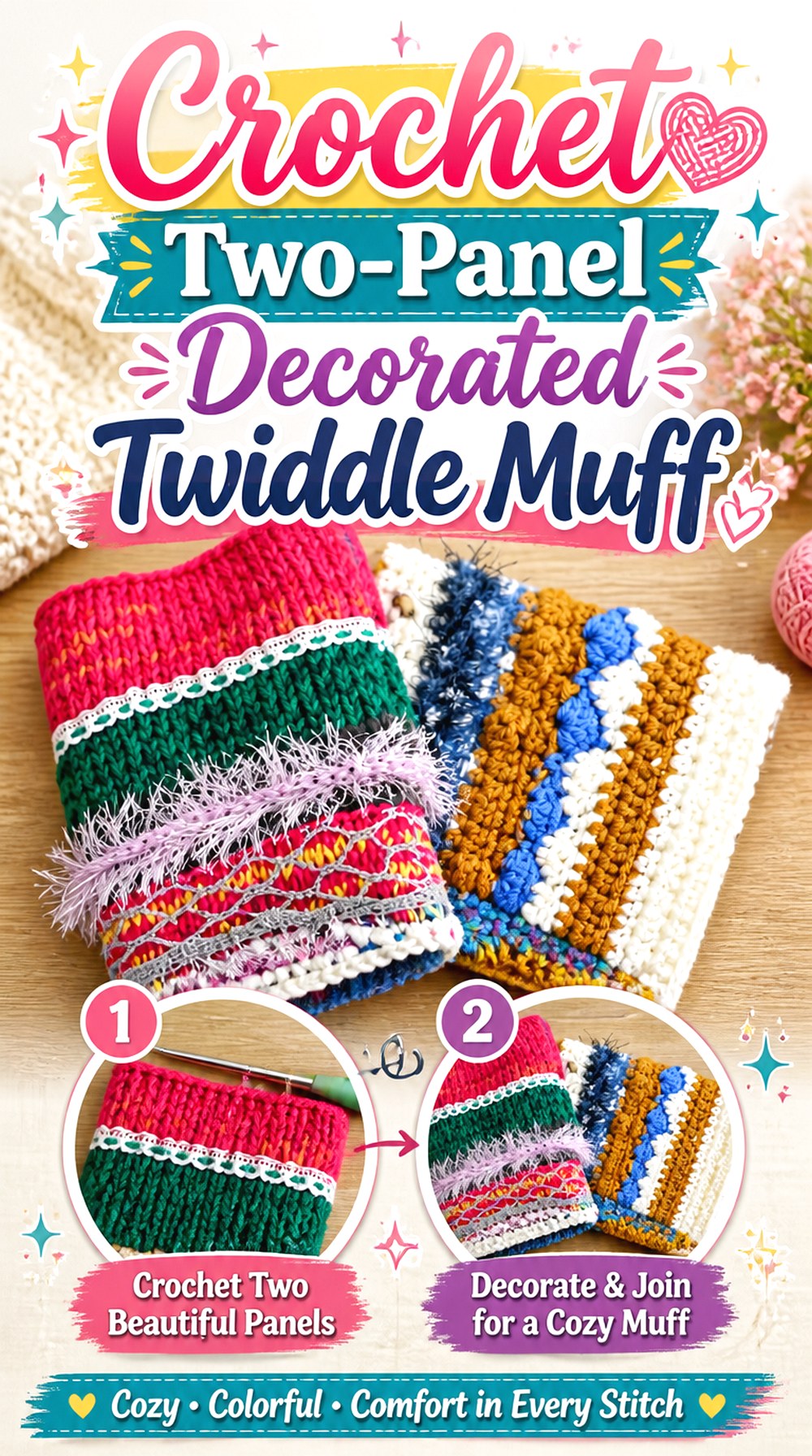
Girlybunches approaches the twiddle muff as a project made from two crocheted parts that are then joined, rather than as a single uninterrupted piece. The creator also discusses adding functional decorations and tactile elements to the finished project.
That separate-piece approach gives you an extra planning opportunity. Before the final join, you can compare what will become interior and exterior areas, see where decorations land relative to the openings, and decide whether either section has become too bulky. It is a useful construction contrast to the one-piece sampler in the previous idea.
Two Pieces Make Interior Planning Easier to See
When the base is still separated, it is easier to inspect the surfaces that will eventually sit against or around the hands. Use that stage to ask whether a raised element feels pleasant from both directions and whether yarn tails or attachment backs need additional attention. Once the two sections are joined, correcting an awkward placement can become more inconvenient.
Functional Decorations Need Working Room
A pocket, zipper, loop, or other interactive feature needs enough surrounding space to be manipulated. Crowding several items into the same small zone can make them difficult to use independently and can stiffen the fabric underneath. Instead of trying to maximize the number of additions, think about how comfortably a hand can locate and interact with each feature.
Secure Attachments Are More Important Than Decoration Count
The tutorial demonstrates a highly customizable category, but every adaptation still needs to suit its recipient. Pull on attachments before considering the project finished and review current rules if it is going to a care organization. A smaller number of well-positioned, appropriate tactile elements is more useful than filling the surface purely for visual impact.
Original Tutorial and Creator Credit
Creator: Girlybunches
8. Crochet Color and Texture Twiddle Muff
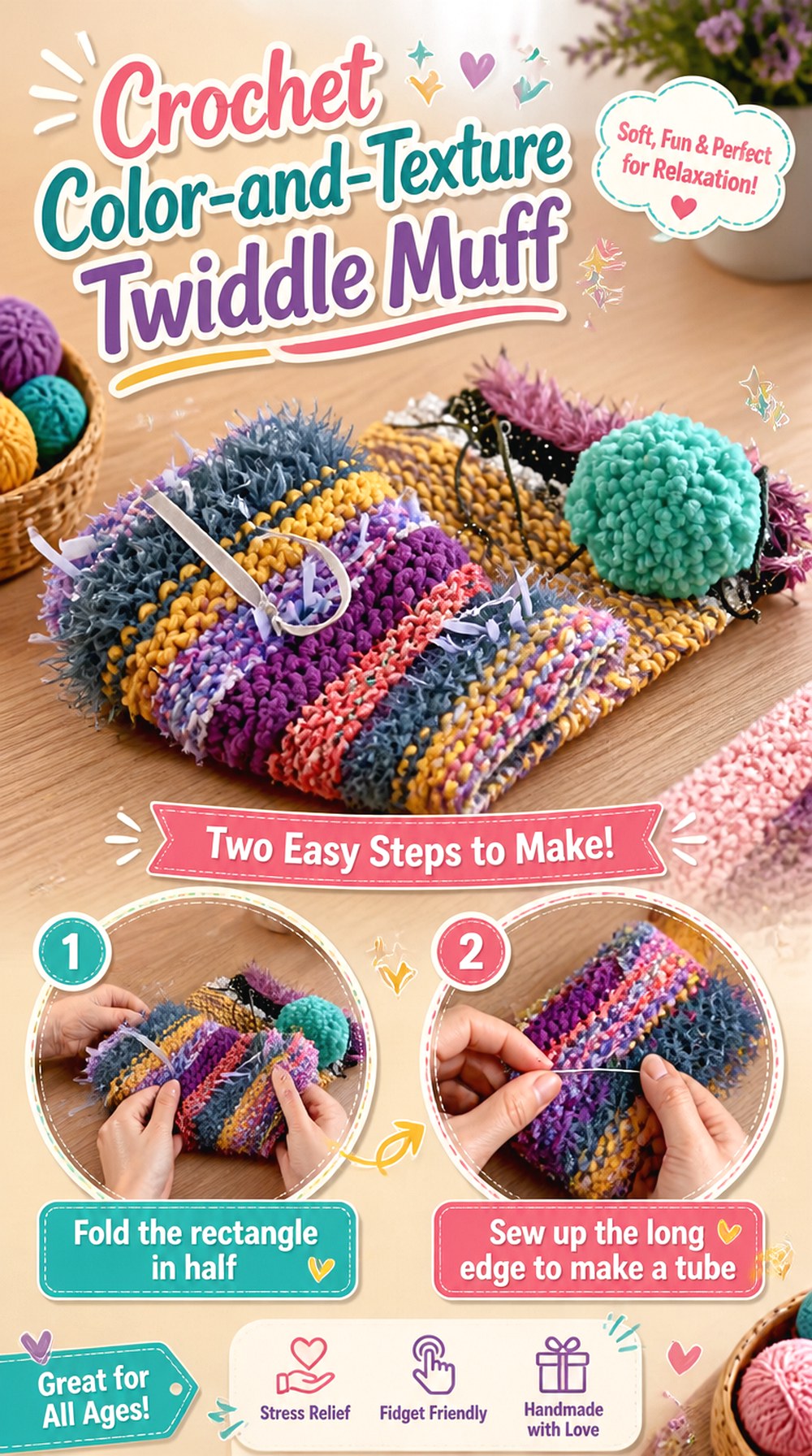
The LoveCrafts twiddlemuff tutorial takes a deliberately varied approach, combining changing crochet sections with colorful and tactile additions. The associated guide describes the project as a crocheted tube intended to accommodate different stitches, colors, textures, and accessories.
This makes the idea useful for stash-based experimentation, but successful variation still benefits from editing. Not every leftover yarn or embellishment needs to appear in the same muff. A more selective combination can give the hands several noticeably different areas without making the surface difficult to navigate.
Change Tactile Character, Not Just Yarn Color
Two smooth yarns in different colors may look very different but feel almost identical. If tactile variety is your priority, compare thickness, loft, firmness, ridges, and raised crochet details rather than relying on color alone. Keeping some calmer sections between heavily textured areas can also make individual features easier to distinguish by touch.
Freestyle Decoration Still Benefits From a Layout Check
Before permanently attaching extras, place the open crochet fabric on a table and arrange possible elements across it. Check where the edges will meet and where the hands will enter. This simple dry layout can reveal that an appealing decoration would end up directly on a seam, clustered beside another bulky feature, or too close to an opening.
Confirm Current Donation Requirements First
LoveCrafts illustrates several common twiddle-muff accessories, but receiving organizations may apply their own current rules. If you are making the muff for donation, ask about accepted materials, attachments, and laundering before finalizing those details. That is more reliable than assuming every accessory shown in a general tutorial will be accepted everywhere.
Original Tutorial and Creator Credit
Creator: LoveCrafts
9. Crochet Scrap Yarn Sensory Hand Muff

Cukicrochet’s sensory muff tutorial is linked to the Asociación IAIA project and explicitly encourages variation in fibers and yarn thicknesses, making it particularly relevant for turning suitable leftovers into purposeful tactile contrast. The creator’s example also treats motifs, textures, flowers, and tassel-like details as part of the sensory surface.
The key idea is not simply “use every scrap.” The better approach is to select leftovers according to how they behave together. Yarn that is extremely fragile, sheds heavily, or creates uncomfortable hard transitions may be less useful than a smaller collection of compatible textures.
Sort Leftovers by Feel Before Sorting by Color
Lay candidate yarns beside each other and compare them by touch. A smooth strand, soft fuzzy section, firm textured yarn, and raised crochet motif can produce more sensory variety than six colors with the same surface. At the same time, avoid assuming that a novelty texture is automatically suitable; comfort, fiber stability, and the intended recipient still matter.
Dimensional Motifs Can Replace Some Hard Add-Ons
Crocheted flowers, spirals, or raised motifs can add movement and relief without necessarily introducing a separate hard object. That can be useful when you want a visually lively surface but prefer to keep the project primarily textile-based. They still need secure attachment, and long loops or narrow cords should be reviewed for the intended setting rather than added automatically.
Charity Context Should Guide the Final Version
The source is connected to a charitable initiative, which is a good reminder that donation pieces are ultimately made for someone else’s requirements. If you plan to contribute to an organization, use its current guidance as the final authority for materials and finishing rather than treating a general online example as a universal specification.
Original Tutorial and Creator Credit
Creator: Cukicrochet
10. Crochet Mixed Texture Fiddle Hand Muff
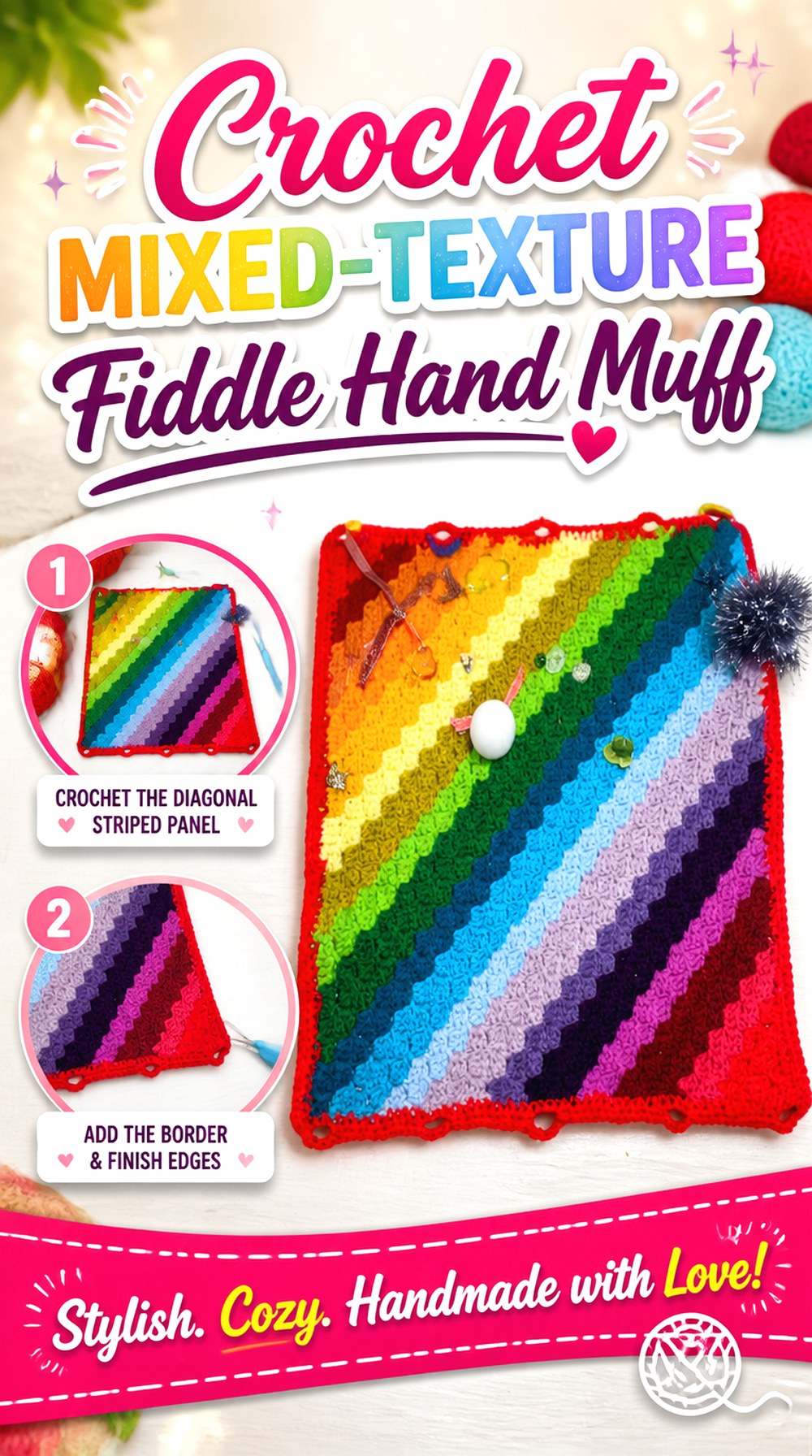
Sooz In The Shed presents a crocheted fiddle muff specifically in the familiar sensory-muff format, giving another useful reference for a tube where tactile variety matters more than a polished fashion-accessory surface.
This type of muff is a good place to think in layers: the underlying crochet fabric provides softness and structure, while raised or interactive areas provide distinct points for the hands to explore. Instead of covering the entire surface at equal density, consider how the recipient will encounter one feature after another while moving around the tube.
Leave Quiet Space Between Strong Textures
A section without large embellishments is not wasted space. It can make neighboring features easier to locate and can provide a softer place for the hands to rest. When every inch contains loops, bobbles, buttons, or hanging pieces, the finished muff may feel visually and physically congested. Alternating quieter crochet with stronger tactile areas creates clearer contrast.
Interior Features Deserve the Same Inspection
A fiddle muff can include interest where the hands naturally rest, but anything placed inside should be assessed without relying on appearance. Run your hand through the completed tube and feel for stiff backs, knots, sharp edges, or attachments that project unexpectedly. This is particularly important because flaws that are obvious from the outside can be hidden once they face inward.
Original Tutorial and Creator Credit
Creator: Sooz In The Shed
11. Crochet Bobble Fidget Sensory Hand Muff

This fidget muff is a useful choice when you want significant tactile interest to come directly from crochet stitches. The related pattern information identifies a one-piece crochet construction and bobble/popcorn-style texture, while linking directly to the project’s YouTube tutorial.
That stitched-in texture provides a different planning route from muffs dominated by beads, zippers, or hanging objects. Raised crochet can be distributed across the tube as part of the fabric itself, making it possible to create areas the fingers can locate without attaching something to every section.
Built-In Bobbles Reduce Reliance on Loose Decoration
Raised stitches are part of the crocheted fabric, so they can provide tactile relief without the same attachment seam created by sewing on a separate object. That does not remove the need for good finishing—ends and joins still need attention—but it gives you a useful option when you want the base crochet to do more of the sensory work.
Keep Raised Texture Away From Overcrowded Openings
Bobbles or popcorn-like details can thicken the fabric substantially. If too many sit immediately at the openings, they may make the edge feel bulky as hands pass through. When adapting the layout, compare the decorative benefit of a highly textured border with the practical benefit of a smoother entrance and reserve the strongest relief for areas with more room.
Original Tutorial and Creator Credit
Creator: GirlScouts Troop8080
12. Crochet Care Setting Twiddle Hand Muff

Crochet Nurse covers twiddle mats, muffs, and related crochet items in one tutorial, placing the hand muff within a broader care-oriented making context. The video specifically includes crochet muffs and discusses donation to care settings.
For a maker planning a donation rather than a personal accessory, that context is useful because it shifts attention from “How decorative can I make this?” to “What will the destination actually accept and use?” The same crochet concept may need different finishing depending on the organization, laundering process, or recipient group.
Destination Requirements Come Before Customization
Contact the intended facility before committing to interactive extras. Ask whether it has guidance covering small objects, long cords, bells, buttons, fiber types, laundering, or identification labels. Requirements can vary, so following one online example exactly does not guarantee acceptance somewhere else. Confirming first can prevent finishing an elaborate muff that a particular organization cannot use.
Care-Focused Crochet Benefits From Inspectable Finishing
Make it easy to check the item thoroughly. Secure yarn ends, examine joins from both sides, and inspect anything added to the surface before donation. A highly complex hidden construction may be less convenient to assess than a clear, sturdy base where the condition of the fabric and attachments can be seen and felt readily.
Original Tutorial and Creator Credit
Creator: Crochet Nurse
13. Crochet Multi Example Activity Hand Muff
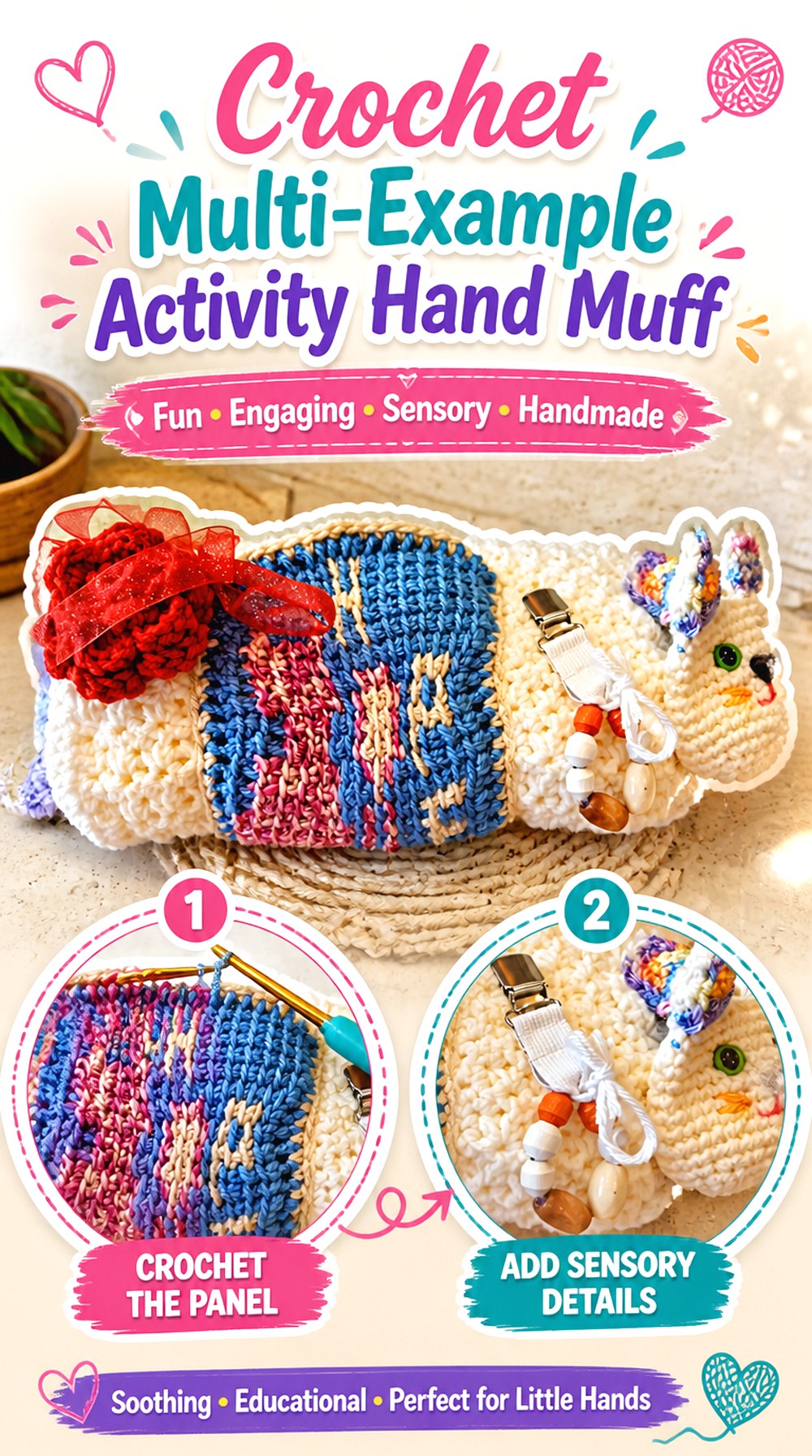
HelenMay Crochet’s tutorial stands out because it shows three caregiver sensory twiddle activity muffs made for charity. Seeing several examples within one tutorial is useful when you want to compare layouts instead of treating one finished object as the only possible arrangement.
This can help with a common design problem: deciding how much variation is enough. Rather than copying a specific decoration scheme, look at the examples as evidence that the same broad muff concept can support different combinations of crochet texture and activity details.
Multiple Examples Reveal Which Features Are Optional
When several finished muffs serve the same general purpose but do not look identical, it becomes easier to separate essential construction from personal decoration. Use that freedom deliberately. Decide which types of texture are appropriate for your recipient and which features are merely aesthetic, then build a coherent version instead of trying to combine everything visible across all examples.
Plan Activity Areas Before Permanent Attachment
If you have several candidate elements, group them temporarily on the flat or unfinished muff. A feature intended for fingertips may work better toward the central area, while bulky pieces can interfere with an opening or neighboring activity. Planning zones helps prevent one side from becoming noticeably heavier or stiffer than the other.
Charity Makes Consistency More Valuable Than Novelty
An inventive detail is not automatically more useful than a secure, understandable one. When crocheting for donation, prioritize the receiving organization’s requirements and reliable finishing over making each muff dramatically different. Color and crochet texture already provide room for individuality without needing increasingly complicated additions.
Original Tutorial and Creator Credit
Creator: HelenMay Crochet
14. Crochet Bobble Texture Donation Fidget Muff

Prince William Public Libraries presents a donation-focused fidget muff built around crochet and tactile surface interest, including textural stitches and bobble-like features.
This is a useful direction for makers who would rather obtain some of the tactile effect from dimensional crochet instead of turning every sensory feature into a sewn-on object. Bobbles create repeated points for the fingers to encounter while leaving room for a simpler overall silhouette. As with any donation project, the organization receiving your finished piece should determine which additional features are appropriate.
Repeated Bobbles Create Predictable Texture
Randomness is not the only route to a tactile piece. A repeated raised texture gives the fingers a surface that can be explored across a larger section of the muff. If you combine it with other textures, keep enough of the bobble area visible that it still reads as a distinct zone rather than disappearing among many unrelated attachments.
Library Donation Projects Can Inspire Local Partnerships
A community tutorial can be a starting point for your own local research rather than an instruction to send projects to the same destination. Libraries, craft groups, senior programs, hospitals, and care organizations may have different needs. Contact a potential recipient first and ask what it currently requests before organizing a group-making session or producing a batch.
Original Tutorial and Creator Credit
Creator: Prince William Public Libraries
15. Crochet Flower Accent Sensory Hand Muff
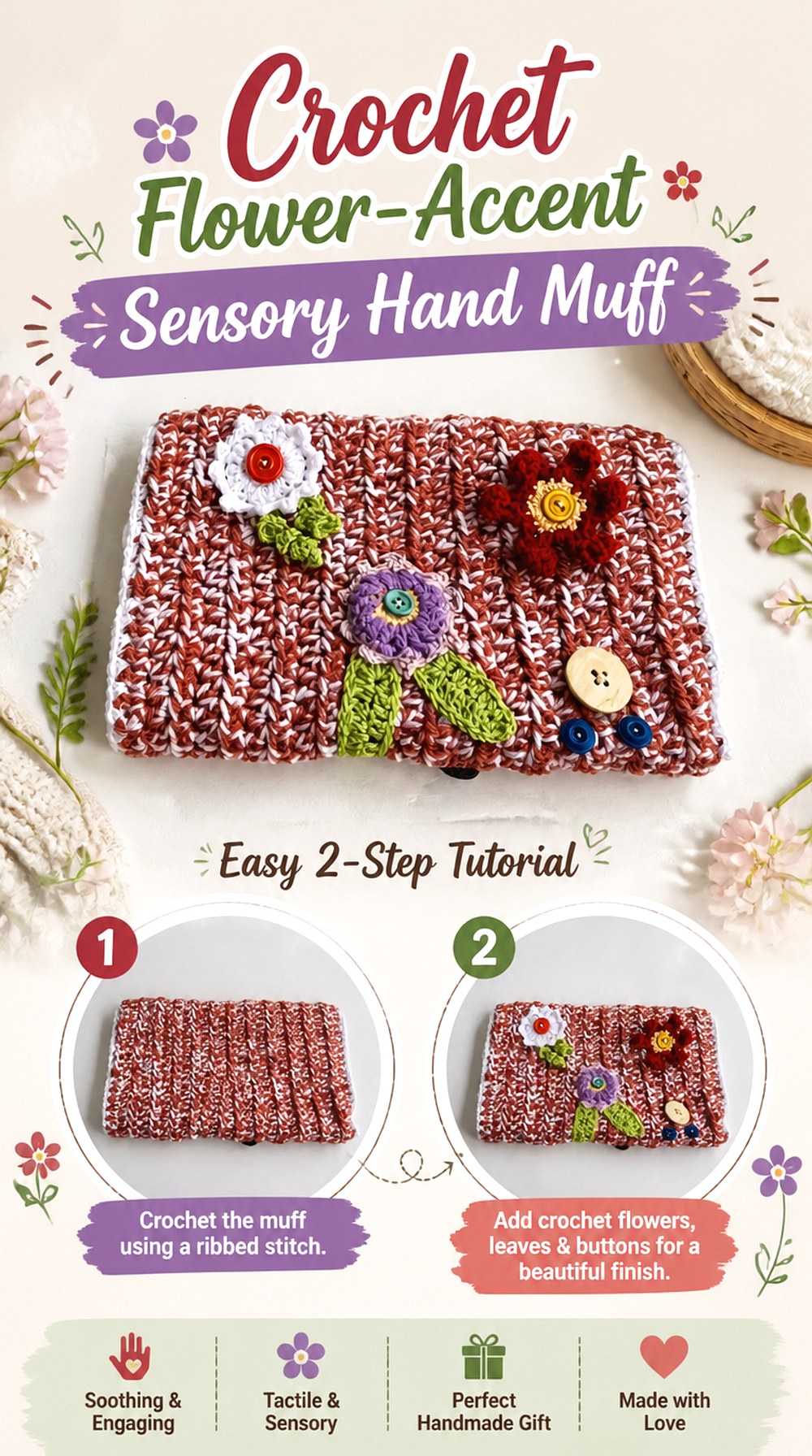
Bea Somnium’s sensory-muff tutorial gives this category a more motif-oriented look, with floral crochet details among the tactile elements associated with the project.
Flowers are useful here because dimensional petals can add recognizable shape as well as surface relief. They also give the maker control over how strongly the embellishment projects from the base. A flatter flower can behave more like appliqué, while fuller petals create more movement. Choose the form according to the intended use rather than assuming that more dimension is always better.
Flower Placement Can Create Clear Tactile Landmarks
Instead of scattering small motifs everywhere, one or two more distinct floral areas can act as recognizable points on the muff. Leave enough surrounding fabric for the fingers to trace the petal edges. If motifs overlap each other heavily, their individual shapes may become harder to distinguish and the underlying crochet can become unnecessarily stiff.
Textile Motifs Still Require Secure Finishing
A crocheted flower may feel softer than a bead or hard button, but it remains an added component if it is attached separately. Check all joins, tails, centers, and projecting loops. If the finished muff is intended for a specific person or organization, confirm that the motif style meets their requirements just as you would with any other embellishment.
Original Tutorial and Creator Credit
Creator: Bea Somnium
16. Crochet Planned Design Sensory Hand Muff

EL CLUB DE LA CALCETA presents a specific sensory muff design called Manguito Sofía, created in connection with an IAIA Wool for Health initiative.
That makes this tutorial useful as a contrast to highly freestyle twiddle-muff approaches. Instead of beginning with a pile of unrelated leftover decorations, you can study a complete authored example and think about the sensory surface as one coordinated object. This route may appeal to makers who prefer having a defined visual direction before choosing their own colors or adaptations.
A Defined Design Can Prevent Surface Overcrowding
Working from a coherent example helps clarify that a sensory muff does not need every possible texture at once. Before adding another motif or attachment, ask whether it introduces a genuinely different tactile experience or simply fills an empty patch. Leaving visible base crochet between focal features can make the final piece easier to read both visually and by touch.
Language Does Not Replace Visual Verification
The tutorial title and description are in Spanish. If you primarily follow English-language crochet instruction, preview enough of the video to decide whether the visual demonstrations and your existing stitch knowledge are sufficient for you. Do not assume measurements, terminology, or construction choices from another pattern; use the creator’s own presentation for the exact design details.
Original Tutorial and Creator Credit
Creator: EL CLUB DE LA CALCETA
17. Crochet Plain Base Fiddle Hand Muff

A sensory muff does not have to begin as a complicated finished object. Good Omen Goodeze’s tutorial focuses specifically on making the muff portion of a fiddle-muff project, which makes it useful when you want to understand the base before deciding what, if anything, belongs on its surface.
That base-first perspective earns its place in this list because it separates structural planning from decoration. You can evaluate the tube, openings, fabric feel, and basic comfort first, then make later choices according to the intended recipient rather than committing to embellishments before you know how the foundation behaves.
Finish the Foundation Before Judging Its Decoration Needs
Once the basic muff can be handled as a real object, it is much easier to see where the hands naturally rest and which sections remain accessible. That information can guide later texture placement. A base that already has noticeable yarn texture may need fewer extras than a very smooth one, and some recipients or organizations may prefer a restrained surface.
A Plain Muff Is Also a Useful Fit Check
Before attaching anything difficult to remove, slide hands through both openings and check the amount of interior room. Look for seams that feel prominent, edges that roll, or a tube that collapses awkwardly. Correcting those structural issues first prevents decorative work from disguising a foundation that still needs adjustment.
Keep Future Additions Appropriate to the Recipient
Treat decoration as a separate design stage rather than an automatic requirement. If the muff is intended for donation, obtain current guidance first. If it is for an individual, consider their preferences and how the item will actually be handled. Integrated crochet texture may sometimes be a more appropriate modification than adding multiple loose or hard components.
Which Crochet Hand Muff Type Fits Your Goal?
For a straightforward cold-weather accessory, the rainbow vintage muff keeps the focus on the traditional shared hand-warmer shape. Choose the loop-texture or ruffled versions when you want the crochet surface or openings to provide most of the visual interest. The bridal option shifts the priority toward formal proportion, while the hidden-pocket muff is the most function-driven choice because storage and carrying balance enter the design.
Twiddle and fidget muffs require a different comparison. A one-piece sampler, bobble-rich muff, or flower-accent design can obtain much of its tactile interest from crochet itself. Highly embellished versions offer more types of interaction but require more careful assessment of attachment security and recipient requirements. For donation work, choosing the receiving organization before choosing embellishments is the more practical order.
Conclusion
The right crochet hand muff depends first on what you expect it to do. For winter use, compare opening comfort, fabric density, decorative volume, and whether you need extras such as a strap or hidden pocket. For formal styling, proportion may matter more than storage or heavy texture. Sensory and twiddle muffs call for another level of planning because tactile choices, attachments, cleaning requirements, and the recipient’s situation can shape the final design.
Use the ideas here to narrow down the construction that matches your goal, then follow the original creator tutorials for their exact crochet methods and project details. That approach leaves room to personalize the finished muff without losing sight of function.
Frequently Asked Questions
What makes a crochet hand muff different from fingerless gloves?
A traditional hand muff is one shared tube with an opening at each end, allowing both hands to rest inside the same enclosed space. Fingerless gloves or wrist warmers are separate fitted pieces worn on individual hands or arms. That distinction matters when searching for tutorials because many online projects labeled “hand warmers” are actually cuffs or fingerless gloves rather than true muffs.
How snug should the openings of a crochet winter hand muff be?
There is no universal opening measurement because hand size, yarn stretch, stitch structure, and winter clothing all change the fit. The openings should allow hands to enter and leave comfortably without excessive pulling. If the muff will be worn with a coat, test it with the actual sleeve or a similarly bulky layer before deciding the edge is comfortable.
Is lining worth adding to a crochet hand muff?
A lining can cover a very open crochet structure and create a smoother interior, but it also adds another layer that can change stretch, bulk, and care requirements. Decide whether the crochet fabric already provides the feel you want before adding one. For a pocket muff, also consider how a lining will interact with the storage compartment rather than treating the two features separately.
Can I add a phone pocket or carrying strap to any crochet muff?
You can adapt many muff concepts, but a pocket or strap changes the structure. A bulky pocket can reduce interior hand room, while the weight of stored items can pull on the strap attachments and distort softer crochet. Test the intended contents and reinforce attachment areas appropriately rather than assuming a decorative muff can support purse-style use without modification.
What should I check before donating a crochet sensory or twiddle muff?
Contact the receiving organization before making the final version. Ask about accepted dimensions, fibers, laundering requirements, embellishments, cords, buttons, beads, bells, zippers, labels, and any other restrictions it applies. Donation policies can differ between facilities and may change, so a feature shown in an online tutorial should not be treated as automatic approval for every current care setting.
Are buttons, beads, bells, or cords appropriate for every sensory hand muff?
No. Their suitability depends on the intended recipient and the rules of the organization using the muff. Small, hard, dangling, or detachable elements may be inappropriate where a person could pull strongly on them or bring them to the mouth. When requirements are uncertain, consider emphasizing secure crochet-created textures such as ridges, bobbles, loops, and integrated motifs until you can confirm what is acceptable.


