

A crochet pocket scarf can be a narrow neck scarf with hand-warming pockets, an extra-wide wrap that covers the shoulders, or even a hooded layer that combines several cold-weather accessories in one piece. The most important differences are not color. Width, pocket position, yarn weight, construction, drape, and whether the scarf is designed to wrap around the neck can completely change how the finished piece feels.
These 14 ideas cover classic scarves, wide pocket shawl-scarf hybrids, a pocket infinity scarf, hooded designs, granny-style construction, plush texture, and a jumbo hand-crocheted option. Use the comparisons to decide what shape fits your wardrobe and climate, then follow the credited original tutorial for the creator’s exact construction details.
Quick List
- Crochet Granny-Cluster Hooded Pocket Scarf
- Crochet Tassel-End Pocket Scarf
- Crochet Classic Straight Pocket Scarf
- Crochet Pocket Infinity Scarf
- Crochet Wide Pocket Shawl Scarf
- Crochet Convertible Pocket Shawl Scarf
- Crochet Fringed Rectangle Pocket Wrap
- Crochet Velvet Comfort Pocket Scarf Wrap
- Crochet Extra-Wide Blanket Pocket Scarf
- Crochet Super-Bulky Hooded Pocket Scarf
- Crochet Diamond-Motif Boho Pocket Wrap
- Crochet Alpine-Stitch Pocket Shawl Scarf
- Crochet Soft Hooded Pocket Wrap Scarf
- Crochet Jumbo Hand-Crocheted Pocket Scarf
Choose the Width by How You Want to Wear the Scarf
Pocket scarves sit on a spectrum from conventional neck scarves to shoulder-covering wraps. A narrower piece is usually easier to cross or wrap around the neck without creating excessive bulk. A wider design behaves more like a stole or shawl and gives the pockets a larger background panel, but folding all that fabric around the neck can feel substantially heavier.
Before committing to a width, think about the primary wearing position. If your hands will normally stay in the pockets while the scarf rests over the shoulders, extra width may be useful. If you expect to wrap it securely around your neck outdoors, compare that width with scarves you already enjoy wearing. Pocket dimensions should then look proportional to the finished panel rather than being planned separately.
How Yarn Changes Drape, Bulk, and Pocket Sag
Pocket scarves need enough flexibility to sit comfortably around the body, but pockets introduce extra weight at both ends. A very loose fabric can stretch when hands or small belongings are placed inside, while an extremely dense fabric may create a scarf that feels stiff when doubled around the neck.
Yarn weight also changes how prominent every detail becomes. Bulky yarn can make a hood, pocket seam, or raised stitch look substantial, while a smoother medium-weight yarn can produce a less imposing layer. Plush yarn increases softness but may hide complex stitch definition.
When substituting yarn, compare more than the number on the label. Work a sample and examine its drape, stretch, stitch visibility, and recovery before deciding whether it suits both the scarf body and its pockets.
Plan Pocket Placement Before the Final Seaming
A pocket can look perfectly centered on a flat scarf and still sit awkwardly once the scarf is worn. Before permanently attaching separate pockets, drape the finished scarf over the intended wearer and mark the natural resting point of the hands. Check both sides rather than assuming identical measurements automatically create identical comfort.
Pocket openings also need enough stability to remain recognizable after repeated use. If the scarf fabric stretches easily, a firm border or carefully controlled attachment can help prevent the opening from becoming distorted.
For designs with folded ends, hoods, or unusual joins, complete a temporary fit check before final finishing. This is particularly helpful when changing the length of a tutorial because altering total length can also move the pockets away from the most comfortable position.
1. Crochet Granny Cluster Hooded Pocket Scarf

This version moves beyond the standard rectangular pocket scarf by combining a long granny-cluster scarf with optional hood, pockets, fringe, and even playful ear details. The modular approach makes it useful if you like the main scarf shape but want control over how many extras appear in the finished piece. The granny-style texture also creates more visible openings than a dense winter scarf, so yarn choice and intended weather matter. It stands apart from simpler designs because the pockets themselves become a decorative feature rather than disappearing into the body of the scarf.
Treat the Hood as Part of the Weight Balance
Adding a hood changes more than coverage. It places another section of crochet at the center back while the pockets add weight at both ends. Before deciding on a heavier substitute yarn, consider how those three weighted areas will interact when the scarf is worn. A yarn that feels pleasant in a small swatch may feel substantially more substantial across the full garment.
Granny Pockets Need a Size Match
If you adapt the pocket motif, block or relax the pocket fabric before attaching it and compare its finished dimensions with the scarf width. A granny-style pocket that is too wide can wrap toward the scarf edges, while one that is too narrow may look visually disconnected. Matching the proportions first is easier than trying to correct placement after permanent seaming.
Optional Ears Change the Styling Direction
The optional ear detail makes this design more playful and character-driven than a conventional winter wrap. Decide whether that suits the intended wearer before adding it. Leaving the ears off keeps the hooded shape more neutral, while retaining them creates a stronger statement piece. This is a useful example of customization that changes style without changing the basic purpose of the scarf.
2. Crochet Tassel End Pocket Scarf

For a more traditional scarf silhouette, this design keeps the emphasis on a long wrap that can go around the neck while still providing pockets at the ends. Tassels add movement without turning the entire project into an oversized shawl. The creator also presents the design as adaptable in size, which makes this a useful reference when you prefer a familiar scarf shape rather than a broad shoulder wrap. Compared with the hooded and blanket-style options in this collection, this one keeps the overall idea focused on neck warmth, hand pockets, and decorative ends.
A Narrower Body Is Easier to Wrap
The more often you plan to circle or cross a pocket scarf around your neck, the more important manageable width becomes. Before making a wider adaptation, fold a piece of fabric to the proposed width and test the bulk around the neck. A scarf can look generous when flat yet become cumbersome after it is doubled and the pocket ends are hanging below.
Pocket Height Should Follow the Wearer’s Hands
Changing total scarf length may require moving the functional pocket area as well. Do not assume that making the center section longer automatically preserves comfortable hand placement. Drape the unfinished scarf as it will actually be worn, let the arms relax naturally, and use that position as the checkpoint before final pocket attachment or finishing.
Tassels Change the Visual Finish
Tassels draw attention to the lower ends, which can be useful on a narrow scarf because they create a more deliberate termination beneath the pockets. They also add additional movement and yarn weight. If you prefer cleaner coat layering or frequently carry a shoulder bag, compare the scarf with and without fringe before committing to the final finish.
Original Tutorial and Creator Credit
Creator: Ophelia Talks Crochet
3. Crochet Classic Straight Pocket Scarf

Sometimes the useful comparison point is the simplest shape. Bianca Schultz’s tutorial is specifically devoted to crocheting a scarf with pockets, making it a good reference if you want to stay close to the familiar long-scarf format rather than adding a hood, infinity join, pronounced motif layout, or blanket-like width.
This style also gives you a relatively neutral base for color or texture choices. Because the tutorial information available publicly does not clearly establish every finished measurement or adaptation option, confirm those details directly in the video before purchasing yarn or planning the scarf for a particular wearer.
Use This Shape as Your Baseline Comparison
A straight pocket scarf makes it easier to decide which extra features you actually need. Compare it with the hooded projects if head coverage matters, the infinity version if you dislike loose scarf ends, or the wide wraps if shoulder coverage is the priority. Choosing the simplest construction can be preferable when pockets themselves are the feature you care about most.
Let Pocket Scale Set the Proportion
On a relatively straightforward scarf, oversized pockets can dominate the ends visually. Before attaching them, place the scarf flat and then wear it to check whether the opening feels proportionate to both the scarf width and the wearer’s hands. If you are changing the tutorial’s yarn or gauge, this visual check becomes more important than copying proportions from a different fabric.
Original Tutorial and Creator Credit
Creator: Bianca Schultz
4. Crochet Pocket Infinity Scarf

This design solves one of the usual pocket-scarf problems in a completely different way: the scarf forms a continuous infinity loop instead of leaving two completely separate ends. Winding Road Crochet describes pocket openings built into the tubular scarf, giving the wearer somewhere to place the hands while retaining the closed-loop shape. The tutorial also uses self-striping cake yarn in its sample, which highlights how continuous color changes can travel around a loop. It is one of the strongest options here if you like infinity scarves but want more function than a standard cowl-style accessory.
The Closed Loop Changes How Length Is Judged
An infinity scarf cannot be evaluated exactly like a straight scarf because there are no loose ends to reposition independently. Before joining or finalizing the circumference, test how the loop sits on the body and whether you can wear it in the intended configuration without pulling the pocket openings away from your hands.
Pocket Openings Must Land Naturally
The cleverness of this construction depends on the openings reaching a comfortable position when the loop is worn. If you alter length substantially, mark the likely hand positions first rather than placing openings according to appearance alone. A few inches of movement can make the difference between a pocket that feels intuitive and one that requires the shoulders or elbows to stay tense.
Self-Striping Yarn Has More Visual Impact Here
A continuous tube gives gradual color changes room to travel around the garment without being interrupted by separate pocket pieces. If you substitute a heavily variegated yarn, make a larger sample first; short, high-contrast changes can look much busier in a loop than they do in a small skein.
Original Tutorial and Creator Credit
Creator: Winding Road Crochet
5. Crochet Wide Pocket Shawl Scarf

A wide pocket shawl offers a different kind of scarf experience: instead of concentrating fabric at the neck, it spreads coverage across the shoulders and upper body. Dream9Design’s tutorial focuses on a crochet pocket shawl worked with straightforward stitches and presents it as a wearable or gift project.
Use this concept when you like the usefulness of pockets but prefer something closer to a wrap than a conventional narrow scarf. Because a wider panel requires more fabric, check the creator’s material information and finished proportions before substituting yarn. A change that seems small across a narrow scarf can become much more noticeable across a large rectangular wrap.
Width Decides Whether It Feels Like a Scarf or Wrap
There is no single dividing measurement between a scarf and a pocket shawl. The practical distinction is how the piece behaves. If it covers much of the back and shoulders when worn open, treat drape and garment weight as major decisions. If you narrow an existing shawl concept, check that the pockets still look balanced instead of occupying most of the remaining width.
Pocket Position Matters More on a Broad Panel
Wide wraps may sit farther out toward the shoulders than narrow scarves. Pin the pockets temporarily and wear the piece before sewing. If your arms must reach backward or outward to use them, adjust their position rather than assuming geometric centering is automatically ergonomic.
Original Tutorial and Creator Credit
Creator: Dream9Design
6. Crochet Convertible Pocket Shawl Scarf

Diving Ducks Crochet explicitly presents this project as a two-in-one shawl and scarf. That versatility makes it particularly useful for someone who wants shoulder coverage indoors but also wants the option of arranging the same piece more closely around the neck. The tutorial includes practical pockets within a simple repeating design, so the finished form remains visually straightforward rather than motif-heavy.
The main planning question is not simply how long to make it. It is whether the finished width, pocket bulk, and fabric flexibility still work when you switch between the two wearing modes.
Test Both Wearing Modes Before Finishing
A length that looks right across the shoulders may behave differently once the scarf is wrapped around the neck. Before final edging or decorative finishing, try the piece both ways. Check where the pockets fall, how much fabric gathers at the neck, and whether one wearing style clearly matters more than the other.
Flexible Fabric Gives the Convertible Shape More Range
A scarf-shawl hybrid benefits from fabric that can spread across the shoulders without feeling rigid but can also fold when brought toward the neck. When substituting yarn, compare the drape of your sample with the tutorial’s finished fabric rather than relying only on yarn weight terminology.
Pockets Become Bulkier When the Scarf Is Wrapped
Pockets that hang neatly when the piece is worn as a shawl may overlap other layers when the scarf is crossed or wrapped. If you mostly plan to use the scarf configuration, avoid filling the pockets with bulky belongings and consider their position while wearing your usual winter coat.
Original Tutorial and Creator Credit
Creator: Diving Ducks Crochet
7. Crochet Fringed Rectangle Pocket Wrap

Bag-O-Day Crochet’s version emphasizes the classic rectangular pocket shawl with fringe, creating a clear boho-inspired alternative to a narrow scarf. The creator also discusses customization with color and optional decorative accents, so this concept is useful if you want a simple overall silhouette that leaves room for personalization.
Its value in this collection is the balance between a plain rectangular construction and a more decorative finish. Unlike the diamond-motif wrap later in the list, the main panel remains visually continuous, letting fringe and pockets carry much of the finished character.
Fringe Adds Movement at Both Ends
Fringe can make a large rectangular wrap feel less blocky, but it also increases the visual length below the pockets. If you are shortening the scarf for a petite wearer, judge the fringe as part of the overall proportion rather than adding it automatically at the original scale.
Wide Rectangles Benefit From Careful Pocket Alignment
On a broad, uninterrupted panel, uneven pocket placement can be more noticeable because there are few other structural details competing for attention. Lay the wrap flat to check symmetry, then wear it to check function. Use both tests before permanent attachment.
Keep Additional Embellishment Secondary
Beads, brooches, or other accents can personalize a simple wrap, but pockets and fringe already create several focal points. Add decoration with the finished use in mind. Heavy embellishments can alter drape, and anything placed near a pocket opening should not interfere with comfortably inserting a hand.
Original Tutorial and Creator Credit
Creator: Bag-O-Day Crochet
8. Crochet Velvet Comfort Pocket Scarf Wrap

Rich Textures Crochet uses velvet yarn and a sedge-stitch fabric for this pocket shawl, with the main rectangular body and two pockets made as separate pieces. That combination creates a softer, plusher direction than the crisp granny or raised Alpine-stitch projects elsewhere in this list.
This concept makes sense when tactile softness is a priority, but plush yarn deserves a little extra planning. Its surface can disguise intricate stitch architecture, and the weight of a completed wide wrap may feel very different from a small swatch. The separate pockets at least allow placement to be checked before final attachment.
Velvet Can Hide Fine Stitch Definition
A highly textured or fuzzy surface tends to soften the appearance of individual stitches. If you are choosing velvet or another plush yarn, prioritize a stitch pattern whose overall fabric you enjoy rather than relying on tiny details to remain sharply visible. Good lighting while crocheting can also make stitch identification easier.
Weight and Drape Affect Shoulder Stay
Plush yarn can produce a fluid fabric, but a wide rectangle still has considerable surface area. Drape the unfinished body over the shoulders before adding pockets and evaluate whether it stays comfortably in place. If the fabric already feels heavy, adding larger pockets or extra fringe will increase the load.
Separate Pockets Make Placement Easier to Adjust
Making pockets independently gives you an important fitting opportunity. Pin them in place, put the wrap on, and compare hand reach on both sides. This is especially useful if you have changed the overall length because the original pocket location may no longer correspond to your natural arm position.
Original Tutorial and Creator Credit
Creator: Rich Textures Crochet
9. Crochet Extra Wide Blanket Pocket Scarf

The Amber Blanket Scarf from CJ Design pushes the pocket-scarf concept toward a substantial cold-weather layer. The tutorial shows an extra-wide scarf with large pockets and distinctive twisted fringe, making it noticeably different from narrow scarves that primarily wrap the neck.
Choose this direction when you want a scarf to provide noticeable shoulder coverage without becoming a fitted garment. The trade-off is extra fabric: width, deep pockets, and decorative ends all contribute to the amount of material hanging from the shoulders. That makes yarn drape and finished weight particularly important considerations.
Blanket Width Creates More Shoulder Coverage
The appeal of an extra-wide scarf is its ability to spread out like a small wrap. Before widening another scarf pattern to imitate this look, remember that every added inch continues for the full length of the project. The effect on yarn requirements and finished weight can therefore become significant even when the change looks modest on paper.
Deep Pockets Can Pull on Soft Fabric
Large pockets are comfortable for hands, but they create a bigger unsupported area at the ends of the scarf. Watch what happens when the pockets are used. If the surrounding fabric stretches noticeably, avoid treating them like handbag compartments and consider whether firmer pocket edges would suit your adaptation.
Twisted Fringe Gives the Edge More Definition
Twisted fringe creates a more structured decorative line than loose strands. It can work especially well on a broad scarf because the finish remains visually substantial enough to match the scale of the main panel. If you shorten or narrow the project, reassess fringe length so it does not overpower the reduced proportions.
Original Tutorial and Creator Credit
Creator: CJ Design
10. Crochet Super Bulky Hooded Pocket Scarf

This Naztazia design combines a hood, long scarf sections, and pockets in super-bulky yarn. The tutorial uses half double crochet worked through the back loops, producing the pronounced ridged, knit-like appearance highlighted by the creator.
Compared with the softer hooded wrap later in the list, this option has a more substantial cold-weather character. Thick yarn makes the overall shape highly visible and can reduce the amount of wrapping needed around the neck, but it also means fit decisions around the hood and pocket ends deserve attention before everything is permanently joined.
Bulky Yarn Makes Hood Shape More Obvious
Thicker yarn creates deeper stitches and a more substantial hood wall, so small fit differences become easier to notice. If you substitute another bulky yarn, compare the actual fabric rather than assuming all yarns carrying the same weight category will produce equivalent thickness or drape.
Back-Loop Texture Adds Directional Stretch
Ribbed-looking crochet created through loop placement can flex differently from a flat, dense stitch pattern. Pay attention to which direction the fabric stretches when checking pocket openings, scarf length, and the hood. A section that grows under wear can change the way the scarf sits after several uses.
Check Hood and Pocket Weight Together
A hood adds weight at the center while pockets add weight near the ends. Try the scarf on before final decorative finishing and see whether it remains balanced when the hood is both up and down. This can also reveal whether the scarf ends need repositioning to keep the pockets accessible.
Original Tutorial and Creator Credit
Creator: naztazia
11. Crochet Diamond Motif Boho Pocket Wrap

The Lazy Diamond Boho Pocket Shawl takes a noticeably different construction route by building the wrap from motif sections rather than treating the entire project as one plain rectangle. The resulting layout produces a more decorative silhouette, including a pointed effect through the back, which separates it visually from standard straight pocket shawls.
This is the option to study when the joining lines themselves are part of the design. It also makes motif consistency important: small differences between pieces can accumulate once several sections have to meet along shared seams.
Motif Joins Become Part of the Silhouette
On a joined-motif wrap, seams are not merely hidden construction details. Their direction helps create the finished shape. Before changing square size or substituting a different motif, sketch how the pieces will meet so you can see whether the original silhouette is still possible.
Match Blocked Squares Before Seaming
Measure motifs after they have settled into their finished shape, not immediately after the last stitch. If one square differs visibly from another, joining can force ripples or tension into the wrap. Correcting motif dimensions before assembly is generally cleaner than trying to make mismatched pieces behave through tighter or looser seams.
The Pointed Back Changes the Drape
A shaped back draws fabric toward a central low point rather than making one horizontal lower edge. That creates a stronger boho silhouette and changes where visual weight sits on the body. If you prefer a conventional stole shape, a rectangular pocket scarf elsewhere in this collection will be easier to style that way.
Original Tutorial and Creator Credit
Creator: JolieKnots Handmade
12. Crochet Alpine Stitch Pocket Shawl Scarf
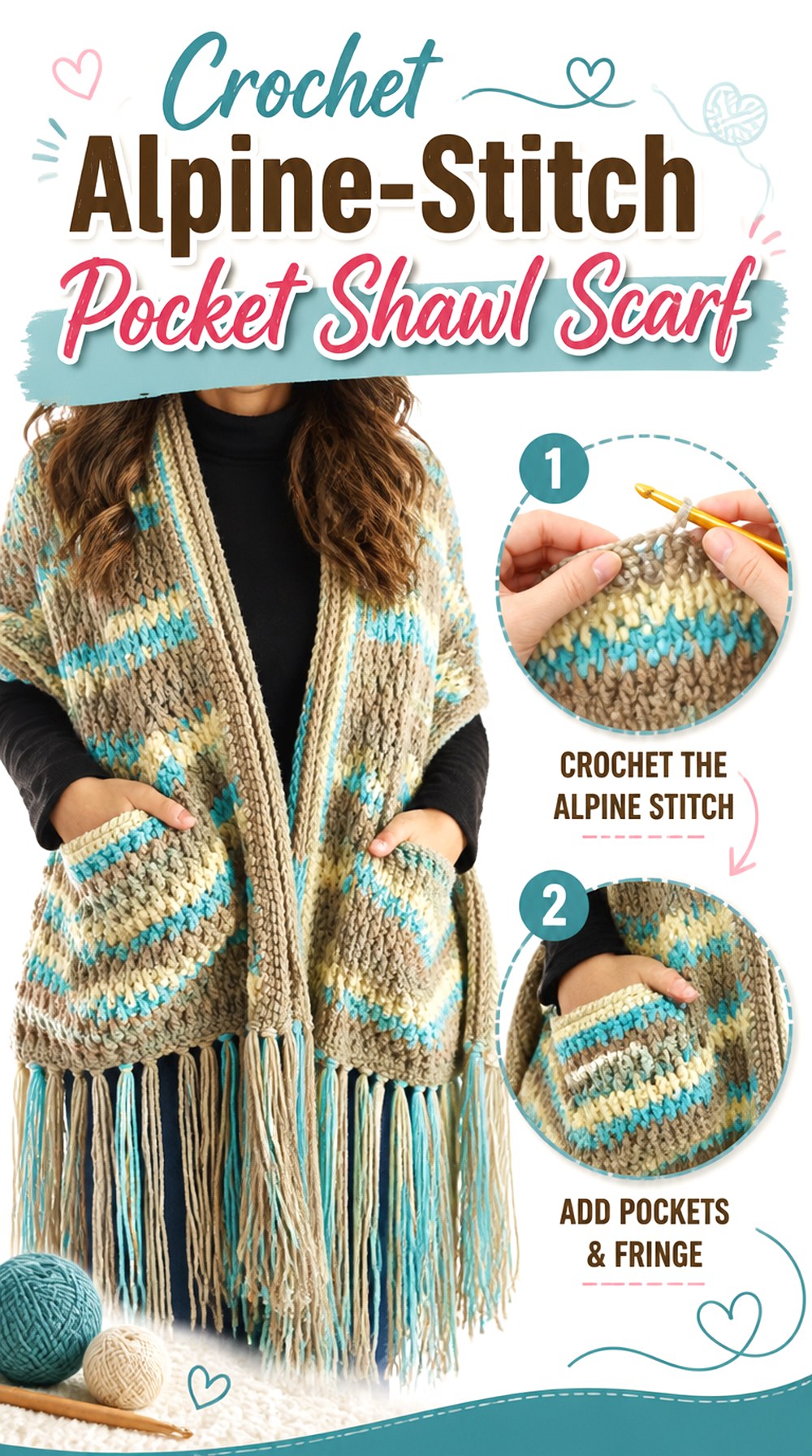
This Yarnspirations tutorial with Mikey of The Crochet Crowd uses the Alpine stitch as the main visual feature of a pocket shawl, giving the fabric a strongly raised surface rather than relying on motifs or plush yarn for interest. The demonstrated version also includes fringe and striped yarn.
It is a useful alternative when you want one continuous fabric but do not want it to look plain. The raised texture already supplies substantial visual detail, so color and finishing choices can be kept quieter if you want the stitch pattern to remain the focus.
Raised Texture Adds Visual Weight
Texture does not need to make a scarf physically heavy to make it look substantial. Deep relief stitches create shadows and a denser-looking surface, which is useful on a simple rectangular silhouette. If you widen the project significantly, step back periodically and assess whether the texture still feels balanced across the larger area.
Stripes Can Compete With Strong Texture
Self-striping yarn and pronounced stitches can work together, but both demand attention. A highly contrasting color sequence may make the raised pattern harder to read from a distance. If stitch definition is your priority, compare a solid, gently changing, and strongly striped swatch before choosing the final yarn.
Fringe Balances a Wide Textured Panel
A fringe finish continues the vertical movement created by a long shawl and can soften the transition from dense textured fabric to the lower edge. It remains optional from a styling standpoint. Leaving it off creates a cleaner outline for anyone who prefers to wear a pocket wrap under a coat or near bags with straps.
Original Tutorial and Creator Credit
Creator: Yarnspirations
13. Crochet Soft Hooded Pocket Wrap Scarf

Selina Veronique Crochet’s Simple Purity design combines the generous dimensions of a pocket wrap with a hood while keeping the overall surface relatively understated. The tutorial uses a soft yarn and presents the finished piece specifically as a hooded pocket scarf, shawl, and wrap.
This makes it a useful contrast to the chunkier Naztazia hooded scarf and the granny-cluster AstroKnotty version. Here, the main appeal is a smoother, softer silhouette rather than bold motif placement or very thick texture. It can suit readers who like the function of a hood but want the scarf to remain visually calm.
A Softer Hood Falls Closer to the Head
Fabric with more drape usually produces a hood that collapses more readily when lowered and follows the head more softly when raised. If you substitute a stiffer yarn, expect the hood silhouette to change even if the dimensions remain similar. Make a fabric sample large enough to judge movement, not just stitch size.
Center the Hood Before Judging Pocket Reach
The hood establishes a clear midpoint at the back of the scarf. Use that center as a fitting reference, put the piece on, and then evaluate where the ends and pockets naturally fall. This is more reliable than deciding pocket placement while the entire scarf is lying flat.
Minimal Surface Detail Keeps the Silhouette Quiet
A relatively restrained body allows the hood and pockets to define the garment. If you add contrasting borders, motifs, or elaborate fringe, you are changing that design balance. Decide whether you want a calm wardrobe layer or a statement accessory before stacking several decorative additions onto the same piece.
Original Tutorial and Creator Credit
Creator: Selina Veronique Crochet
14. Crochet Jumbo Hand Crocheted Pocket Scarf

The Cool Hand Pocket Scarf from Tamara Kelly of Moogly is the outlier of the collection because it is demonstrated with hand crochet rather than depending on a conventional crochet hook. Jumbo yarn produces an intentionally oversized stitch scale, and the scarf ends fold to form the pockets, with buttons available as an optional detail.
This is a strong choice for visual impact and for anyone curious about crochet at an unusually large scale. That scale also means tension inconsistencies and bulky seams become far easier to see, so the project rewards deliberate loop sizing.
Jumbo Yarn Magnifies Tension Differences
When each stitch is physically large, a small difference in loop height can become obvious across the finished fabric. Work slowly enough to establish a repeatable hand movement before judging the scarf’s width or drape. If your first section changes substantially as your tension settles, consider whether restarting will give a cleaner overall result.
Fold-Up Pockets Keep the Construction Direct
Forming pockets from the scarf ends avoids introducing two separate pocket panels. The important checkpoint is the fold position: test the scarf on the wearer before permanently closing the pocket sides so the usable depth and hand position feel natural rather than simply symmetrical on the table.
Optional Buttons Need Intentional Placement
Buttons can add contrast and a finished visual detail to a very chunky scarf. Before attaching them, decide whether you want them mainly as decoration or whether your adaptation expects them to interact with the pocket area. Do not assume a decorative element can carry functional tension unless the construction has been planned for that purpose.
Which Crochet Pocket Scarf Style Should You Choose?
| If you want… | Start with… | Main trade-off to consider |
|---|---|---|
| A familiar scarf shape | Crochet Tassel-End Pocket Scarf or Crochet Classic Straight Pocket Scarf | Less shoulder coverage than a wide wrap |
| A scarf that stays in a loop | Crochet Pocket Infinity Scarf | Pocket position depends closely on the loop circumference |
| A hood plus pockets | Granny-Cluster, Super-Bulky, or Soft Hooded Pocket Scarf | More fabric and weight around the center back |
| Broad shoulder coverage | Wide Pocket Shawl, Fringed Rectangle Wrap, or Blanket Pocket Scarf | More fabric to manage when wrapping around the neck |
| Strong surface texture | Velvet Comfort Wrap or Alpine-Stitch Pocket Shawl Scarf | Texture can affect stitch visibility, bulk, and drape |
| Decorative construction | Diamond-Motif Boho Pocket Wrap | Motif dimensions and joining accuracy matter |
| Dramatically oversized stitches | Jumbo Hand-Crocheted Pocket Scarf | Tension variations are more visible |
Conclusion
The most useful crochet pocket scarf is the one whose construction matches how you actually plan to wear it. Choose a narrow scarf if neck wrapping matters most, an infinity version if you prefer a continuous loop, or a wide pocket wrap when shoulder coverage is more important. Hooded styles add another layer of cold-weather function, while Alpine texture, velvet, granny motifs, or jumbo stitches can turn the scarf itself into the main visual feature.
Before finishing any version, check pocket reach, drape, width, and overall weight on the wearer rather than judging the project only while it is flat. For stitch counts, assembly sequences, materials, and exact construction, follow the original credited tutorials linked with each idea.
Frequently Asked Questions
How long should a crochet pocket scarf be before I add the pockets?
There is no universal length because comfortable pocket placement depends on the wearer’s height, arm position, scarf width, and how the scarf will be styled. Instead of copying a generic measurement, drape the unfinished scarf in its intended position and mark where relaxed hands naturally reach. If you change the length of a tutorial, recheck pocket placement rather than automatically attaching them at the creator’s original relative position.
Can I make a pocket shawl tutorial narrower and use it as a scarf?
Often the concept can be adapted, but narrowing the body can affect stitch repeats, borders, pocket proportions, and the way the fabric drapes. Confirm the tutorial’s construction before changing its width. After making the narrower body, reassess pocket size instead of automatically using pockets designed for a much wider shawl. The finished piece should still leave enough surrounding fabric for the pockets to look and function proportionally.
What yarn qualities work well for a crochet pocket scarf?
Look at drape, stretch, recovery, warmth, stitch definition, and finished weight together. A soft yarn may feel pleasant around the neck but could stretch substantially beneath loaded pockets. A firmer yarn may support pocket shape better but create more bulk when wrapped. Work a sample, handle it as fabric rather than just measuring gauge, and check the yarn label for the manufacturer’s care instructions before choosing it for a frequently worn scarf.
Why do crochet pocket scarf pockets start to sag?
Sagging can come from stretchy yarn, loose fabric, large pockets, frequent use, or carrying more weight than the crochet fabric comfortably supports. Pocket scarves are particularly affected because each pocket hangs from a long flexible panel. Keep the intended use realistic, check attachment edges for distortion, and avoid treating soft crochet pockets as substitutes for a structured handbag when the design was mainly intended for hands or lightweight personal items.
Is a hooded crochet pocket scarf better than a regular pocket scarf?
It depends on how you wear outer layers. A hood adds head and neck coverage and can make one accessory more versatile, but it also places additional fabric at the center back. A regular pocket scarf is usually simpler to layer beneath coats and easier to wrap tightly around the neck. Compare the AstroKnotty, Naztazia, and Selina Veronique hooded versions with the narrower non-hooded scarves to see which silhouette suits your wardrobe.
Should I block a crochet pocket scarf before attaching separate pockets?
Blocking or otherwise allowing the scarf and pocket pieces to settle into their intended finished dimensions can make placement more predictable, particularly with motifs or fabrics that change noticeably after finishing. Follow the yarn’s care guidance and the tutorial’s instructions rather than applying one blocking method universally. Once the pieces have stabilized, pin the pockets temporarily and perform a wearing check before permanent seaming.


