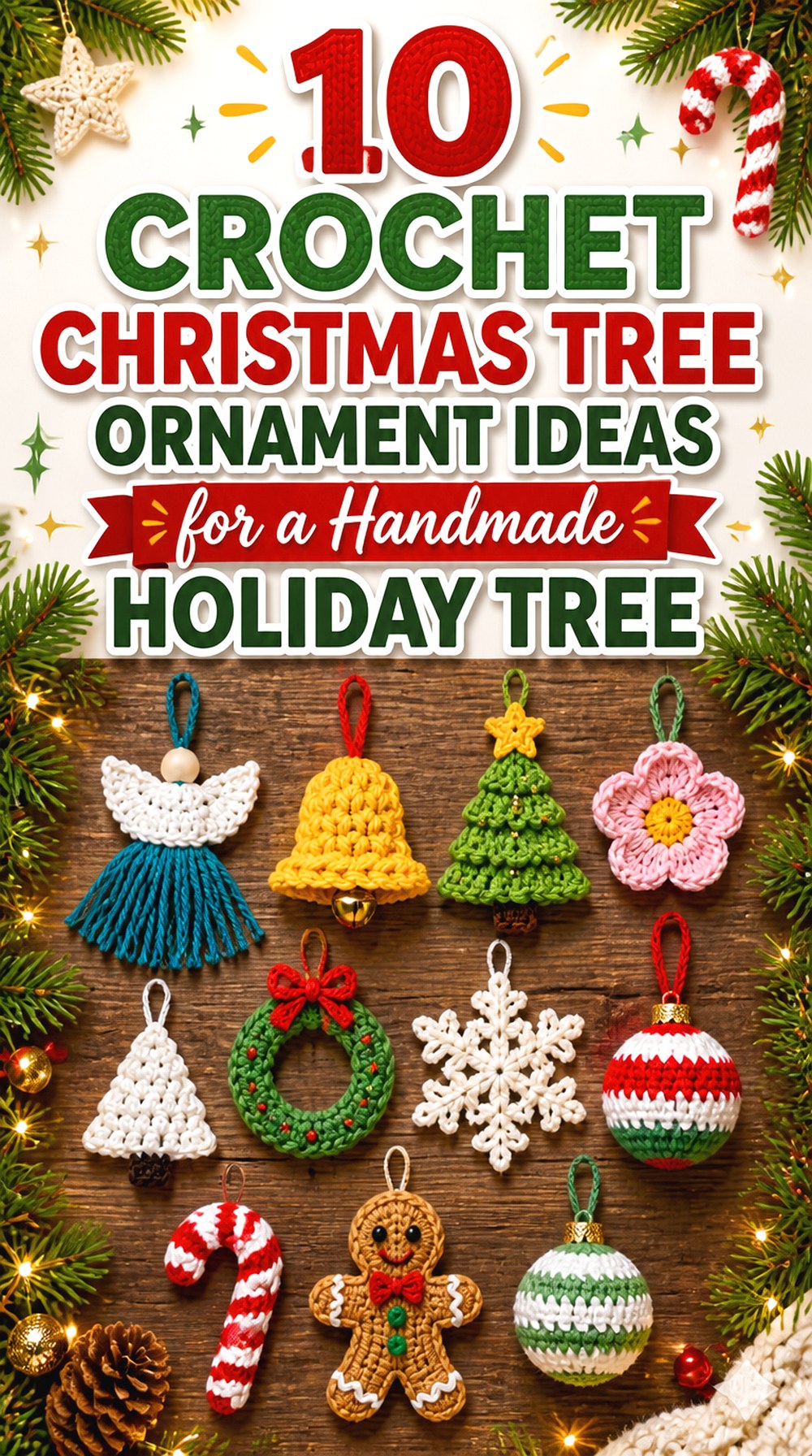

Crochet Christmas tree ornaments can be delicate and nearly flat, softly stuffed, shaped around a support, or built as miniature versions of familiar holiday objects. Those differences affect more than appearance. A lacy snowflake needs good shaping, a round bauble takes up more branch space, and a tiny stocking creates an opening that can become part of the design.
The 10 ideas below cover noticeably different silhouettes and construction styles rather than repeating the same ornament in new colors. You can compare them by structure, visual weight, storage, hanging behavior, and finishing details. Each project also includes an original YouTube tutorial from a different crochet creator, so once you choose a style, you can follow the credited source for its exact construction.
Quick List
- Crochet Lacy Snowflake Tree Ornament
- Crochet Embroidered Bauble Ornament
- Crochet Five-Point Star Ornament
- Crochet Mini Christmas Stocking Ornament
- Crochet Curled Wreath Tree Ornament
- Crochet Gingerbread Man Ornament
- Crochet Angel Tree Ornament
- Crochet Textured Christmas Tree Ornament
- Crochet Mini Bell Ornament
- Crochet Spiral Candy Cane Ornament
Choose Ornament Shapes by How They Will Hang
A finished ornament should make sense on the branch, not only look appealing while lying flat. Snowflakes and stars create a broad silhouette without much depth, so they suit areas where neighboring ornaments already occupy plenty of space. Stuffed baubles project farther forward and can become stronger focal points.
Longer shapes such as stockings, angels, trees, bells, and candy canes need enough vertical clearance beneath the branch. Wreaths are useful when you want an open center that prevents the ornament collection from looking too visually dense.
Before repeating one design for an entire set, finish a single sample with its actual hanging loop. Place it on the type of tree or display branch you plan to use and check its balance, orientation, and spacing.
Yarn Choice Changes Shape, Drape, and Definition
An ornament often benefits from different yarn qualities than a scarf or garment. A soft, drapey yarn can make openwork points or flat shapes lose definition, while a firmer fiber can help motifs look cleaner. Naztazia’s snowflake tutorial, for example, specifically uses worsted-weight cotton and discusses its ability to retain shape.
Dimensional ornaments have another consideration: stitch density. If an ornament is stuffed, gaps become more noticeable because the filling can show through. For textured designs, choose yarn that allows raised stitches, edges, and embroidered details to remain visible.
Always compare your yarn with the tutorial’s intended construction before assuming that changing fiber or thickness will produce the same scale or behavior.
Plan Hanging Loops and Embellishments Before Finishing
A hanging loop is part of the ornament’s structure. Its position affects whether a star hangs point-up, a stocking tilts sideways, or a dimensional bauble rotates awkwardly. Check the balance before permanently securing the loop, especially after adding beads, bows, stuffing, embroidery, or other decoration.
Small embellishments also change how an ornament should be used. Beads, bells, buttons, wooden pieces, and wire supports can add detail, but they deserve secure attachment and sensible placement. If ornaments will be accessible to babies, small children, or pets, avoid treating decorative parts as automatically safe simply because they are attached to crochet.
For a reusable holiday collection, also consider storage. Flat ornaments can usually be layered with protection between them, while stuffed or reinforced pieces need more room to avoid being crushed.
1. Crochet Lacy Snowflake Tree Ornament
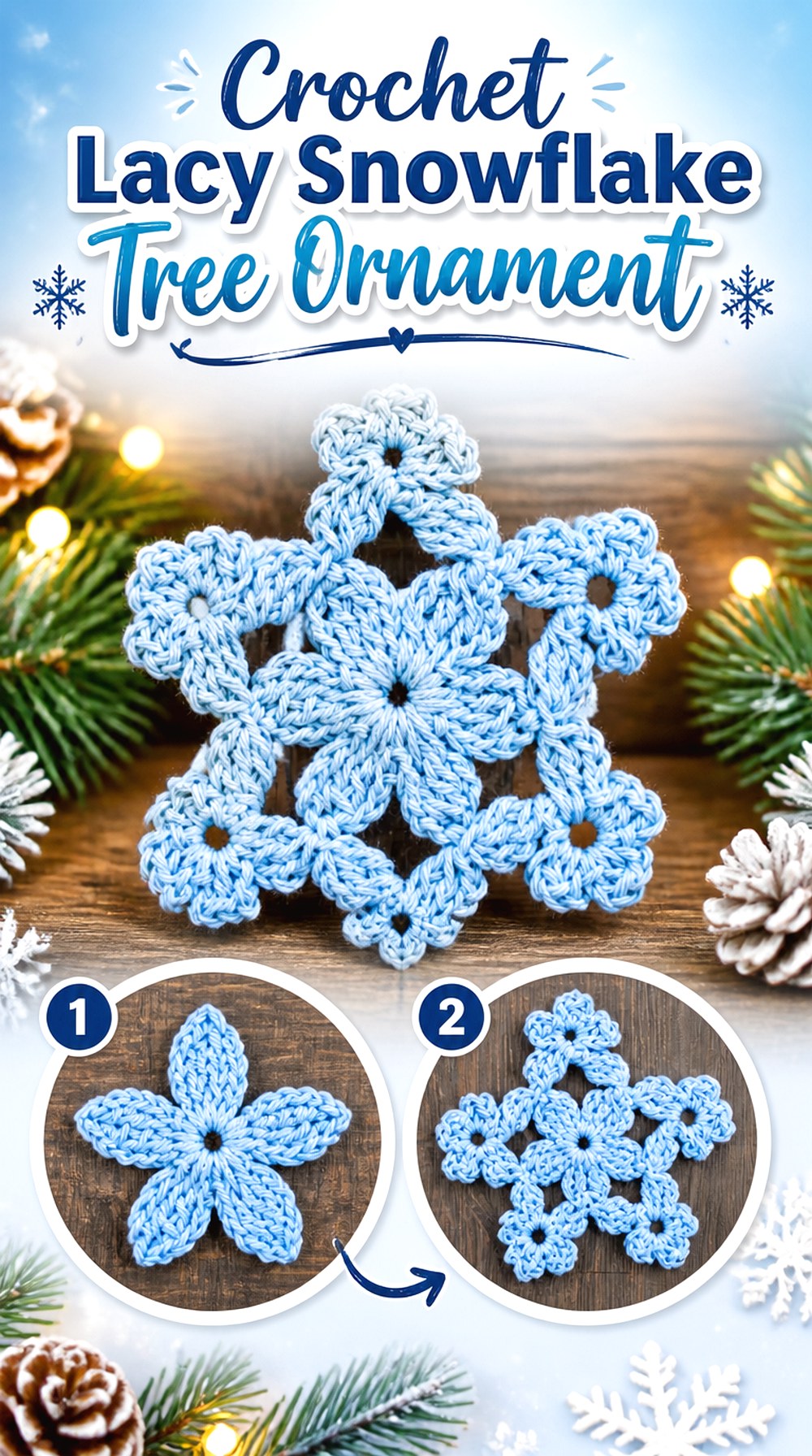
A crochet snowflake creates a wide decorative shape with very little bulk, making it useful for filling open spaces between larger ornaments. Naztazia’s version has the recognizable six-sided snowflake structure and uses cotton yarn to help the finished piece retain definition.
This is a strong choice when you prefer winter imagery rather than character-based Christmas decor. Because the visual impact comes from the outline, openings, and repeated points rather than stuffing or embellishment, the quality of the final shaping matters considerably. It can also work well in a coordinated group where several identical snowflakes create rhythm without making the tree feel crowded.
Blocking Determines How Clearly the Points Read
An open crochet motif can look uneven immediately after it leaves the hook even when the crochet itself is consistent. Assess the snowflake only after giving the points a chance to settle into their intended positions.
If you make several, compare them while they are being shaped rather than assuming each will naturally finish identically. Small differences become especially noticeable when multiple snowflakes hang close together.
Cotton and Stiffening Create Different Finishes
The tutorial uses worsted-weight cotton and notes that its structure can reduce the need for additional stiffening. That does not mean every cotton yarn will behave identically.
Decide whether you want a softer handmade look or a very crisp decorative silhouette. If you use a stiffening product, test the result on a sample first because it changes both the hand of the fabric and how the ornament should later be stored.
2. Crochet Embroidered Bauble Ornament
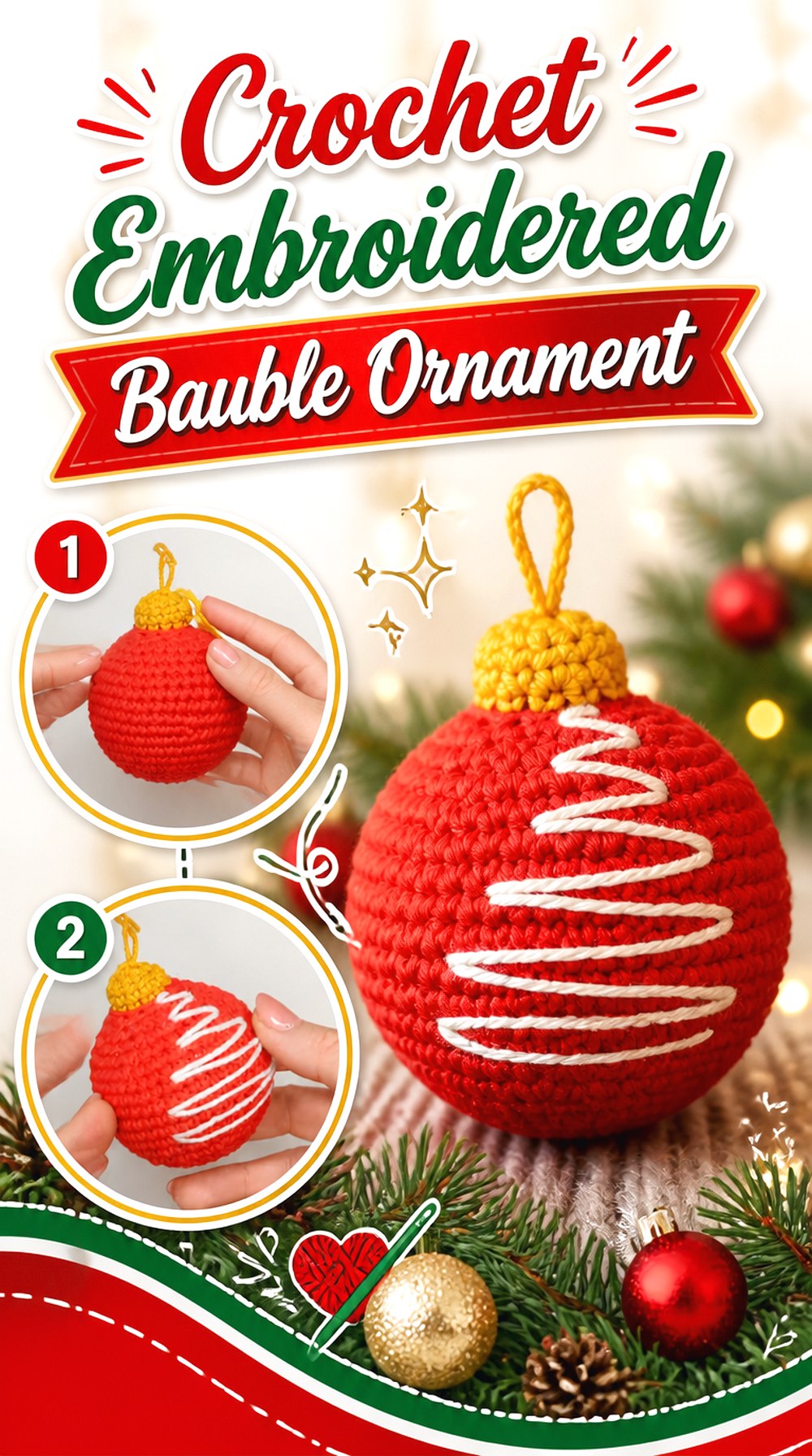
This crochet bauble gives you a dimensional alternative to flat motifs. Amigurumi_Joys demonstrates a rounded ornament and several embroidery treatments, so the main shape can stay consistent while the surface decoration changes.
A bauble works particularly well as a focal ornament because its rounded body occupies more physical and visual space than a snowflake or star. It also gives you a larger uninterrupted surface for decorative stitching. When planning several, think about how much depth your tree can accommodate; a collection of dimensional ornaments needs more separation between branches than an assortment dominated by flat pieces.
Stuffing Should Support the Sphere Without Distorting It
The goal with a round ornament is an even silhouette. Underfilling can leave soft dents, while excessive filling can stretch the crochet fabric and make gaps more visible.
Add filling gradually and rotate the ornament as you assess it. Judge the shape from several angles because the side facing you during assembly may not be the side that faces forward once it hangs.
Embroidery Can Create Variety Without Changing Construction
The tutorial includes several embroidered decoration ideas on the basic bauble. This is useful if you want a coordinated set without making ten completely different structures.
Keep decorative density consistent if the ornaments will hang together. One heavily stitched bauble beside several nearly plain ones can look less intentional unless that contrast is part of the plan.
Check the Hanging Point After Decoration
Surface stitching can subtly shift visual balance, particularly if one side is much more decorated than the other. Add or test the hanger after the ornament’s main decorative work is complete.
A properly positioned loop should let the finished design present itself naturally instead of requiring you to twist the ornament every time it is placed on the tree.
Original Tutorial and Creator Credit
Creator: Amigurumi_Joys
3. Crochet Five Point Star Ornament
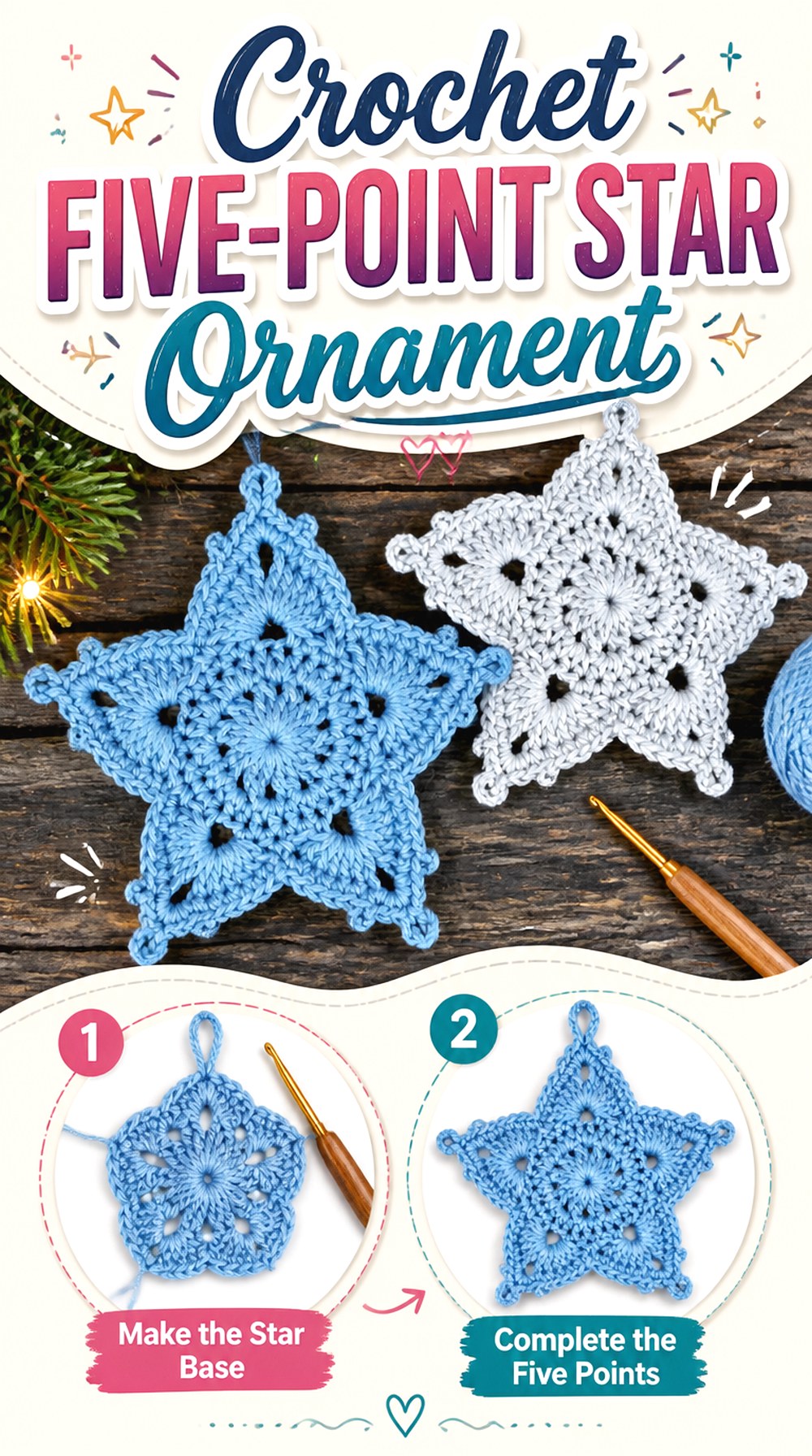
A crochet star provides a stronger, simpler outline than a detailed snowflake. Kristines Crochets demonstrates a pointed star worked as a flat Christmas decoration, with open spaces and a defined outer edge rather than a stuffed construction.
This shape works well where you want something graphic enough to remain recognizable from across the room. Stars also mix easily with round baubles and longer ornaments because their width helps interrupt rows of narrow hanging shapes. The main planning question is not color but point definition: a star that curls or has unevenly shaped tips loses much of the clean geometry that makes the design effective.
Symmetry Matters More on a Simple Outline
The fewer major features an ornament has, the more noticeable uneven ones become. Compare the five points before finishing and check whether one extends or curves differently from the others.
If the star will be blocked, shape all five points during the same session. For a repeated set, using one finished star as a visual reference can help keep later ornaments reasonably consistent.
Choose the Hanging Point Before Adding the Loop
A five-point star usually reads most naturally with one point facing upward. Mark that point before adding a hanger so you do not accidentally shift the ornament’s visual orientation.
If you want stars to hang at different angles for a more informal tree, vary them deliberately. Random loop placement can look more like an assembly mistake than intentional variation.
Original Tutorial and Creator Credit
Creator: Kristines Crochets
4. Crochet Mini Christmas Stocking Ornament
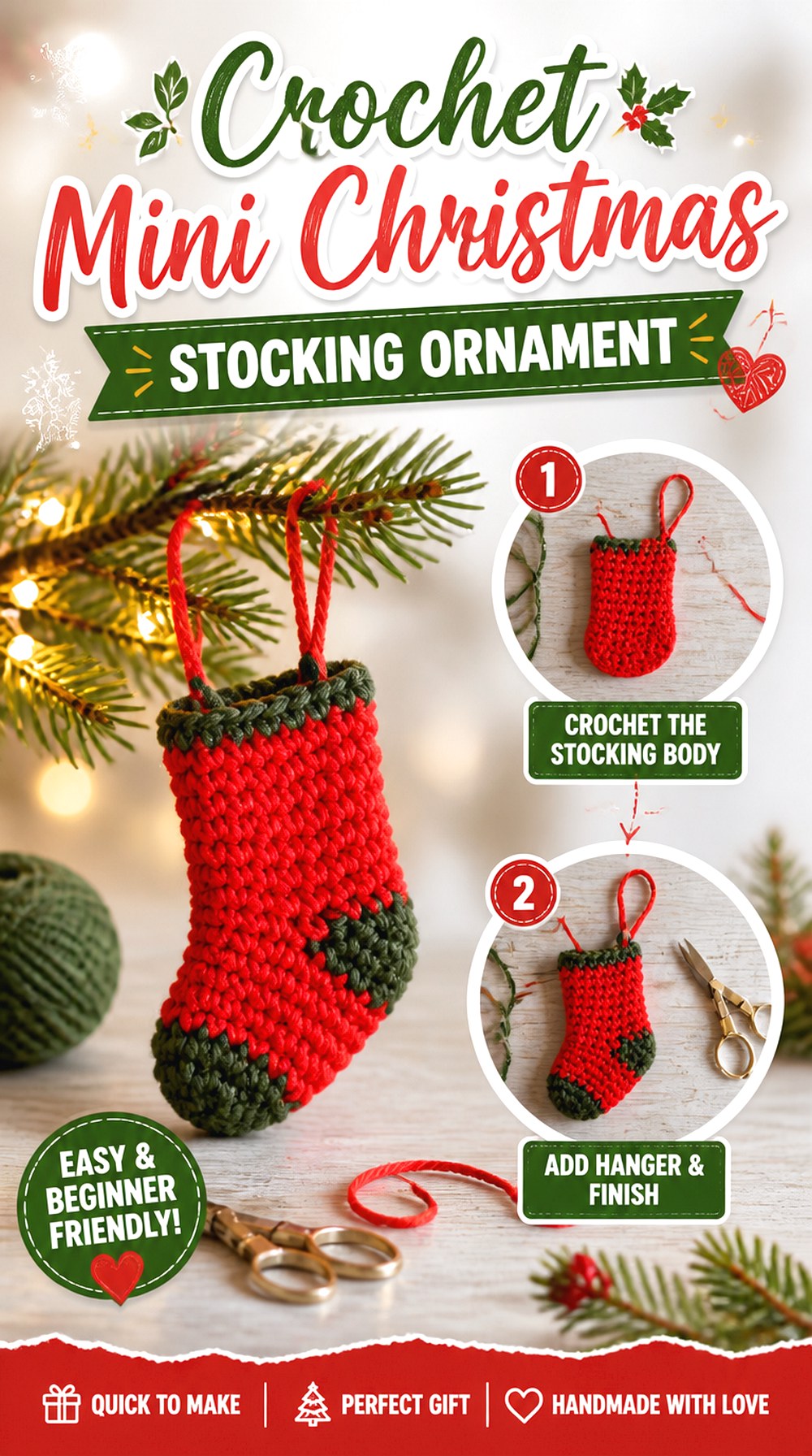
A miniature stocking adds both shape and a functional-looking opening to the tree. Whistle and Ivy Modern Crochet’s tutorial makes a small stocking specifically suited to ornament or garland use.
Unlike a flat motif, the stocking has a recognizable heel, cuff, and hanging direction, giving it the feel of a tiny household object rather than a decorative symbol. It is particularly effective on traditional trees where miniature versions of familiar Christmas pieces fit the overall theme. Before making a large set, decide whether the opening will stay purely decorative or whether you expect to tuck anything inside, because filling the stocking can change how it hangs.
The Heel Creates the Recognizable Silhouette
A tiny stocking needs enough distinction between leg, heel, and foot to remain readable from a distance. Pay attention to the shape as the project develops rather than evaluating only the stitch texture.
If your finished piece twists when hanging, lightly arrange the heel and foot before adjusting the hanger. The stocking should look intentional without needing constant repositioning.
A Decorative Opening Is Not Automatically a Gift Pocket
Because the ornament has an opening, it can be tempting to treat it like a miniature container. Test that assumption before placing anything inside.
Added contents can stretch the fabric, change the hanging angle, or become too heavy for a delicate tree branch. If you want a functional gift-holder version, choose the contents based on the actual finished stocking rather than an assumed capacity.
Cuff Contrast Can Clarify the Shape
A contrasting cuff immediately separates the top from the body and can make the tiny stocking easier to recognize. If you prefer a monochrome tree, texture or subtle yarn differences can play the same visual role.
For sets, keep the main construction consistent and vary cuff colors only if you want controlled color changes without changing the silhouette.
Original Tutorial and Creator Credit
Creator: Whistle and Ivy Modern Crochet
5. Crochet Curled Wreath Tree Ornament
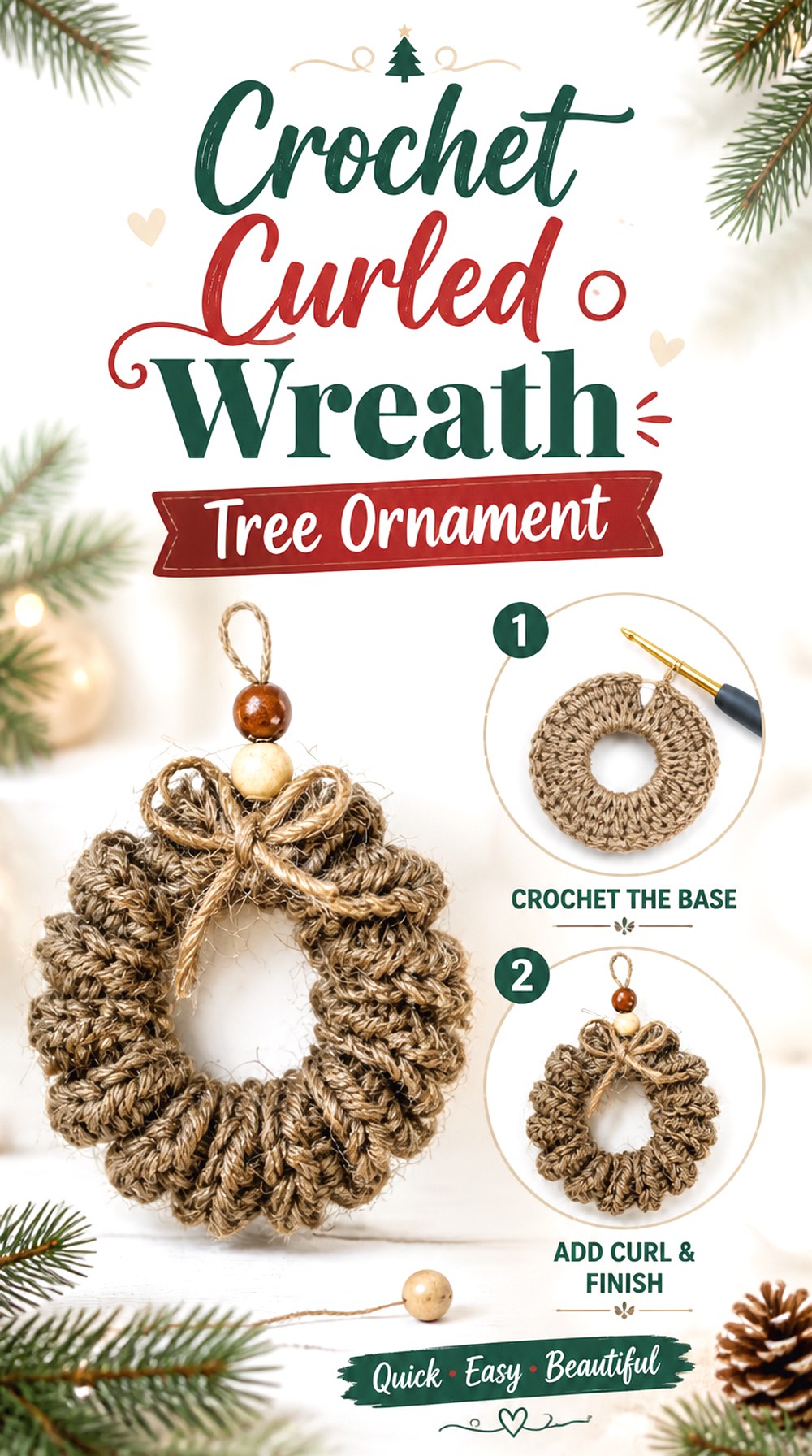
MJ’s Off The Hook Designs takes a different route to a miniature wreath by using a curled crochet length that is shaped into a ring and finished with rustic decorative details.
The open center makes this ornament visually lighter than a solid bauble while still giving it more texture and depth than a flat star. Wreaths are also useful between character ornaments because the circular form provides a visual pause. If you make multiples, focus on keeping the diameter and opening reasonably consistent; different amounts of compression in the curled section can make otherwise identical pieces look noticeably different.
The Center Opening Is Part of the Design
Do not evaluate only the thickness of the crocheted ring. The empty area in the middle is equally important because it keeps the wreath recognizable.
Before securing the final shape, adjust the crochet evenly around the circle. A noticeably narrow opening on one side can make the wreath look pulled out of round even when the outer circumference seems acceptable.
Decorative Beads Change the Top Weight
The creator’s design incorporates twine and wooden beads in its finishing. Any decoration positioned above the wreath affects how it hangs.
If you substitute heavier beads or hardware, test the ornament on a branch before repeating the modification across a complete set. What works aesthetically on a table may pull differently once suspended.
Store Wreaths Without Flattening Their Texture
A textured ring can lose some of its character if compressed under heavier decorations for months. Give these ornaments enough storage space that the curled surface is not permanently squashed.
If you are building a yearly collection, a shallow divided box can help keep dimensional pieces separate from flat motifs and heavier baubles.
Original Tutorial and Creator Credit
Creator: MJ’s Off The Hook Designs
6. Crochet Gingerbread Man Ornament
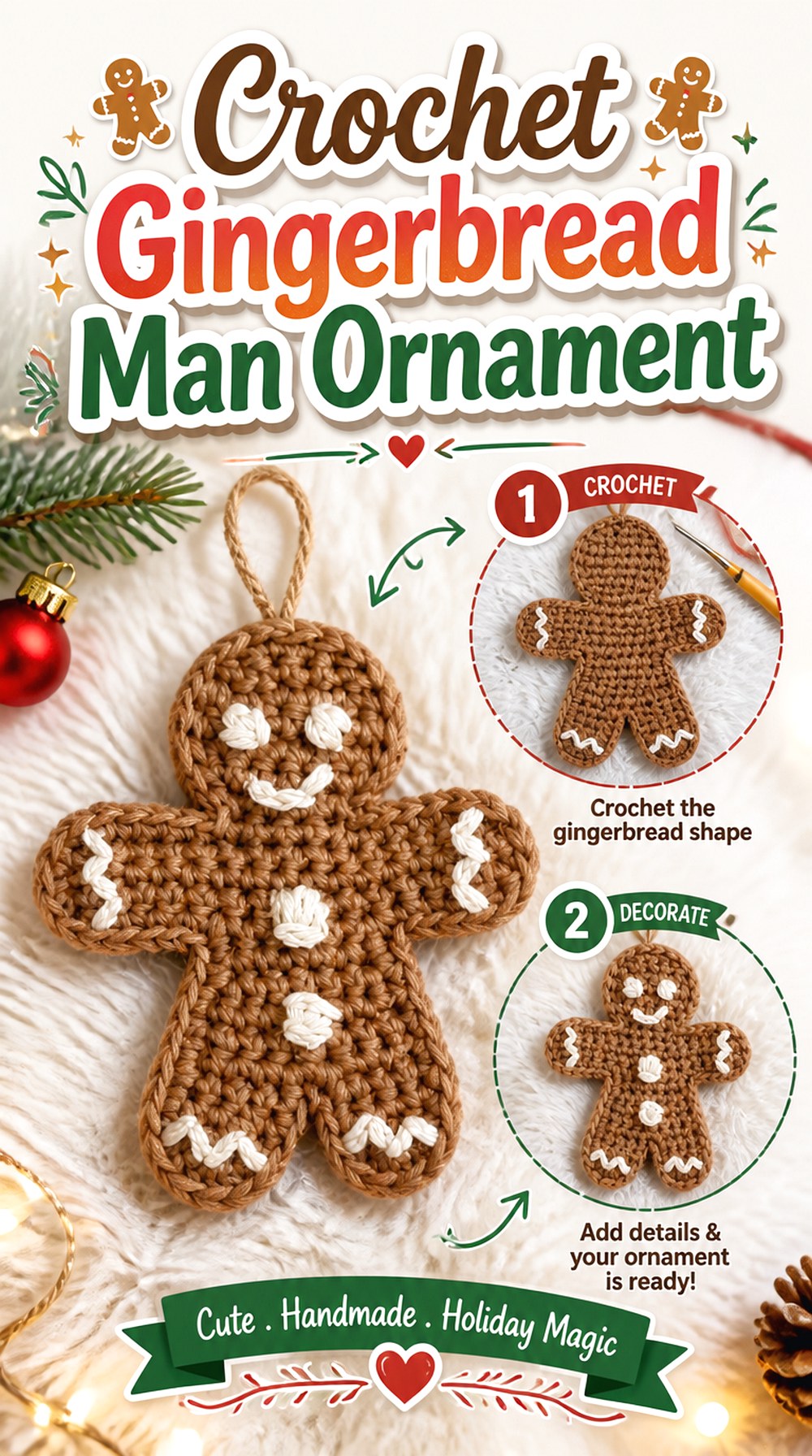
The gingerbread man introduces a figurative ornament without requiring the rounded bulk of a fully stuffed character. Candid Crochet presents the small figure as suitable for Christmas tree, garland, or Advent decoration.
Its recognizable arms, legs, and head make it a stronger storytelling piece than geometric decorations, while the relatively flat form keeps it easier to layer among other ornaments. Surface details can change the personality considerably, so this is a useful design if you want related ornaments that are not perfectly identical. Keep the overall silhouette consistent first; facial and decorative differences are easier to appreciate when the underlying figures remain balanced.
Facial Details Need to Read at Ornament Scale
A detail that looks subtle while you hold the piece close may disappear once it hangs among lights and branches. Before permanently adding facial features, view the ornament from farther away.
This does not mean every feature needs to be larger. Strong contrast and uncluttered placement often make small embroidery clearer than adding many separate decorations.
Flat Figures Can Curl at Their Narrowest Areas
Arms and legs have less fabric supporting them than the torso. If your yarn or tension leaves those sections curling noticeably, assess the finished figure before adding all decorative details.
Gentle shaping or appropriate blocking may improve presentation, but use a method compatible with the chosen fiber and any attached decorations.
Keep Small Decorations Appropriate for the Display
Buttons, beads, and similar details can create a classic gingerbread-cookie look, but they also introduce detachable components. Consider where the finished ornament will hang and who can reach it.
Embroidery or securely crocheted surface details can provide an alternative when loose small embellishments would be undesirable.
Original Tutorial and Creator Credit
Creator: Candid Crochet
7. Crochet Angel Tree Ornament
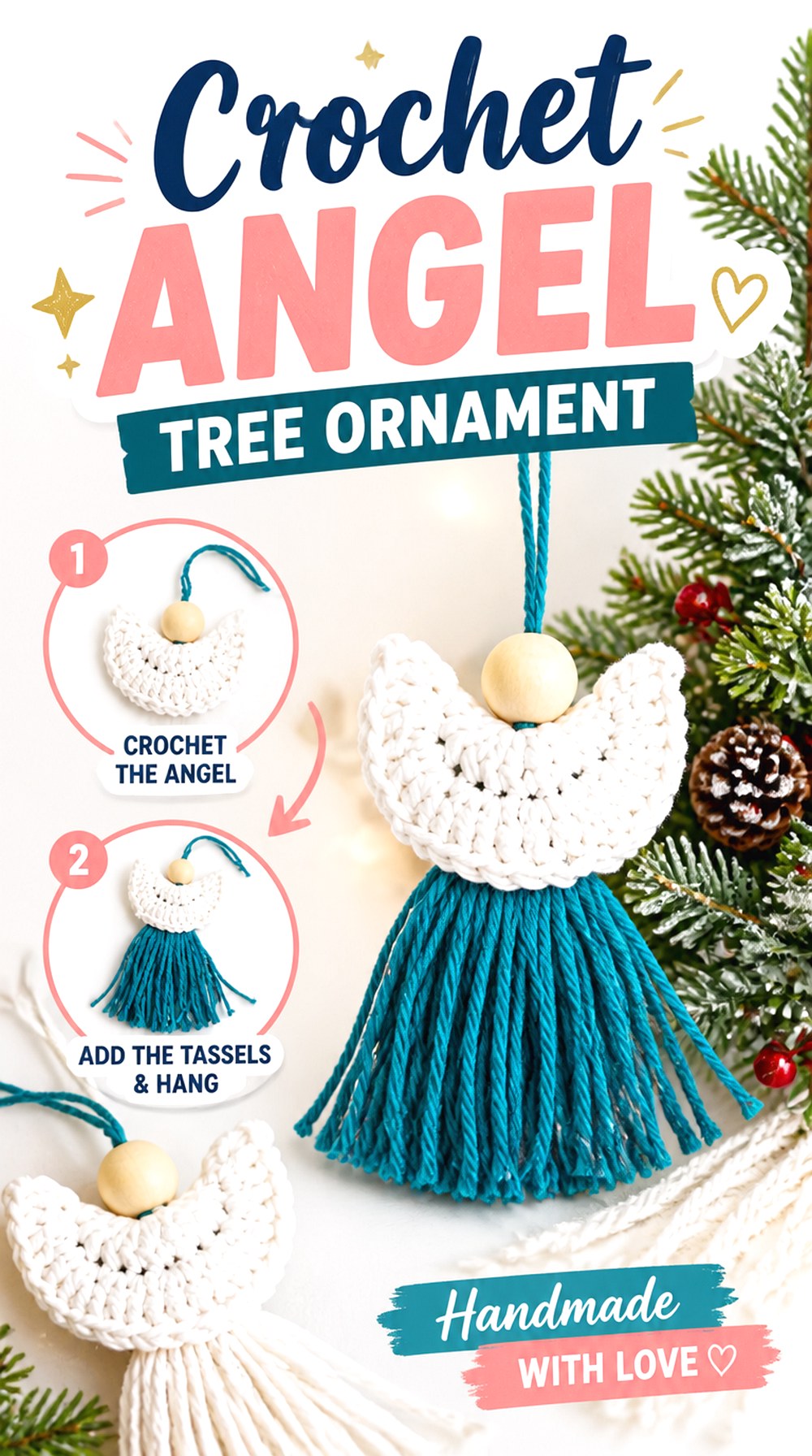
Winding Road Crochet’s angel combines a crocheted body and wings with additional materials, including a wooden bead used for the head. The result is longer and more dimensional than a simple angel appliqué while remaining relatively light-looking.
This format suits trees where traditional Christmas symbolism is more important than playful character styling. The wings give the ornament useful width, while the hanging skirt creates vertical movement below the branch. Because several materials meet at the center of the ornament, assembly and balance deserve as much attention as the crochet itself.
Wing Position Controls the Finished Width
The wings create most of the angel’s horizontal silhouette. Before securing them permanently, compare their height and angle from both the front and back.
If one side sits noticeably higher, the asymmetry becomes obvious once the ornament hangs freely. Temporary placement before final attachment can save more adjustment than trying to correct wings after every component has been secured.
Mixed Materials Need a Secure Connection
This tutorial combines crochet with a wooden bead head. When adapting a mixed-material ornament, make sure the hanging system does not depend on a decorative component that can easily separate.
Check joins again after the ornament has been handled and stored. Seasonal pieces may spend most of the year packed away, so attachment quality matters beyond the first day on the tree.
Trim Hanging Fibers Only After the Shape Is Settled
If your angel includes loose yarn forming part of the skirt or decorative body, resist trimming too early. Let the pieces hang naturally first.
Once the ornament is suspended, you can judge the lower edge more accurately. Trimming while the fibers are compressed on a table can produce an unexpectedly uneven line when gravity pulls them downward.
Original Tutorial and Creator Credit
Creator: Winding Road Crochet
8. Crochet Textured Christmas Tree Ornament
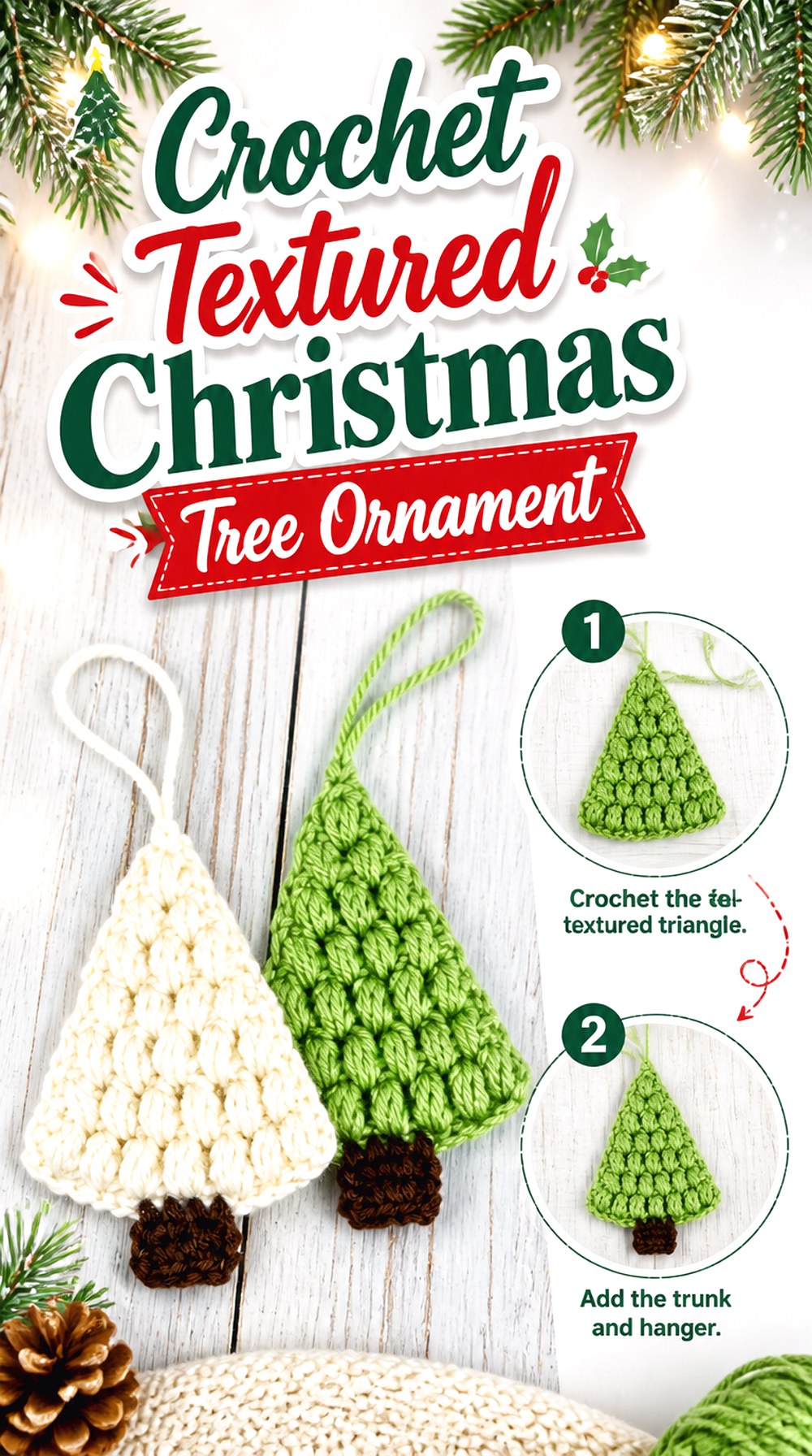
A Christmas tree ornament shaped like a miniature tree creates a playful tree-within-a-tree effect. Desert Blossom Crafts’ flat version combines single crochet with raised puff-stitch texture and includes a separate trunk and hanging finish.
The triangular silhouette is easy to recognize even when the ornament is partly surrounded by branches. Compared with the more open star and snowflake designs, this one offers a denser surface where texture becomes the main decorative feature. It is also relatively flat, which makes it useful for balancing a collection that already contains several stuffed ornaments.
Raised Texture Needs Yarn With Visible Definition
A textured stitch can disappear in very fuzzy, highly variegated, or visually busy yarn. If the puff details are important to the look, compare yarn choices under the same lighting in which the finished tree will be displayed.
Strong stitch definition can make a single-color ornament more interesting without requiring beads or extra surface decoration.
Keep the Tree’s Centerline Vertical
A triangular motif makes crooked hanging especially noticeable. Before fastening the loop permanently, identify the visual center running from the top point through the trunk.
Suspend the ornament temporarily and check whether the trunk falls directly beneath the top. A slight adjustment at the hanger may correct an otherwise distracting tilt.
Embellishment Is Optional, Not a Requirement
A miniature crochet tree naturally invites beads, buttons, knots, or other “ornaments,” but the textured fabric may already provide enough detail.
Before adding extra components, decide whether the piece will sit beside heavily decorated baubles and characters. A simpler tree can provide useful visual contrast in a mixed handmade collection.
Original Tutorial and Creator Credit
Creator: Desert Blossom Crafts
9. Crochet Mini Bell Ornament
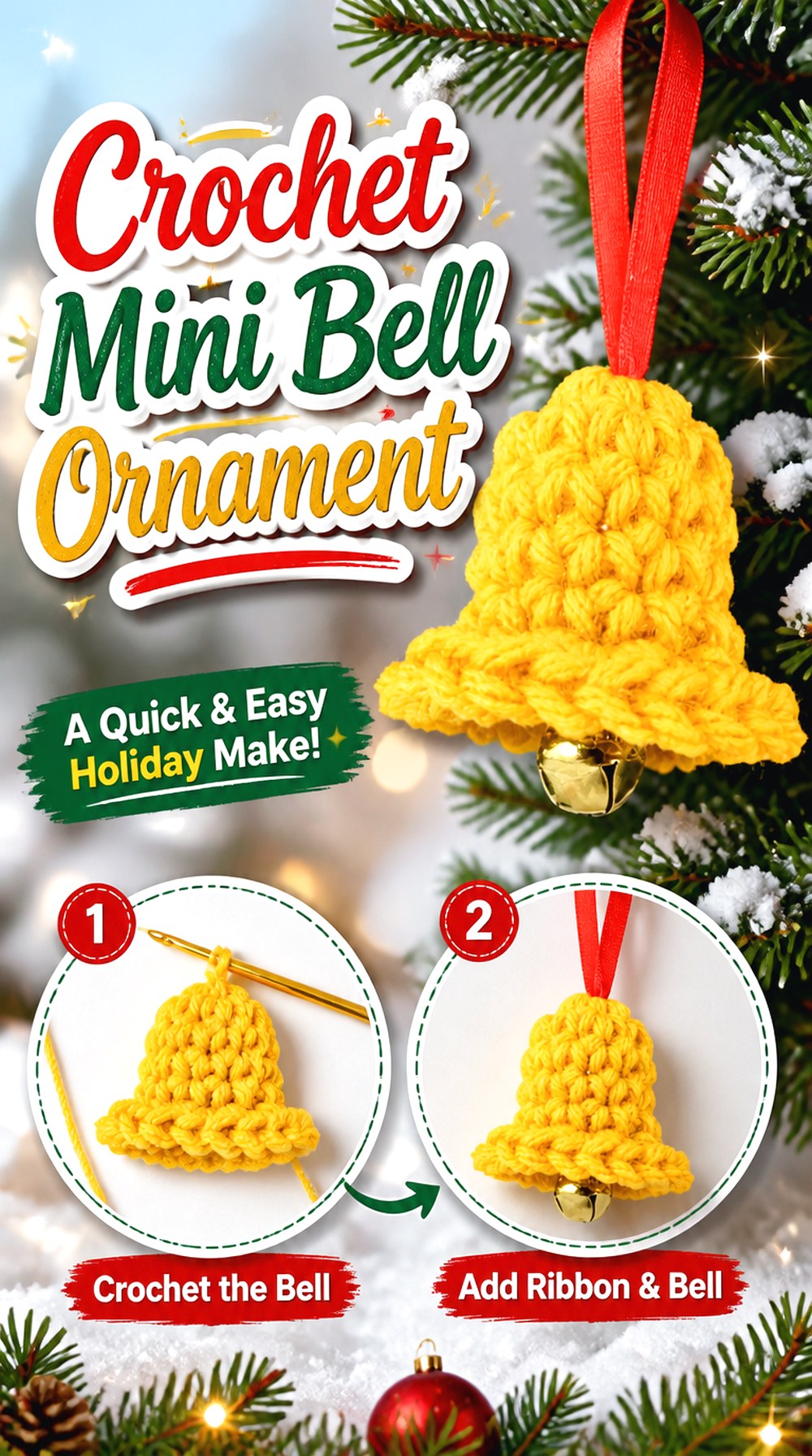
A crochet bell gives the collection a dimensional shape without becoming a fully stuffed object. Jayda InStitches’ tutorial creates a recognizable bell form that can hang as a soft ornament and may be further decorated according to the maker’s preference.
The flared lower edge makes this shape different from the round bauble and straight-sided stocking. Bells also look especially effective where there is some empty space beneath the branch, since the silhouette depends on seeing the lower flare rather than pressing it against surrounding greenery.
The Flared Edge Should Stay Clearly Defined
The bottom edge is what separates a bell visually from a small pouch or cone. Check the silhouette after finishing and make sure the edge is not folded inward by the way it was stored or handled.
If the bell needs reshaping, use a method appropriate for the fiber rather than forcing the stitches into position while dry.
A Real Jingle Bell Changes More Than the Sound
Adding a metal bell or another weight inside may make the ornament more interactive, but it also changes how much force the hanger and branch must support.
If you adapt the tutorial this way, test the finished weight on the intended display before making a whole set. A decorative crochet shell by itself behaves differently from one carrying hardware.
Match the Hanger to the Bell’s Center
A bell looks most convincing when it hangs vertically. Position the loop so the widest section falls evenly beneath the top.
After attaching additional decoration such as a bow, recheck the balance. A heavier element on one side can pull the bell off-center even when the original hanging point was correct.
Original Tutorial and Creator Credit
Creator: Jayda InStitches
10. Crochet Spiral Candy Cane Ornament
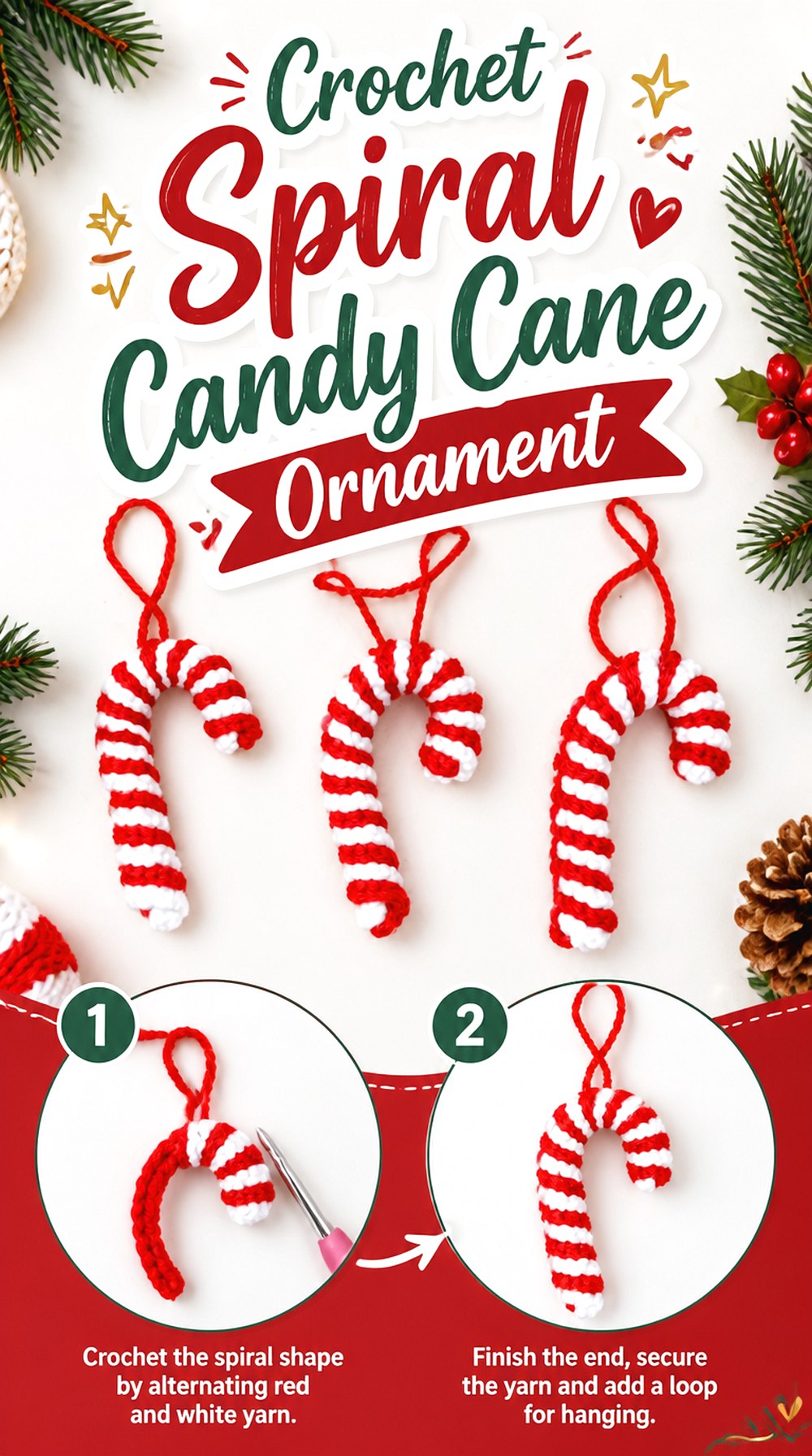
Made by Phia’s candy cane takes a very different construction approach from the other ornaments in this collection. The tutorial creates red and white crocheted coils and uses a pipe cleaner to support the recognizable curved cane shape.
That internal support makes the ornament more sculptural than the flat motifs but narrower than a stuffed bauble. It works particularly well when you need vertical shapes to break up clusters of round decorations. Because the cane’s identity depends on its curve and striped spiral, shaping and color placement carry more visual importance than surface embellishment.
Internal Support Makes the Curve Adjustable
A supported candy cane can hold a stronger hook shape than soft crochet alone. The tutorial specifically incorporates a pipe cleaner into the ornament.
Shape the curve gradually rather than creating a hard bend in one point. A smooth transition from the straight section into the hook usually reads more clearly as a traditional candy cane silhouette.
Keep the Two Colors Visually Balanced
A red-and-white spiral is recognizable because neither color disappears into the other. When assembling or positioning the crocheted sections, view the cane from the front and check whether both colors remain visible along the full length.
If you substitute another palette, maintain enough contrast for the spiral construction to remain obvious from tree-viewing distance.
Supported Ornaments Need Thoughtful Storage
Unlike a soft stocking, a shaped candy cane should not be forced flat simply to fit a small storage box. Repeated bending can change the intended curve or stress the internal support.
Store it alongside other dimensional ornaments with enough space to retain its silhouette until the following Christmas season.
Which Crochet Christmas Tree Ornament Style Should You Choose?
| Ornament | Main visual quality | Useful when you want | Main planning checkpoint |
|---|---|---|---|
| Snowflake | Open and delicate | Minimal bulk | Point shaping |
| Bauble | Rounded and substantial | A focal ornament | Even stuffing |
| Star | Graphic and flat | Strong simple outlines | Symmetry |
| Stocking | Miniature object | Traditional decor | Hanging angle |
| Wreath | Textured open circle | Visual breathing room | Ring shape |
| Gingerbread man | Character silhouette | Playful seasonal details | Small features |
| Angel | Long and layered | Traditional symbolism | Component balance |
| Christmas tree | Flat and textured | Dense stitch detail | Centered hanger |
| Bell | Flared dimension | Vertical movement | Lower-edge shape |
| Candy cane | Narrow and curved | Striped sculptural form | Support and curve |
Conclusion
Choose your crochet Christmas tree ornaments by silhouette and structure before settling on colors. Snowflakes and stars keep the tree visually light, while baubles and bells add dimension. Stockings, gingerbread figures, angels, and miniature trees bring recognizable Christmas imagery, and the wreath provides an open shape that helps separate denser decorations. The supported candy cane is useful when you want a narrow ornament with a strong curved outline.
For a balanced handmade tree, mixing flat, dimensional, wide, and vertical pieces generally creates more variety than repeating one basic construction. Once you have chosen an idea, use the original tutorials above for the creators’ exact stitchwork, assembly, materials, and construction details.
Frequently Asked Questions
What yarn works well for crochet Christmas tree ornaments?
Start with the construction rather than assuming one fiber is ideal for every ornament. Crisp flat motifs often benefit from yarn that holds definition, while stuffed ornaments need fabric dense enough to contain filling neatly. Textured designs need yarn that does not hide raised stitches. If you change the fiber or yarn thickness used in a tutorial, expect the finished scale and firmness to change as well.
Do crochet snowflakes and stars need to be blocked?
Blocking can be particularly useful for flat geometric or openwork ornaments because it helps points, openings, and edges settle into a clearer silhouette. Whether additional stiffening is necessary depends on the fiber, construction, and finish you want. Complete one sample first and see how it hangs before treating an entire batch. Always use blocking or stiffening methods appropriate for the actual yarn fiber.
How do I stop crochet ornaments from hanging crooked?
Test the hanging loop after the ornament is otherwise complete. Hold or temporarily suspend the piece from the proposed attachment point and look at its center of gravity. Stuffing, wooden beads, bells, bows, and embroidery can all shift the balance. Moving a loop slightly may solve the problem more cleanly than trying to reshape the finished ornament every time it is hung.
Are flat or stuffed crochet ornaments easier to store?
Flat stars, snowflakes, trees, and figures generally require less storage depth, although shaped points should still be protected from bending. Stuffed baubles and dimensional bells need more space so they are not compressed. Supported shapes such as the candy cane also benefit from storage that preserves their curve. For a mixed collection, separating flat and dimensional pieces can prevent heavier ornaments from crushing delicate ones.
Can I make all 10 ornaments with the same yarn?
You can experiment with one yarn across several projects, but identical yarn does not guarantee identical results. A yarn that works beautifully for a soft stocking may not give an open snowflake the crisp definition you want, while changing yarn weight can substantially alter the scale of a bauble or star. Compare each tutorial’s original material choice and make one sample before committing to a complete coordinated set.
What should I consider when adding beads, bells, or buttons?
Treat embellishments as functional additions, not only decoration. They can change an ornament’s balance, overall weight, storage needs, and suitability for a particular household. Attach them securely and reconsider small detachable parts when ornaments will be within reach of babies, young children, or pets. Embroidered or crocheted decoration can often provide color and detail without adding separate small components.