Crochet Christmas stockings can look traditional, modern, playful, or almost quilt-like depending on how they are constructed. Some are shaped as one continuous stocking, while others build the boot from granny squares, hexagons, or flat panels. Texture also changes the result: chunky stitches create a substantial mantel piece, while finer colorwork puts more attention on pattern and detail.
These eight crochet Christmas stocking ideas cover that wider range. You’ll find a miniature ornament, geometric motif stockings, a classic heel-flap shape, plush texture, cables, and mosaic colorwork. Along with the original tutorials, the comparisons below explain what to consider about stretch, openings, hanging loops, motif alignment, and real holiday use before choosing a project.
Quick List
- Crochet Granny Square Patchwork Stocking
- Crochet Mini Stocking Ornament
- Crochet Plush Moss-Stitch Christmas Stocking
- Crochet Chunky Post-Stitch Christmas Stocking
- Crochet Mosaic Colorwork Christmas Stocking
- Crochet Cabled Panel Christmas Stocking
- Crochet Hexagon Motif Christmas Stocking
- Crochet Classic Heel-Flap Christmas Stocking
Choose the Stocking Construction Before the Color Palette
Construction changes more than the appearance of a Christmas stocking. A one-piece shaped design has fewer joins to manage, while a motif stocking lets individual squares or hexagons become part of the decoration. Flat-panel designs offer another route because the silhouette becomes visible before the pieces are seamed.
Think about how you want to work as well as how you want the stocking to look. Motif construction is useful when you enjoy making portable repeated pieces. Mosaic crochet concentrates the visual interest inside the fabric itself. Cabled or post-stitch stockings put texture first. A classic toe, heel, and leg construction creates the most familiar sock-like profile.
For seasonal crochet that may be displayed, stored, and reused, structure, hanging method, scale, and storage behavior can matter just as much as color.
Match Yarn Structure to How the Stocking Will Be Used
A stocking meant only for decorative display does not need to behave exactly like one that will be filled with small gifts. Open granny-square fabric can look airy and colorful, but tiny loose items may show through the spaces. A separate gift pouch or simple lining can make that style more practical without changing the visible crochet.
Thicker yarn creates a bolder silhouette but also adds weight. Dense texture, cables, and post stitches can increase the amount of yarn concentrated in the fabric, so check the hanging loop and its attachment before loading the stocking. Lighter yarn makes detailed colorwork easier to see without producing quite as much visual bulk.
When changing the yarn specified by a tutorial, remember that thickness affects finished scale, heel proportions, cuff behavior, and motif dimensions—not just softness.
Plan the Cuff, Opening, and Hanger as Functional Details
The top of a stocking does several jobs at once. It frames the design, provides the opening for gifts, and often supports the hanging loop. A thick fold-over cuff can look substantial but reduces flexibility around the opening. A simpler border leaves more room for stuffing irregularly shaped items.
Hanging loops deserve similar attention. Ribbon, crocheted loops, leather tabs, and yarn ties create different finishes, but decorative appearance does not automatically mean the attachment is intended to support a heavily filled stocking. If the project will hold gifts, inspect where the hanger joins the fabric and reinforce that area when appropriate.
Also consider storage. Tassels, pom-poms, faux fur, and raised stitches keep their appearance better when stockings are stored dry and without being tightly compressed.
1. Crochet Granny Square Patchwork Stocking

This version turns the familiar granny square into an entire Christmas stocking rather than using it as a small accent. MJ’s Off The Hook Designs demonstrates a stocking assembled from traditional granny-square motifs and finishes the design with a ribbed fold-over cuff and tassel.
The repeated motifs give the stocking a patchwork character that works especially well when several holiday colors need to appear without complicated colorwork inside one continuous fabric. It is also a useful choice for crocheters who prefer making smaller components before assembly. Compared with a conventional shaped stocking, however, the joins and motif dimensions have a much larger influence on the final silhouette.
Motif Seams Become Part of the Stocking Design
Granny-square joins are visible structural lines, so consider them part of the finished look instead of treating them as an afterthought. A contrasting join can emphasize the patchwork arrangement, while a join close to the outer motif color creates a quieter surface.
Before committing to the entire set, place several completed squares together under the lighting where the stocking will be displayed. A combination that looks balanced as individual motifs can become much busier once the colors repeat across an entire boot shape.
Block the Squares Before You Commit to the Boot Shape
Motif stockings depend on consistent square dimensions. Small differences that seem harmless when the pieces are separate can accumulate during assembly, leading to puckered seams or sections that pull sideways.
Compare the blocked dimensions of several motifs before joining the full stocking. If one square behaves differently, correct the inconsistency before it becomes part of the heel or edge. This becomes particularly important when mixing yarn colors from different product lines, since nominally similar yarns do not always behave identically.
Open Granny Fabric Changes How You Fill It
Classic granny construction naturally creates openings between stitch groups. That is attractive on a mantel, but it is worth considering what will actually go inside the stocking.
Wrapped gifts and larger objects are usually less troublesome than tiny loose pieces that could push through an opening. If the stocking will function as more than decor, a fabric insert or separate inner gift bag is one practical adaptation. It preserves the patchwork exterior without requiring you to redesign the crochet motifs.
Original Tutorial and Creator Credit
Creator: MJ’s Off The Hook Designs
2. Crochet Mini Stocking Ornament

For a project that works at ornament scale rather than as a full gift stocking, Hopeful Turns demonstrates a miniature crochet stocking intended for Christmas decorating. The creator specifically suggests uses such as ornaments and garland pieces and notes that changing yarn or thread changes the finished scale.
That smaller format makes this idea meaningfully different from the mantel stockings in the rest of the collection. It can hang from a tree branch, become part of a repeated garland, or decorate a wrapped present. Because the project is viewed at close range, neat color transitions and a clearly recognizable heel and toe matter more than adding elaborate surface decoration.
Scale It for Trees, Garlands, or Gift Toppers
Decide where the mini stocking will go before selecting yarn. A tree ornament needs enough presence to remain recognizable among branches, while a repeated garland usually looks better when the stockings remain relatively light.
If you are making several, crochet one complete sample before committing to the entire batch. Hold it against the intended tree, package, or garland cord. This simple visual check is more useful than assuming a yarn substitution will produce the right decorative scale.
Scrap Yarn Works Better When Thickness Stays Consistent
Mini stockings are a natural scrap-yarn project, but mixing leftovers works most smoothly when the yarns have reasonably compatible thickness and behavior. A dramatically thicker cuff yarn, for example, can overpower a tiny stocking body.
Color is much easier to change than construction. If you want a coordinated set from assorted leftovers, keep the yarn scale relatively consistent and vary the palette instead. That produces individual ornaments without making one stocking look noticeably larger or stiffer than the others.
3. Crochet Plush Moss Stitch Christmas Stocking

Rich Textures Crochet uses super bulky yarn and even moss stitch to create a Christmas stocking with a visibly substantial, cushioned surface. Instead of relying on multiple motifs or graphic colorwork, the fabric texture itself supplies most of the visual interest.
This is a strong direction when you want a stocking to read clearly from across a room. Thick yarn and pronounced texture can create a cozy mantel look even with a restrained palette. The trade-off is additional visual and physical weight, so details such as heel shaping, the opening, and the hanger become especially important. A plush stocking also needs more storage space than a flatter motif or lighter-weight version.
Plush Texture Makes the Silhouette Feel Heavier
Raised or deeply textured fabric can make a stocking appear fuller before anything has been placed inside it. That can be an advantage when the stocking is primarily holiday decor because the boot shape remains visually substantial.
It also means color does not need to do all the work. A single rich shade paired with a contrasting cuff can still have plenty of dimension. If your mantel already contains patterned garlands, signs, or ornaments, keeping this type of stocking more restrained can prevent the overall display from becoming crowded.
Watch the Heel and Toe When Using Very Thick Yarn
Thick yarn magnifies shaping. A small change in tension around a heel or toe can be more visible than it would be in finer fabric because every stitch occupies more space.
Rather than evaluating only the overall length, periodically set the stocking flat and inspect the transition through the heel and foot. Look for unwanted twisting or a heel that pulls the leg off-center. Catching that change early is easier than trying to reshape a dense super-bulky fabric after all the finishing is complete.
Give the Hanger the Same Attention as the Stocking Body
A dense, super-bulky stocking already carries its own weight before gifts are added. Treat the hanging point as a structural detail rather than just a decorative loop.
Inspect the attachment from both sides and consider distributing the stress across more than one small point when adapting the design. If the stocking will be filled, the hook, mantel holder, or rail supporting it matters too. Avoid assuming any handmade loop has a particular load capacity unless the designer specifically provides one.
Original Tutorial and Creator Credit
Creator: Rich Textures Crochet
4. Crochet Chunky Post Stitch Christmas Stocking

Make & Do Crew takes a different approach to chunky crochet by using post stitches for a modern ridged surface. The tutorial works with super-bulky yarn and also demonstrates multiple hanger treatments, including crocheted and alternative material options.
Although this stocking and the plush moss-stitch option both use thick yarn, their finished character is different. Post stitches create clearer vertical and dimensional lines rather than an all-over nubby texture. This makes the project a useful choice when you want a simple color palette with architectural stitch detail. The optional hanger treatment also gives you room to coordinate the stocking with leather, ribbon, wood, or other materials already used in your holiday decor.
Post-Stitch Ridges Create a Cleaner Modern Surface
Strong stitch relief can make a solid-color stocking feel intentional without adding stripes or motifs. This is particularly useful in neutral, Scandinavian-inspired, or modern rustic holiday displays where too many colors would compete with the surroundings.
Before switching yarn, check whether the replacement has enough stitch definition to show the raised texture. A very fuzzy yarn can soften those ridges until much of the design disappears. Smooth or moderately textured yarn generally allows dimensional stitches to remain easier to see.
The Hanger Can Change the Entire Finish
A crocheted loop blends into the body and keeps the project textile-focused. Ribbon can introduce a softer decorative contrast, while a leather-style tab produces a more tailored look. The tutorial presents hanger customization as part of the project.
Choose the material for both appearance and intended use. If a non-crochet hanger is added, make sure its attachment will not cut through or distort the surrounding stitches when the stocking is hanging.
Keep the Opening Functional When the Stocking Is Meant to Be Filled
A chunky cuff can look dramatic, but thickness around the top affects how easily larger packages slide inside. If this stocking will actually hold gifts, test the opening before adding optional decorative elements.
Place your hands inside the finished upper section and gently check whether it can expand without the stitches becoming excessively strained. Decorative stocking fillers can vary widely in shape, so a functional opening may matter more than creating the stiffest possible cuff.
Original Tutorial and Creator Credit
Creator: Make & Do Crew
5. Crochet Mosaic Colorwork Christmas Stocking
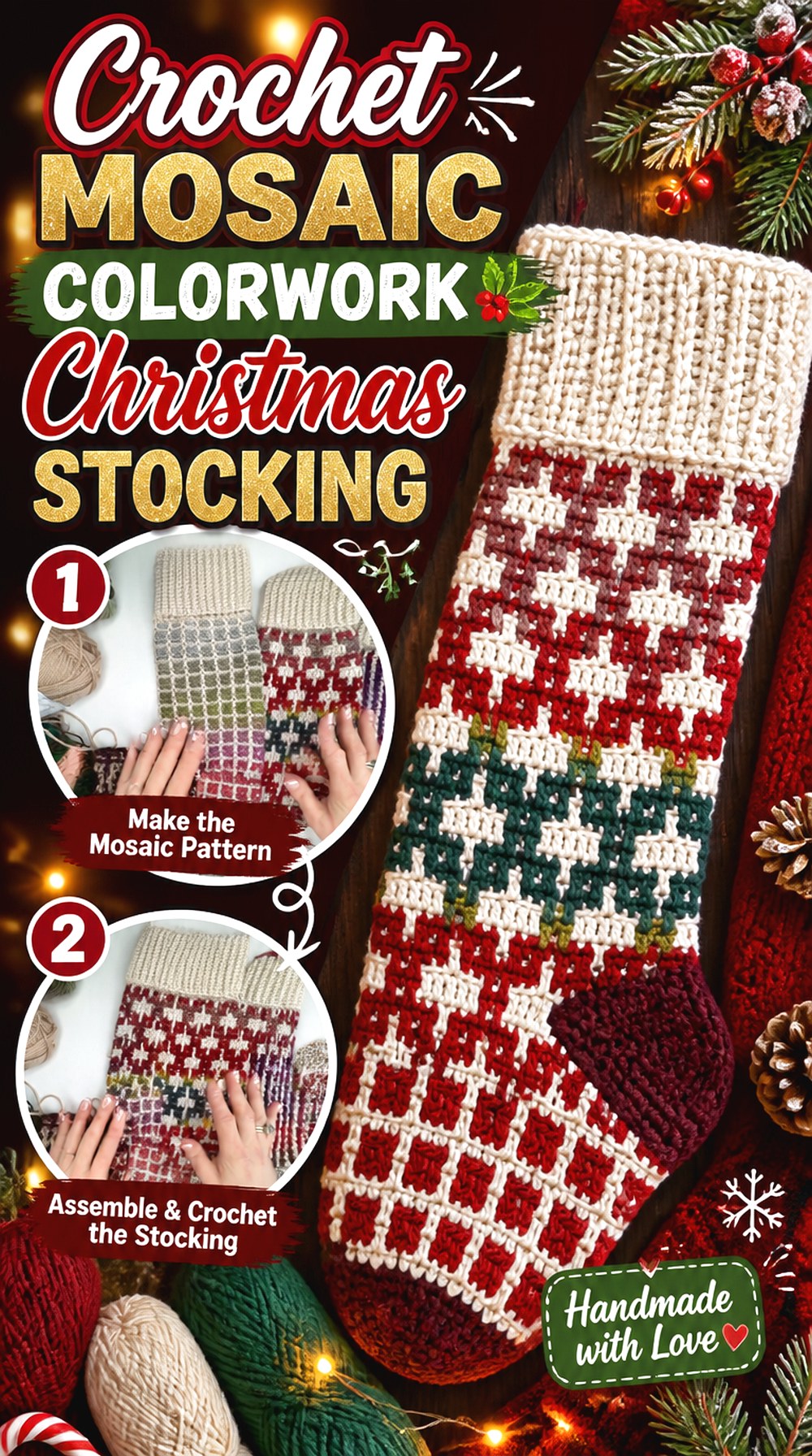
HanJan Crochet’s tutorial presents five Christmas stocking designs built around overlay mosaic crochet, using single- and double-crochet-based colorwork in DK-weight yarn. The creator classifies the pattern as intermediate.
This option is for readers who want the body of the stocking to carry a graphic pattern rather than relying mainly on a cuff, tassel, or textured stitch. Mosaic crochet can produce crisp repeating geometry from a limited palette, making it especially effective in coordinated family stockings. Because the patterning covers a substantial portion of the surface, color selection becomes a structural design decision. A low-contrast pairing may make the motif difficult to read from across a room.
High Contrast Does Most of the Visual Work
Before starting the full stocking, place the two proposed yarn colors side by side and view them from several feet away. If they merge visually, the mosaic pattern may also lose definition once repeated across the fabric.
Contrast does not require traditional red and white. Dark green with cream, burgundy with pale gray, or another clearly separated pairing can still create a strong holiday result. What matters is preserving enough visual difference for the geometric shapes to remain recognizable at display distance.
Colorwork Density Changes the Feel of the Fabric
Overlay mosaic crochet creates design through layered stitch placement, so its fabric behaves differently from a very open granny square. That denser surface is helpful when the stocking will contain small packages because there are fewer obvious open spaces.
The same density can make the stocking feel firmer. If you substitute yarn, check the fabric after a small section rather than assuming a different fiber will drape the same way. A colorwork stocking should still open comfortably enough for its intended use.
Pick the Motif Before Building the Whole Family Palette
With multiple mosaic designs available in the source tutorial, you can choose between repeating one design for a coordinated set or assigning different motifs to different people.
If you plan a family collection, decide that system early. Using one consistent background color across several motifs is one way to create unity. Another is to reverse the same two colors between stockings. Planning the overall set first helps prevent individual pieces from looking unrelated once they are displayed together.
Original Tutorial and Creator Credit
Creator: HanJan Crochet
6. Crochet Cabled Panel Christmas Stocking
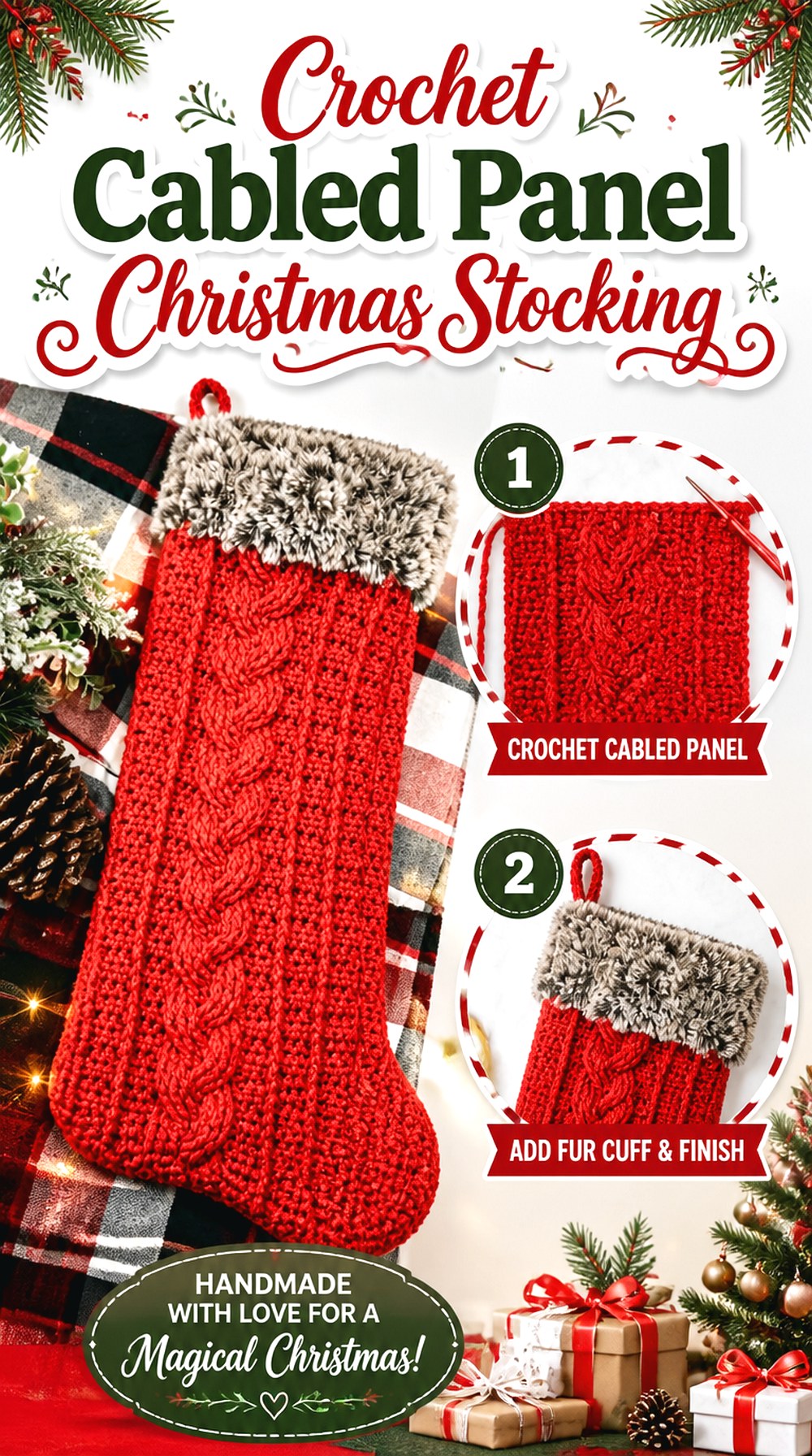
Sierra Fontaine’s cabled Christmas stocking is constructed with separate front and back sections before seaming, with a cuff added to complete the piece. The tutorial uses worsted-weight yarn for the main stocking and incorporates faux-fur yarn as part of the finishing.
That flat-panel approach makes this project distinctly different from the toe-up stockings in the collection. The front becomes a decorative surface for the cable design while the back can remain visually quieter. It is a useful format when you enjoy inspecting texture on a flat piece before assembly. Once seamed, however, edge consistency matters because uneven panels can pull the final boot shape out of alignment.
Flat Panels Make Symmetry Easier to Inspect
Before seaming, place the front and back sections together with their edges aligned. This is the easiest stage to identify differences in length, width, or shaping.
Do not rely only on row counts when comparing pieces after a yarn substitution; actual dimensions are more informative because tension can change from one section to another. If the panels do not match cleanly, correct the discrepancy before adding the seam. Seaming cannot fully hide a substantial size difference between two fabric pieces.
Cables Need Definition More Than Fuzz
Crochet cables create their impact through shadows, crossings, and raised lines. A smooth worsted yarn usually allows those features to remain more visible than an extremely fuzzy alternative.
That does not mean the entire stocking needs to be plain. You can keep the body yarn relatively clear and reserve a fluffier texture for the cuff, as the source design does with faux-fur yarn. Separating the textures lets the cables remain readable while still producing a soft holiday trim.
Treat the Faux-Fur Cuff as Its Own Material Decision
Faux-fur yarn can transform the top of a stocking, but its long fibers make individual stitches harder to see than they are in smooth yarn. If you are unfamiliar with the material, work slowly and rely more on touch and stitch placement than perfect visual clarity.
Also consider storage and cleaning before using a specialty trim. Check the care instructions for both the body yarn and the faux-fur yarn rather than assuming the two materials can always be washed or dried in the same way.
Original Tutorial and Creator Credit
Creator: Sierra Fontaine
7. Crochet Hexagon Motif Christmas Stocking

Bella Coco’s Christmas stocking uses crocheted hexagons as the building units, with the tutorial demonstrating how the motifs are arranged and joined into the finished boot shape. The source specifies a construction using 16 hexagons.
Compared with the granny-square stocking, hexagons create more angled seam lines and a noticeably different geometric rhythm. This makes the project useful when you like motif crochet but want something less grid-like than traditional squares. Assembly becomes a major design stage: the same individual hexagon can contribute to the leg, foot, heel, or toe depending on its placement. Color distribution therefore deserves planning before the final join.
Hexagons Produce a More Angular Boot Shape
A square-based stocking naturally organizes itself around right angles. Hexagons create diagonal lines, so the silhouette can appear more faceted and patchwork-driven.
Lay the motifs in the intended arrangement before sewing or crocheting the permanent joins. Step back and check whether the heel and toe read clearly. This is particularly helpful when several colors are involved because a strong color contrast at the wrong seam can visually interrupt the stocking shape even when the assembly itself is correct.
Assembly Planning Matters More Than Motif Speed
Repeated motifs can feel quick while you are making them, but the arrangement stage deserves its own time. Identify which pieces will sit at prominent areas such as the upper front and outer toe before beginning the final join.
If one motif has a looser edge or noticeably different dimensions, avoid hiding the problem inside the assembly. Correct the motif first. Joined geometric projects depend on compatible edges, and forcing one piece into place can cause puckering in several neighboring seams.
Use Color Placement to Control Visual Busyness
A stocking made from many multicolor hexagons can become visually intense. If you want a calmer result, repeat one outer-round color across the motifs so the seams have a shared visual framework.
For a more playful version, distribute the strongest colors across the whole stocking instead of clustering them in one area. Take a quick photo of the laid-out motifs before joining. Viewing the arrangement on a screen often makes an unbalanced patch of color easier to notice.
Original Tutorial and Creator Credit
Creator: Bella Coco
8. Crochet Classic Heel Flap Christmas Stocking

Naztazia’s full-size Christmas stocking tutorial focuses on a traditional sock-like silhouette made with worsted-weight yarn. The project includes a shaped toe, heel-flap section, leg, cuff, and hanging loop, with the creator presenting it as an approachable classic stocking tutorial.
This is the most conventional option in the collection and a useful contrast to motif, mosaic, and panel-based construction. The main visual identity comes from the recognizable stocking proportions rather than elaborate surface treatment. That leaves plenty of freedom for color changes, cuffs, appliqués, or personalized details later. It is also a practical starting point if you want several family stockings that share one consistent shape but use different color combinations.
The Heel Flap Keeps the Silhouette Familiar
The heel is what makes a crocheted tube begin to look convincingly like a stocking. On a classic design, check the profile after the heel is formed and again after the leg has started.
The stocking should lie reasonably flat without the heel forcing the upper section into a severe twist. If your tension changes noticeably between flat and circular sections, slow down around that transition. Correct proportions at the heel contribute more to the recognizable Christmas-stocking shape than extra surface embellishment.
Worsted Weight Leaves Room for Different Styling Directions
The source tutorial uses worsted-weight yarn, which creates a middle ground between delicate colorwork and extremely chunky fabric. That gives you room to personalize the surface without automatically making the stocking feel oversized.
If you substitute another yarn of the same general category, still compare the developing fabric with the tutorial’s intended look. Fiber, twist, and tension can affect stiffness. A stocking that will actually hold gifts needs enough flexibility to open without becoming so loose that the shape collapses.
Add Personalization After the Core Shape Looks Right
Names, appliqués, surface embroidery, buttons, and decorative tags can make a family set easier to identify, but they should not distract from correcting the stocking itself.
Finish the main shape first and lay it flat before deciding where an embellishment belongs. A name placed too close to a folded cuff can disappear when the stocking hangs, while a heavy decoration near the toe may pull the fabric forward. Treat personalization as a finishing layer rather than a substitute for balanced construction.
How the Eight Crochet Christmas Stocking Styles Compare
Choose the Naztazia stocking when a familiar, traditional silhouette matters most. For colorful patchwork, the MJ’s Off The Hook Designs granny-square version offers a regular square-based layout, while the Bella Coco hexagon stocking creates more angular seams. Hopeful Turns is the clear choice when you need ornament scale rather than a full mantel stocking.
For surface detail, the options split in useful ways. Rich Textures Crochet emphasizes plush all-over texture, Make & Do Crew uses chunky post-stitch relief, Sierra Fontaine centers the design on cables, and HanJan Crochet creates graphic interest through mosaic colorwork. Your choice can therefore start with the technique you want to see most clearly rather than simply choosing a holiday color palette.
Conclusion
The most useful crochet Christmas stocking idea is the one whose construction matches both your preferred crochet style and the way the finished piece will be used. Choose the classic heel-flap stocking for a familiar shape, granny squares or hexagons for modular patchwork, mosaic crochet for graphic colorwork, and cables or chunky texture when surface detail is the main attraction. The mini stocking is better suited to trees, garlands, and gift decoration than full-size stocking use.
Before starting, decide whether the piece will be decorative or regularly filled, then consider its opening, hanger, fabric density, and storage needs. Use the original tutorials for exact construction details and creator-specific instructions.
Frequently Asked Questions
What type of yarn works well for a crochet Christmas stocking?
It depends on the intended appearance and construction. Medium-weight yarn can provide good stitch definition for traditional shaping, cables, and detailed colorwork, while bulky yarn creates a more substantial stocking with fewer, larger stitches. Motif projects also need yarn that produces consistent square or hexagon dimensions. If you want the stocking to match a tutorial’s proportions closely, start with the yarn weight specified by that creator rather than changing thickness immediately.
Can I use a different yarn weight than the Christmas stocking tutorial recommends?
You can, but the result may change substantially. Thicker yarn generally enlarges stitches and can alter the heel, cuff, motif, and overall scale; thinner yarn usually moves the project in the opposite direction. With granny squares or hexagons, test one completed and blocked motif first. For a shaped stocking, make an early fabric sample and compare its density and flexibility before assuming the substitution will behave like the original yarn.
Should a crochet Christmas stocking be lined?
Not every stocking needs lining. Dense crochet fabric used primarily as decoration may work perfectly well without it. A lining becomes more useful when the crochet contains larger openings, such as traditional granny motifs, or when small loose gifts could poke through the fabric. Lining can also reduce direct stretching from objects inside. If you add one, allow enough room for the crochet and fabric to move together rather than forcing a rigid insert into a flexible stocking.
How can I make the hanging point of a crochet stocking more secure?
Start by looking at where the loop or strap connects to the stocking. An attachment that distributes tension across several strong stitches or a reinforced edge generally puts less stress on one small section than a loop attached to a delicate point. Ribbon or another material can also be considered when appropriate. Do not assume a decorative hanger has a specific weight capacity; a stocking intended to hold gifts should be assessed together with the hook or mantel holder supporting it.
Can I enlarge a mini crochet stocking simply by using thicker yarn?
Sometimes a thicker yarn produces a larger version, but it does not guarantee the proportions or fabric will remain suitable for full-size use. The heel, opening, hanger, and overall structure were still designed around an ornament-scale project. If you need a stocking that will hold gifts, following a dedicated full-size tutorial is usually more predictable than enlarging a miniature design through yarn changes alone.
How should handmade crochet Christmas stockings be stored after the holidays?
Make sure the stocking is clean and fully dry according to the care guidance for its yarn. Store it flat or loosely folded rather than tightly compressing raised cables, faux-fur cuffs, tassels, pom-poms, or bulky texture. Keep detachable decorations from pressing into neighboring crochet pieces. For mixed-material stockings, check the care requirements of every material because a specialty cuff, ribbon, leather-style hanger, or embellishment may need different treatment from the main yarn.10 Crochet Christmas Tree Ornament Ideas for a Handmade Holiday Tree