Plum Noir and Cranberry give a crochet toy soldier garland a darker holiday direction than the familiar bright-red soldier palette. Plum Noir can provide the deepest visual anchor for hats, boots, jackets, or connecting details, while Cranberry supplies a warmer red that remains clearly connected to traditional Christmas decor.
The challenge is keeping two rich colors from merging into one dark mass. A lighter neutral or restrained metallic-style accent can separate faces, uniform trim, and small details. Because a garland repeats the same character several times, color distribution also matters across the entire strand—not just on one soldier.
The tutorial sources below support nutcracker or toy-soldier crochet construction. The proposed Plum Noir and Cranberry palettes are independent color adaptations and should not be assumed to be the colors used by the tutorial creators.
Quick List
- Plum Noir Cranberry And Antique Gold Crochet Toy Soldier Garland
- Cranberry Led Plum Noir And Ivory Crochet Toy Soldier Garland
- Plum Noir Cranberry And Charcoal Crochet Toy Soldier Garland
- Plum Noir Cranberry And Oatmeal Crochet Toy Soldier Garland
- Cranberry Plum Noir And Soft Gold Crochet Toy Soldier Garland
- Plum Noir Cranberry And Winter White Crochet Toy Soldier Garland
- Plum Noir Cranberry And Forest Green Crochet Toy Soldier Garland
- Cranberry Plum Noir And Dusty Rose Crochet Toy Soldier Garland
- Plum Noir Cranberry And Camel Crochet Toy Soldier Garland
- Plum Noir Cranberry And Black Crochet Toy Soldier Garland
Keep Plum Noir and Cranberry Distinct on Small Crochet Soldiers
Plum Noir and Cranberry are different hues, but both can occupy the darker end of a palette. Before assigning them to neighboring parts of a small soldier, compare the actual yarns side by side. A grayscale photo can also help reveal whether they have enough light/dark separation to create a visible boundary.
When the two shades are close in value, insert a lighter trim color between them rather than depending on hue difference alone. A narrow neutral area between a Plum Noir hat and Cranberry jacket, for example, can make both colors easier to read from across the room.
Plan Plum Noir and Cranberry Across the Whole Garland
A garland is viewed as a sequence. If every soldier uses identical color proportions, the strand can look highly formal and orderly. If you want more movement, alternate which shade dominates while repeating enough Plum Noir and Cranberry to keep the soldiers connected.
Keep the connecting cord in mind as part of the palette. A very dark cord can visually disappear against Plum Noir details, while a lighter cord becomes another visible horizontal element. Test several finished soldiers together before committing the entire strand.
Use Light Accents to Protect Plum Noir and Cranberry Details
Faces, mustaches, hat bands, jacket trim, and boots occupy relatively small areas on a crochet toy soldier. Those details need enough separation to remain readable once the figures are hanging rather than being examined close up.
You do not need a light color everywhere. Concentrating it around important boundaries can be more effective than dividing the garland evenly among four or five shades.
1. Plum Noir Cranberry And Antique Gold Crochet Toy Soldier Garland
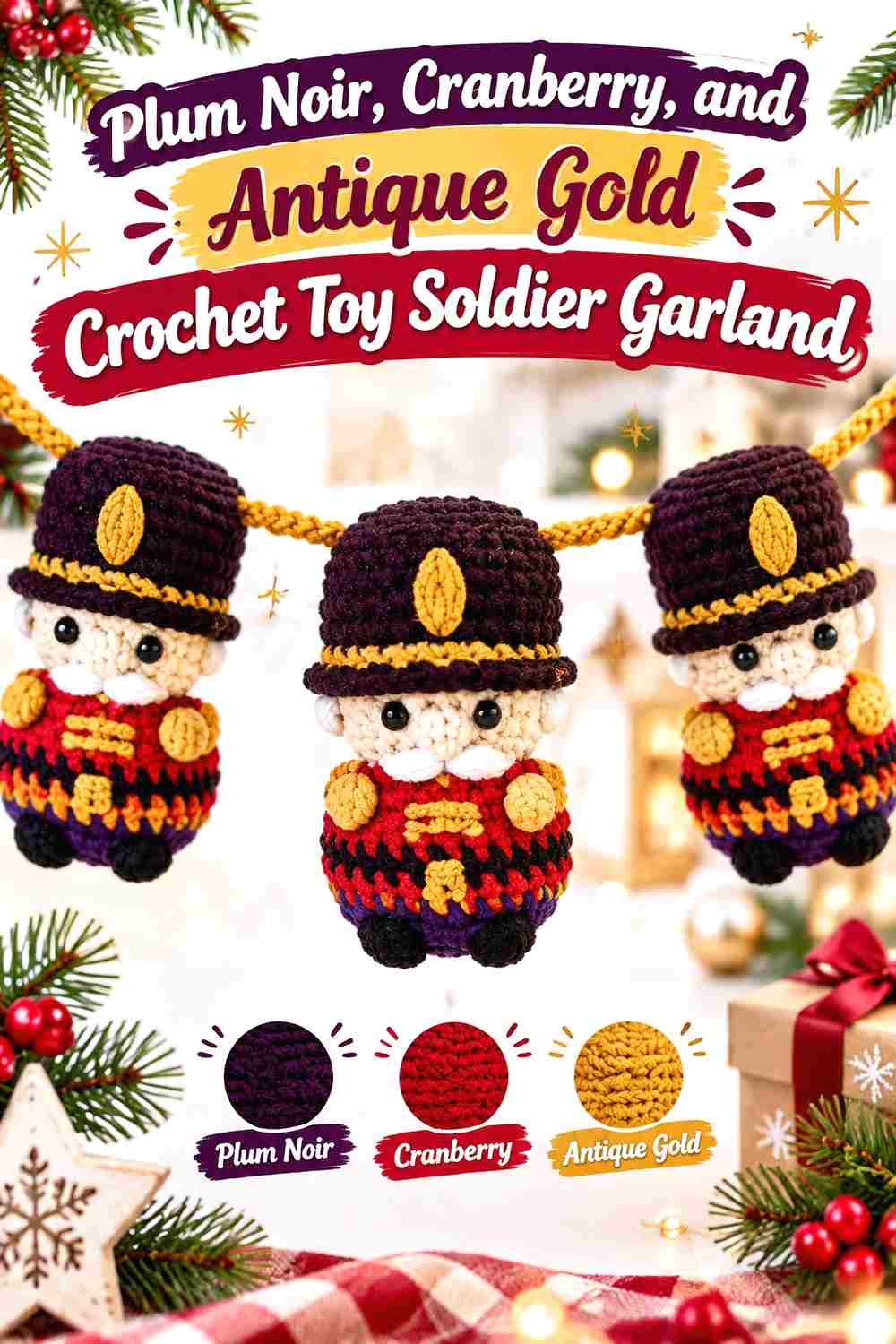
This palette puts Plum Noir and Cranberry in the leading roles and uses antique-gold-inspired coloring sparingly for uniform definition. Try Plum Noir on the tall hats and boots, Cranberry across the jackets, and the gold-toned accent at hat bands, belts, or small uniform details. The darker top and bottom give each soldier a strong vertical frame without taking Cranberry out of the spotlight.
Plum Noir Can Anchor Each Crochet Soldier at the Hat and Boots
Repeating Plum Noir at both ends of each figure creates a useful visual bracket around the Cranberry uniform. This placement is especially effective in a garland because the repeated dark hats create a rhythm along the strand.
If the soldiers start to look too dark, reduce Plum Noir on the torso before changing the hat. The tall hat is one of the strongest toy-soldier features, so it is a logical place to preserve the deepest shade.
Cranberry Should Carry More of the Toy Soldier Jacket
Let Cranberry occupy a larger uninterrupted area on the torso rather than scattering it across many tiny details. That gives the warmer red enough visual presence to balance the much deeper Plum Noir.
When several soldiers hang together, check them from normal viewing distance. If Cranberry disappears between dark hats, boots, and facial details, increase its jacket coverage rather than adding another bright color.
Antique Gold Can Separate Plum Noir From Cranberry
A muted gold-toned accent works most efficiently as a separator. Use it where a Plum Noir section meets Cranberry or where a small uniform detail needs definition.
Avoid spreading the accent equally across every surface. Plum Noir and Cranberry should still identify the garland at first glance; the gold tone is there to clarify the uniform.
Creator Credit: KumoAmu
2. Cranberry Led Plum Noir And Ivory Crochet Toy Soldier Garland

This version makes Cranberry the most visible color and moves Plum Noir into a supporting role. Ivory provides the strongest value break, making it useful around faces, hair, beards, or narrow uniform separations. It suits a garland where you want the soldiers to remain rich and dark without losing their small features.
Cranberry Can Lead Across the Crochet Soldier Uniforms
Use Cranberry for the main jackets and repeat it consistently across the strand. A larger Cranberry field helps distinguish this scheme from versions where Plum Noir controls most of the figure.
You can still repeat Plum Noir on hats and footwear. Keeping those areas smaller prevents the darkest color from visually swallowing the Cranberry body.
Ivory Gives Plum Noir Facial Details More Separation
If Plum Noir is used for a mustache, hair, hat edge, or another small feature, placing ivory nearby can keep the detail legible. This becomes increasingly important when the soldier itself is small.
Check one completed face from several feet away. If the expression becomes a single dark patch, increase the light separation rather than adding more tiny facial elements.
Plum Noir Can Tie the Cranberry Soldiers to the Garland Cord
Using Plum Noir for a connecting cord or hanging loops can repeat the darkest shade beyond the individual soldiers. That makes the cord feel intentionally related to the figures instead of like a separate component.
If the display background is also very dark, however, compare Plum Noir with a lighter cord option before committing. The best choice depends on whether you want the connecting line to disappear or remain visible.
Creator Credit: Little Crochet Farm
3. Plum Noir Cranberry And Charcoal Crochet Toy Soldier Garland
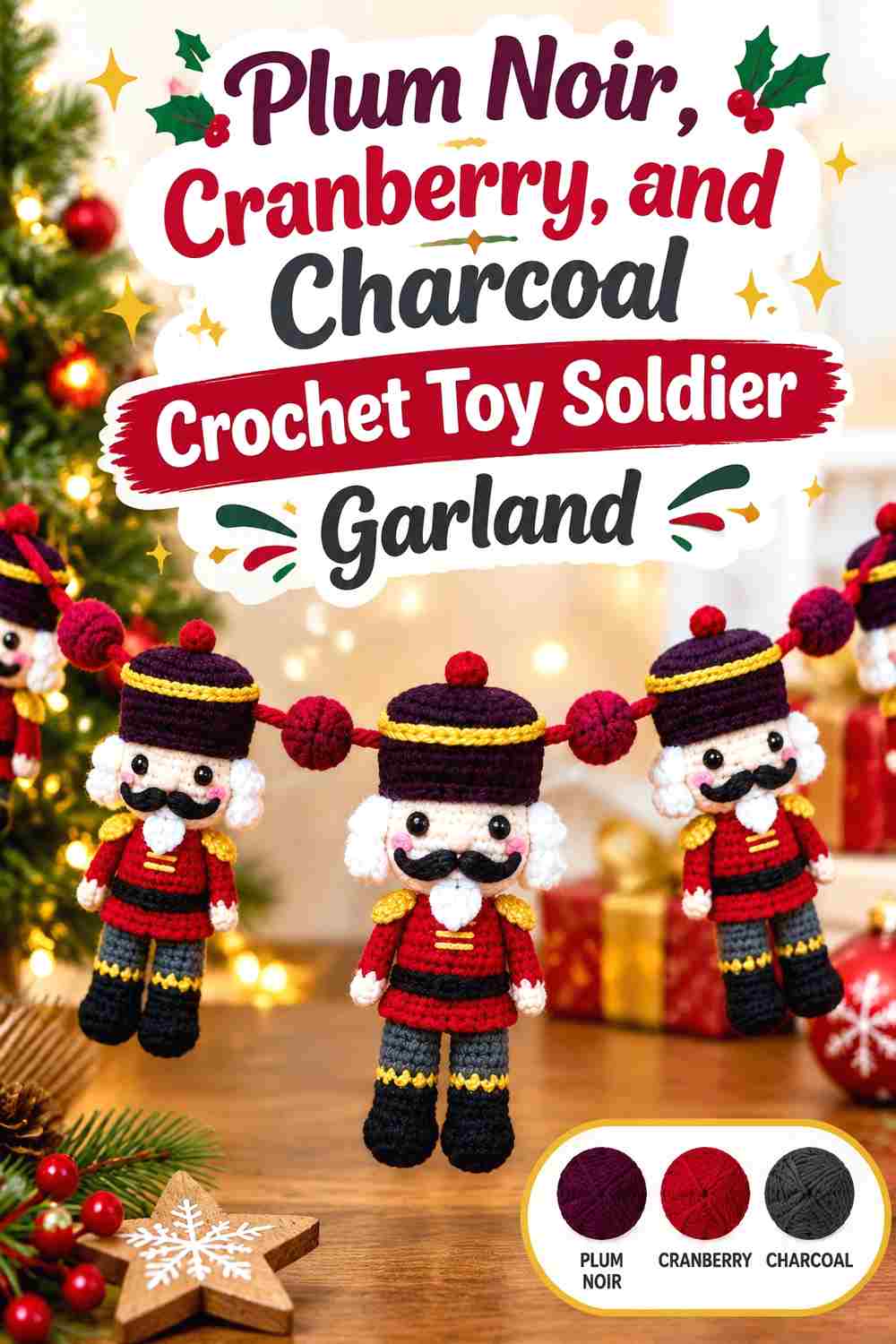
Charcoal keeps this palette almost entirely dark, so color placement has to do more work. Use Plum Noir as the recognizable purple-black anchor, Cranberry as the warm uniform color, and charcoal only where a softer alternative to pure black is useful. This scheme benefits from deliberate boundaries rather than numerous small accents.
Plum Noir Needs Space Away From Charcoal on the Soldier Hat
Plum Noir and charcoal may sit close in value depending on the yarns you choose. Putting them directly beside each other across a tiny hat can make the distinction disappear.
If both colors are important, separate them with Cranberry or a small lighter detail. Otherwise, let Plum Noir own the hat and reserve charcoal for another part of the figure.
Cranberry Prevents the Plum Noir Garland From Becoming One Dark Block
Cranberry works best here in substantial sections such as the jacket rather than tiny stripes. That warmer block breaks up the Plum Noir and charcoal while preserving the dark overall direction.
Look at the full strand rather than judging one figure. If the soldiers merge visually when placed side by side, increasing the repeated Cranberry areas can restore separation.
Charcoal Can Replace Black Beside Cranberry Boots and Belts
Charcoal offers a dark supporting option without introducing the strongest possible contrast. It can suit boots, belts, or small structural-looking details when Plum Noir already occupies the hat.
Do not use charcoal merely because a fourth dark area is available. If it cannot be distinguished from Plum Noir at garland-viewing distance, simplifying back to two dark shades may produce a clearer result.
Creator Credit: ToyGurumi
4. Plum Noir Cranberry And Oatmeal Crochet Toy Soldier Garland

Oatmeal changes the mood by adding a softer light neutral rather than a crisp white. Plum Noir can remain concentrated on hats and boots, while Cranberry leads the jackets and oatmeal opens up faces, hair, trim, or spaces between darker sections.
Oatmeal Softens the Boundary Around Plum Noir Details
Use oatmeal where a lighter separator is needed but a stark light/dark jump is not your goal. Around Plum Noir facial or hat details, it can provide enough distinction to keep shapes readable.
The exact result depends on the yarns, so compare oatmeal directly against both main colors. It should remain light enough to perform a real separating role.
Cranberry Can Repeat Through Every Crochet Soldier Jacket
A consistent Cranberry jacket gives the garland a clear visual backbone even when smaller uniform details vary. This repetition is useful when each soldier has several decorative elements.
If you alternate minor details from figure to figure, keep the Cranberry torso relatively stable. That prevents the strand from looking like unrelated individual ornaments.
Plum Noir Can Define the Oatmeal and Cranberry Soldier Silhouette
Plum Noir works well at visually important outer areas such as the hat or footwear. Those placements create dark endpoints without requiring a Plum Noir outline around every component.
Too much dark edging can make a small figure look narrower or heavier than intended. Start with the major silhouette points and add more only where the shape genuinely needs definition.
Creator Credit: Poppy Crochet Design
5. Cranberry Plum Noir And Soft Gold Crochet Toy Soldier Garland

This variation pushes Cranberry forward and uses Plum Noir as the formal contrast color. A soft gold-toned accent can mark the military-inspired trim, but it should occupy much less area than either core shade. The result is especially effective when repeated details stay consistent from soldier to soldier.
Cranberry Can Create a Continuous Uniform Rhythm
Keeping Cranberry on each torso makes the individual figures read as one coordinated regiment. This is useful on a garland because repeated color placement can create order even when the soldiers are separated by cord.
If you want variation, change small accents rather than moving Cranberry to completely different parts of every soldier.
Plum Noir Gives Cranberry Hats and Boots a Dark Counterweight
Place Plum Noir above and below the Cranberry torso to distribute visual weight through the figure. If all Plum Noir is concentrated in the hat, the upper half can appear disproportionately dark.
Boots, cuffs, or another lower detail can repeat enough Plum Noir to reconnect the bottom of the soldier with the hat.
Soft Gold Should Stay Secondary to Plum Noir and Cranberry
Treat the gold-toned shade as trim rather than a third dominant color. Hat bands, jacket lines, belt areas, or tiny repeated accents can provide enough contrast.
If the gold starts covering large areas, the garland shifts away from its Plum Noir-and-Cranberry identity. Compare all the soldiers together before adding extra accent details to later figures.
Creator Credit: Rhonda Butler
6. Plum Noir Cranberry And Winter White Crochet Toy Soldier Garland
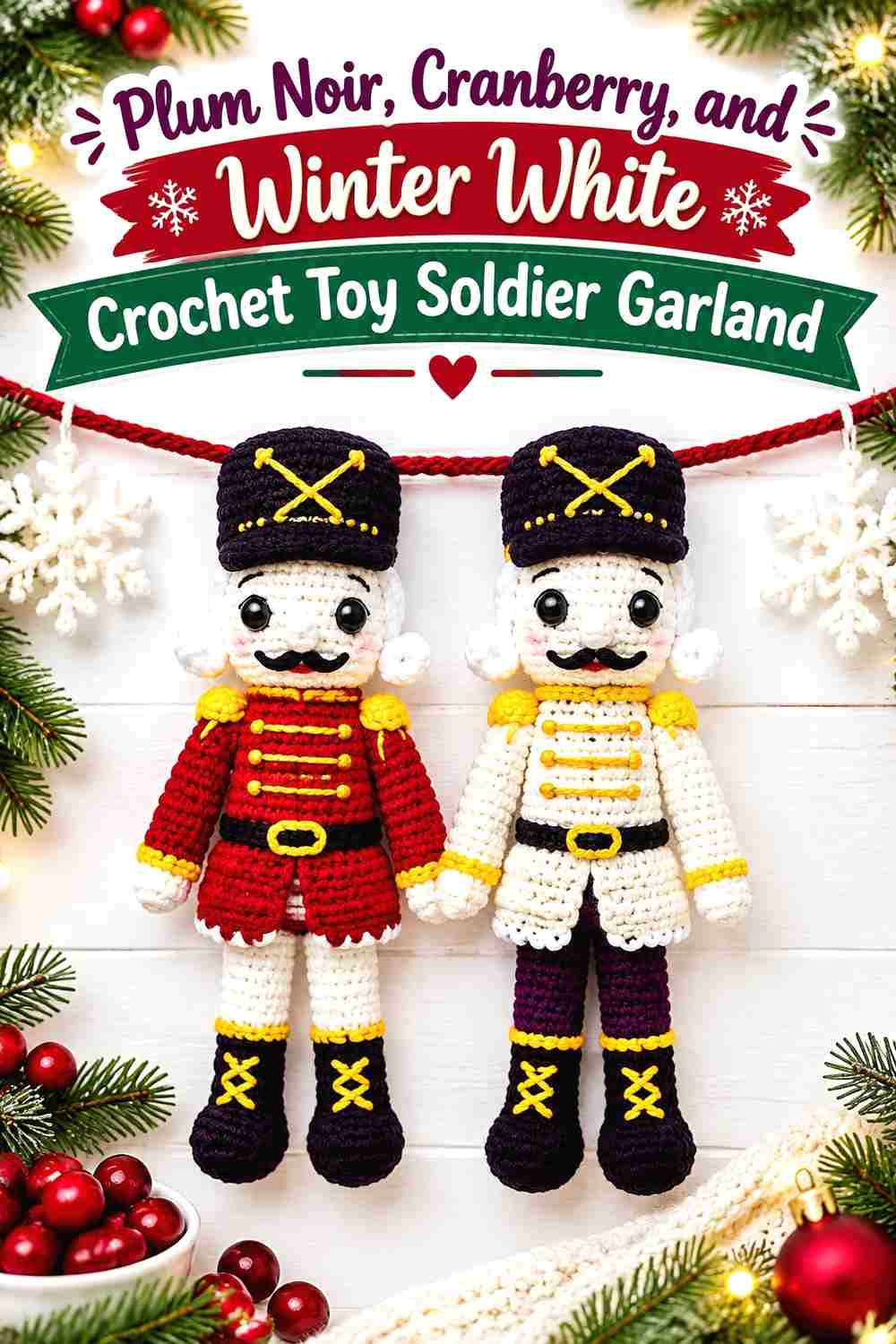
Winter white creates one of the clearest value breaks in this collection. It can make facial areas and narrow uniform details easier to distinguish between Plum Noir hats and Cranberry jackets. Keep the white controlled so it illuminates the darker palette rather than becoming the main color.
Winter White Can Open Up Plum Noir Toy Soldier Faces
A light face or hair area creates breathing room directly beneath a Plum Noir hat. That separation helps preserve the soldier silhouette when the figure is viewed at garland distance.
If you use Plum Noir for facial hair as well, make sure it does not reconnect visually with the hat and create one continuous dark patch.
Cranberry Can Bridge Winter White and Plum Noir
Cranberry sits naturally between the lightest and darkest parts of this scheme. Using it prominently on the uniform prevents the transition from winter white to Plum Noir from feeling overly stark.
This is also a useful reason to avoid reducing Cranberry to tiny accents. It needs enough surface area to remain one of the two defining colors.
Plum Noir Can Keep Winter White From Dominating the Garland
Repeat Plum Noir consistently at hats, boots, or selected trim so the light neutral does not take over the strand. On a pale wall, the dark repetition also helps the soldier shapes remain defined.
On a very dark mantel or wall, test the opposite balance. Winter white may need slightly more visible area to keep the figures separated from the background.
Creator Credit: VioToys Amigurumi
7. Plum Noir Cranberry And Forest Green Crochet Toy Soldier Garland
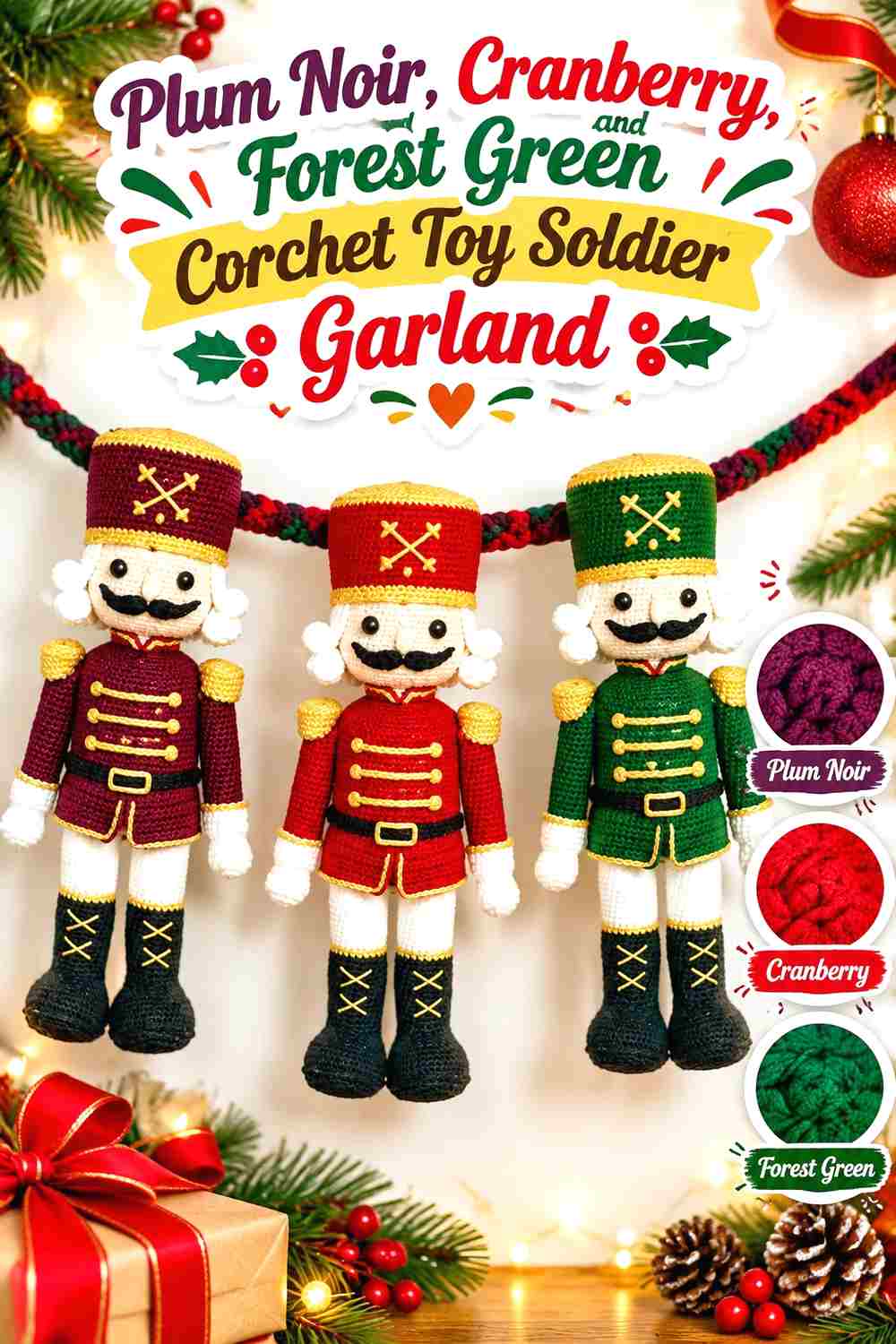
Forest green introduces a traditional holiday companion color without turning the garland into a standard red-and-green scheme. Plum Noir should remain the deepest anchor, Cranberry can control the uniforms, and forest green works better in selected supporting areas or between soldiers.
Plum Noir Should Stay Darker Than the Forest Green Details
Because both shades can look deep in crochet fabric, compare them before placing them side by side. If Plum Noir and forest green collapse into nearly the same value, use Cranberry or a lighter detail between them.
This matters particularly on tiny hats, cuffs, or boots, where there is little surface area for hue differences to register.
Cranberry Keeps Forest Green From Replacing the Core Garland Palette
Give Cranberry noticeably more space than forest green. Jackets are a logical location, while green can be reserved for selected trim, alternating details, or connecting elements.
The objective is a Plum Noir-and-Cranberry soldier garland with green support—not a three-color scheme in which every shade competes equally.
Forest Green Can Appear Between Plum Noir and Cranberry Soldiers
Instead of forcing green onto every uniform, consider repeating it in small spacer motifs or other connecting details along the strand. That distributes the holiday green without crowding the soldiers themselves.
Repeat it at regular intervals if you want the addition to look intentional. A single isolated green section may feel disconnected from an otherwise tightly controlled palette.
Creator Credit: Cometa Crochet
8. Cranberry Plum Noir And Dusty Rose Crochet Toy Soldier Garland

Dusty rose creates a tonal red-family bridge around Cranberry while Plum Noir supplies the necessary dark endpoint. This is a softer alternative to cream or white and works particularly well when you want less dramatic light/dark contrast.
Dusty Rose Can Lighten Cranberry Without Introducing a Neutral
Place dusty rose around small Cranberry areas where you want separation without a cream or white accent. It can be useful for selected uniform details or decorative sections.
Make sure the dusty rose remains visibly lighter than Cranberry. If the two yarns are nearly identical in value, the tonal effect may be too subtle for miniature garland details.
Plum Noir Gives the Dusty Rose and Cranberry Soldier Enough Definition
A tonal red palette needs a clear dark anchor. Plum Noir can perform that job on hats, boots, or carefully chosen outlines while dusty rose and Cranberry handle the warmer middle of the figure.
Avoid putting Plum Noir around every dusty rose element. Strategic dark repetition is usually enough to define the soldier without fragmenting it.
Cranberry Should Remain Stronger Than Dusty Rose Across the Garland
Use dusty rose as a supporting shade rather than dividing the uniforms equally between both reds. Cranberry needs enough repeated area to remain visually tied to the article’s core palette.
Lay several completed or partially completed figures side by side. If the strand reads pink before it reads Cranberry, reduce dusty rose to smaller uniform details.
Creator Credit: Mamie Crochet
9. Plum Noir Cranberry And Camel Crochet Toy Soldier Garland

Camel adds warmth without the brightness of white or metallic-inspired yellow. It can be especially useful for faces, hair, narrow trim, or connecting details where Plum Noir and Cranberry need a medium-light separator rather than a very pale one.
Camel Can Separate Plum Noir Hats From Cranberry Jackets
A camel-colored face or narrow transition area can keep the dark hat and rich jacket from touching visually. That makes the three main vertical sections of the soldier easier to distinguish.
Check the camel against Cranberry before starting the whole garland. It needs enough value difference to serve as a separator rather than simply becoming another warm midtone.
Cranberry Can Carry the Largest Uniform Area Beside Camel
Camel has visual warmth of its own, so keeping Cranberry dominant prevents the neutral from changing the identity of the soldier. Use Cranberry for the main torso and reserve camel for smaller areas.
This proportion also helps the garland remain recognizable as Plum Noir and Cranberry when viewed from a distance.
Plum Noir Can Repeat in the Garland Cord and Soldier Boots
Repeating Plum Noir beyond the hats can distribute the deepest color more evenly. A Plum Noir cord paired with Plum Noir boots is one option when you want the connecting structure to feel integrated.
Before choosing a dark cord, test it against the intended display surface. If it disappears completely, a Cranberry or camel connection may produce a more visible garland line.
Creator Credit: GUMILUPIS CROCHET
10. Plum Noir Cranberry And Black Crochet Toy Soldier Garland
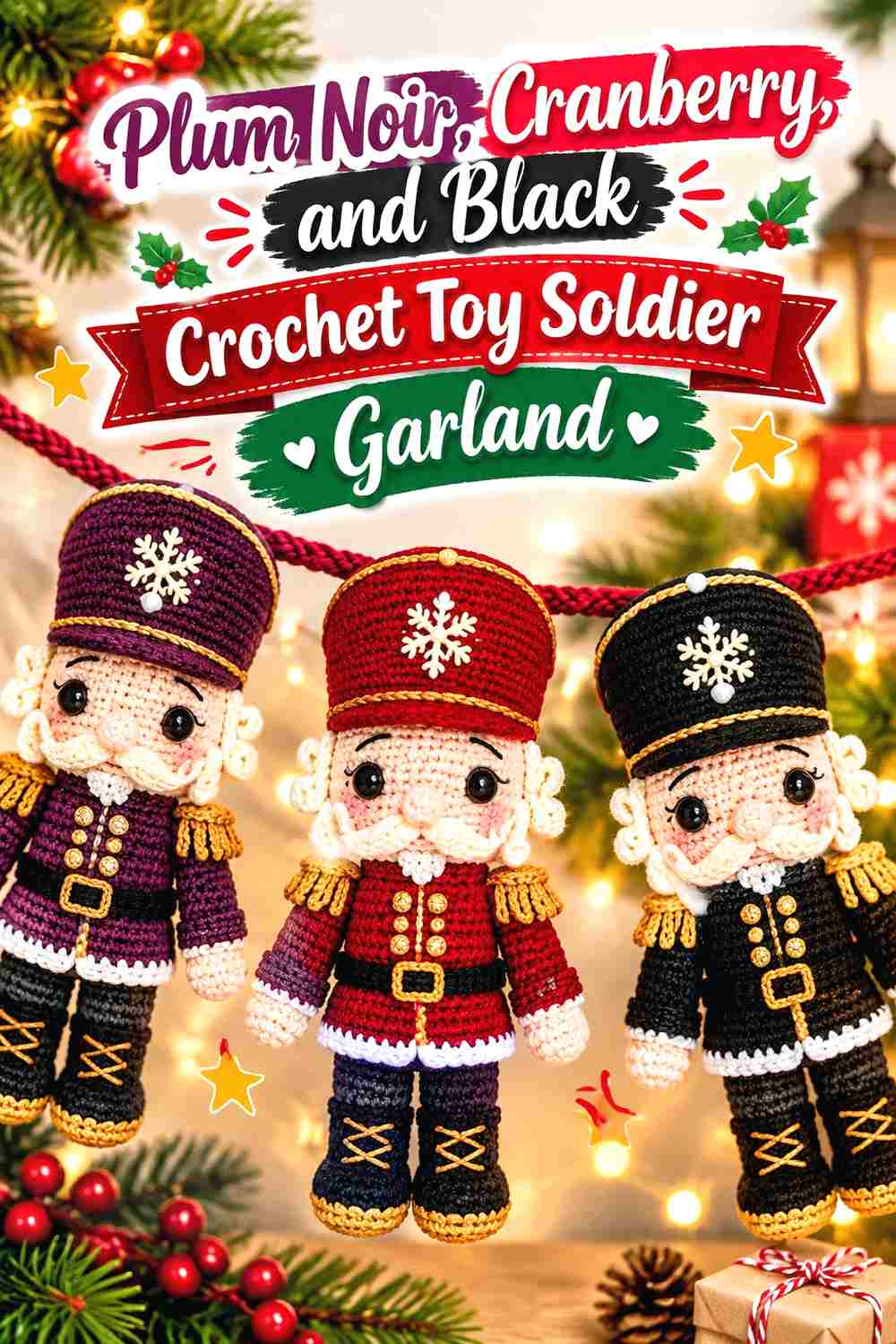
Black creates the strongest dark-on-dark challenge in the collection. Rather than using black and Plum Noir interchangeably, give them separate jobs: Plum Noir can carry the decorative hat or selected uniform sections, Cranberry can dominate the jacket, and black can be restricted to boots, mustaches, or narrow definition.
Plum Noir Needs a Separate Role From Black
Place Plum Noir and black in different parts of the soldier whenever possible. On a small crochet figure, adjacent near-black colors may become indistinguishable unless the Plum Noir is clearly lighter or more visibly purple.
If your chosen yarns look almost identical from a few feet away, reduce the black rather than forcing both colors into equal roles.
Cranberry Creates the Essential Break Between Plum Noir and Black
A substantial Cranberry torso is especially important here. It stops the figure from becoming a continuous dark silhouette and preserves the warmer holiday element of the palette.
Keep the Cranberry areas reasonably uninterrupted. Breaking them into tiny strips between black and Plum Noir can weaken the strongest source of color separation.
Black Works Better as a Controlled Accent Beside Plum Noir
Use black where a very dark, clearly defined detail is useful: boots, a mustache, a narrow belt, or another small feature. That leaves Plum Noir enough space to function as a color rather than appearing to be an accidental variation of black.
View the complete garland under the lighting where it will actually hang. Dark neighboring shades that look separate on a worktable may become much harder to distinguish in lower room lighting.
Creator Credit: Creative Crochet
Comparing the Plum Noir and Cranberry Garland Directions
For the strongest light/dark separation, the winter-white and ivory versions give Plum Noir and Cranberry the clearest pale counterpoint. Oatmeal and camel soften that contrast while still giving faces and uniform divisions a lighter area.
The antique-gold and soft-gold directions emphasize formal uniform details, while forest green pushes the garland toward a more traditional multicolor Christmas palette. Dusty rose creates the most tonal red-family direction. Charcoal and black keep the result dramatically dark, but they require the most careful value checking because Plum Noir already occupies a deep part of the palette.
Whichever direction you choose, judge several soldiers together. A color distribution that looks balanced on one figure can feel repetitive, too dark, or too busy once it appears across an entire garland.
Conclusion
Plum Noir and Cranberry work particularly well for a toy soldier garland when each color has a defined job. Cranberry can make the uniforms immediately visible, while Plum Noir gives hats, boots, and selected details a deeper frame.
Choose ivory or winter white when clear detail separation matters most. Oatmeal and camel provide a softer neutral transition, while dusty rose creates a more tonal interpretation. Gold-toned accents emphasize uniform trim, forest green adds another traditional holiday note, and charcoal or black creates the darkest direction.
Before repeating a palette across the full strand, finish one soldier and place it at the distance from which the garland will normally be seen. That simple check can reveal whether Plum Noir, Cranberry, facial details, and trim remain distinct before you commit to every repeated figure. Use the credited tutorials for their exact construction guidance when adapting the soldier form.
Frequently Asked Questions
How can I keep Plum Noir and Cranberry from blending together on a crochet toy soldier?
Compare the actual yarns for light/dark value as well as hue. If they are close in value, place a lighter shade such as ivory, oatmeal, camel, or winter white between important Plum Noir and Cranberry sections. A grayscale photo can also help you see whether the boundary remains clear.
Should Plum Noir or Cranberry dominate a crochet toy soldier garland?
Either can lead, but assigning them different roles usually creates a clearer design. Cranberry can dominate the jackets while Plum Noir repeats on hats and boots, or Plum Noir can take more uniform area for a darker overall strand. Keep the choice consistent enough that repeated soldiers feel connected.
What accent colors work with Plum Noir and Cranberry crochet soldiers?
Light neutrals provide useful value separation, while muted gold-toned accents can define formal uniform details. Forest green adds a more traditional Christmas direction, and dusty rose creates a tonal red-family scheme. Choose an accent based on the visual job it needs to perform rather than simply adding another color.
How many colors should I use on each Plum Noir and Cranberry toy soldier?
There is no required number. For a small garland motif, Plum Noir and Cranberry plus one supporting color may already provide enough distinction. Add another shade only when it has a clear function, such as defining facial features or separating neighboring dark areas.
Should every Plum Noir and Cranberry crochet soldier use identical color placement?
Not necessarily. Identical placement creates a formal, regimented rhythm, while alternating small details can add variation. If you change the distribution, keep Plum Noir and Cranberry recurring in recognizable positions so the garland still reads as one coordinated set.
What color should connect a Plum Noir and Cranberry crochet toy soldier garland?
Plum Noir can create a discreet dark connecting line, Cranberry can make the cord part of the main palette, and a lighter neutral can make the strand more visible against a dark display surface. Test the cord against the wall, mantel, tree, or shelf where the garland will hang before deciding.
How can I tell whether Plum Noir toy soldier details are visible enough?
Check the finished figure from normal display distance rather than only at close range. Look specifically at the boundary between the hat, face, Cranberry jacket, boots, and small facial features. If separate elements collapse into one dark area, adjust the light/dark contrast or simplify the number of dark details.